Last updated: July 27, 2026, 4:15 p.m. ET
The Federal Open Market Committee meets Tuesday and Wednesday, July 28 and 29, and the overwhelming consensus is that it does nothing. That consensus is also, right now, only about 60 cents on the dollar. Fed funds futures moved to roughly a 38% implied probability of a quarter-point hike as of July 23, up from under 12% a week earlier, and to something near 80% for a hike by the September meeting. A committee that has held its target range at 3.50%–3.75% is being asked, for the first time in this cycle, whether it should be going the other way.
So the short answer to the question most people are typing into a search box this week: a July 2026 Fed rate hike is unlikely but no longer implausible, and the market is pricing it as a live risk rather than a tail scenario. What makes this particular week unusual is not the Fed decision on its own. It is that the decision lands in the same 48 hours as earnings from Microsoft, Meta Platforms, Apple and Amazon — four companies that together account for roughly a fifth of the S&P 500 by weight — at precisely the moment when the equity market has started punishing those companies for spending money.
That is the connective tissue of this story, and it is easy to miss if you treat the Fed and Big Tech as separate calendar events. The artificial-intelligence buildout has become a macroeconomic force. It is absorbing an extraordinary share of new corporate borrowing, bidding up the price of memory chips, electrical equipment and power, and pushing at least one hyperscaler into negative free cash flow for the first time in its public life. Some Fed officials now cite it, explicitly, as an inflation input. Meanwhile the credit market has begun to charge more for it. Those two facts are the same fact viewed from different desks.
Key Takeaways
- The Fed decision: The FOMC meets July 28–29, 2026, with a statement due at 2:00 p.m. ET Wednesday. The target range stands at 3.50%–3.75%. No updated projections or dot plot accompany this meeting.
- Market pricing: Futures implied roughly a 38% chance of a July hike and about an 82% chance of a hike by September as of July 23, according to CME FedWatch data reported by CNBC — a sharp repricing driven by energy, not by the inflation prints themselves.
- The inflation split: June headline CPI fell 0.4% month over month to 3.5% year over year and core CPI was essentially flat at 2.6% annually, but core PCE — the Fed’s preferred gauge — hit 3.4% in May, its highest since October 2023.
- Oil’s reversal: Brent fell roughly 7%–8% Monday to the high $80s after the U.S. and Iran paused strikes for a third night. Brent had briefly traded above $100 the prior week. The two-year Treasury yield barely moved.
- The earnings problem: Alphabet reported 24% revenue growth and its first negative free cash flow quarter since its 2004 IPO — and the stock fell. Intel posted a 25% revenue increase, its fastest since 2011, and the stock closed lower the next session.
- Why it matters: If good results no longer move these stocks higher, the mechanism that has carried index returns for three years is changing — and it is changing while the Fed is deciding whether financial conditions are too easy.
- What comes next: Fed statement Wednesday 2:00 p.m. ET; Microsoft and Meta Wednesday after the close; Apple and Amazon Thursday after the close.
The week, stripped to what is actually confirmed
A great deal of commentary this week will be forecast dressed as fact. It is worth separating the two at the outset.
Confirmed: the FOMC convenes Tuesday and concludes Wednesday, July 29, with the policy statement at 2:00 p.m. ET and a press conference scheduled for 2:30 p.m. ET. July is not a projection meeting — there is no Summary of Economic Projections and no dot plot, which removes one of the tools a chair would ordinarily use to frame a surprise. Microsoft reports fiscal fourth-quarter results and Meta reports second-quarter results on Wednesday, July 29. Apple’s fiscal third quarter and Amazon’s second quarter follow on Thursday, July 30. Roughly 35% of S&P 500 members report during the week, including Coca-Cola, Visa, Boeing, Ford and UPS.
Also confirmed: the U.S. paused strikes on Iran beginning late Friday, July 24, without a formal announcement, and Tehran said it had halted retaliatory strikes in response. Brent crude fell more than 7% Monday morning, trading near $89.85 in early London hours and slipping toward $88.49 later in the session; September WTI dropped about 7.7% to $82.43. The naval blockade remains in place. Talks involving Oman over the Strait of Hormuz are ongoing.
Not confirmed: that the pause becomes a ceasefire, that the Fed hikes, that the Nvidia–OpenAI guarantee closes on the reported terms, or that any of the four large-capitalization technology companies reporting this week will raise or lower capital-expenditure guidance. Those are the open questions, and the rest of this piece is about why they are harder to answer than usual.
Fact Box
July 2026 FOMC meeting at a glance
- Meeting dates: Tuesday, July 28 and Wednesday, July 29, 2026
- Statement release: 2:00 p.m. ET, Wednesday; press conference 2:30 p.m. ET
- Current federal funds target range: 3.50%–3.75%
- No Summary of Economic Projections or dot plot at this meeting; the 2026 projection meetings are March, June, September and December
- Chair: Kevin Warsh, presiding over his second meeting since taking office
- Prior meeting outcome (June 16–17, 2026): unanimous hold
Original source: Federal Reserve Board meeting calendar
How a routine hold became a coin flip
To understand why a 38% hike probability is remarkable, it helps to remember where this committee started the summer.
Kevin Warsh took over the chair earlier this year and presided over his first meeting on June 16–17. The committee held rates unanimously. Warsh told reporters afterward that there had been a “good family fight” about rates internally — a phrase that has followed him around ever since, and one that reporters have recycled into this week’s preview coverage. He also used that first meeting to announce task forces reviewing major Federal Reserve operations, signaling that his agenda extends well beyond the policy rate.
The June minutes showed something the unanimous vote concealed: officials were split on whether rates should rise before year-end. That split has since become public. Several officials have made the case for tightening in speeches and interviews. Others have argued that the inflation impulse is a supply shock the Fed should look through.
The June inflation report that helped, and the one that didn’t
Two weeks before this meeting, the inflation data broke in the doves’ favor. June CPI, released July 14, fell 0.4% month over month — the largest monthly decline since April 2020 — bringing the annual rate to 3.5% against a Dow Jones consensus of 3.8%. Core CPI was essentially unchanged on the month, roughly -0.02%, described by analysts as the softest non-recessionary reading since 2017, with the annual core rate easing to 2.6% from 2.9%. Gasoline prices fell 9.7% on the month and did most of the work. Following the release, CME FedWatch showed an 86% probability of a hold.
That is the number the doves point to. Here is the number the hawks point to. Core PCE — the measure the Fed actually targets — reached 3.4% year over year in May, its highest reading since October 2023, and has now run above 2% every month since March 2021. That is a stretch of more than five years. Producer prices tell a similar story: core PPI was running around 5.1% year over year in June even as core CPI printed 2.6%, a gap that means firms are either absorbing input costs in their margins or preparing to pass them through.
Those two data sets are not contradictory so much as differently timed. Headline consumer inflation is being flattered by an energy decline that had already partially reversed by the time the report was published. Core PCE reflects a broader basket and a different weighting scheme, and it is moving the wrong way. A committee member who wants to hike can build a defensible case; so can one who wants to wait. That is exactly the condition under which dissents appear.
Why oil rewired the debate
Between the CPI report and this meeting, crude did something violent. Brent briefly traded above $102 last week — roughly $30 above where the most actively traded contract sat at the start of the month — and futures markets responded by repricing the Fed. The hike probability for July climbed from under 12% to nearly 38% in a week, and September odds went from below 53% to roughly 82%.
That repricing is worth examining skeptically, because it implies the Fed responds mechanically to an energy shock. It generally does not, and there is a good reason for that. A supply-driven increase in oil prices raises the price level and reduces real income simultaneously; the textbook response is to look through the first-round effect while watching for second-round pass-through into wages and core services. The question is not whether oil is high. It is whether high and violently unstable oil is starting to leak into expectations and into core categories.
There is a case that it is. Distillates run on a longer fuse than crude. Diesel and jet fuel feed into freight, airline costs and a long tail of goods pricing, and those prices come down more slowly than they go up. And there is a distinct argument, aired repeatedly on trading desks this month, that oil volatility is independently inflationary: when input prices swing 10% a week, firms price defensively and are slow to cut, because the cost of being caught short is higher than the cost of being caught expensive. That mechanism does not show up cleanly in any single data series, which is part of why it is contested.
On Monday, the practical test of that theory ran in real time. Crude fell 7%–8%. The two-year Treasury yield moved about two to three basis points, holding near 4.30%. The thirty-year stayed north of 5%. If the rate market genuinely believed the hike case rested on crude, an 8% decline should have produced considerably more relief than that.
The asymmetry nobody can explain away
This is the most analytically interesting feature of the current bond market, and it deserves more attention than it usually gets. Over the past several weeks, Treasury yields and oil prices have traded close to in lockstep on the way up. On the way down, the correlation weakens sharply. Yields ratchet higher with crude and then decline only grudgingly when crude retraces.
There are at least three plausible readings, and the evidence does not clearly favor one.
The first is that the market has structurally repriced term premium — the extra yield investors demand for holding longer-dated paper — because geopolitical risk around two separate maritime chokepoints has become a persistent feature rather than an episode. Under that reading, each oil spike permanently shifts the distribution of future inflation outcomes, and a retracement in spot crude does not undo it.
The second is a supply story that has nothing to do with Iran. The Treasury is issuing heavily — $69 billion of two-year notes came to market Monday, with seven-years following Tuesday — and corporate issuance tied to the AI buildout is arriving at the long end in size. When two enormous borrowers compete for the same pool of capital, yields do not need an inflation narrative to stay elevated.
The third, and least flattering to the market, is that positioning is simply short duration and the pain trade runs one way. Yields fall reluctantly because the marginal participant has no appetite to buy a rally.
The honest answer is that all three are probably operating simultaneously, in proportions nobody can measure. What matters for the Fed is the consequence: the yield curve is delivering tighter financial conditions to households and small businesses regardless of what the committee does on Wednesday, and doing it for reasons the committee does not fully control.
Who Kevin Warsh is, and what he is actually trying to build
The uncertainty premium in this meeting is not a personality quirk. It follows from a deliberate institutional project, and it is worth understanding on its own terms.
Warsh served as a Federal Reserve governor through the 2008 financial crisis before spending years outside the institution as one of its more persistent critics — particularly of the scale of its balance sheet and the extent of its communication with markets. President Trump appointed him after Jerome Powell’s term as chair concluded in May 2026. He arrived treating confirmation as a mandate for structural change rather than as custodianship.
The clearest evidence of what that means came at his first meeting. Alongside the unanimous hold, Warsh announced five task forces charged with reviewing Fed communications, balance sheet policy, data sources, productivity and employment, and the inflation framework itself. That is an unusually broad review to launch in a first month. One characterization that has stuck among Fed watchers is regime change in a velvet glove: the policy rate did not move, but nearly everything around it was placed under examination.
The stated objective is a quieter, more humble central bank — less engaged in guiding markets, more narrowly focused on inflation, and less willing to let price pressures run hot in service of other goals. His first post-meeting press conference was noticeably shorter than his predecessor’s, though he did take questions in the conventional format, suggesting the communications shift will be gradual rather than abrupt.
This context matters for reading Wednesday. A chair who believes the Fed’s credibility problem is precisely that it has tolerated above-target inflation for five years has a different threshold for action than one focused on employment risk. It also explains the strange debate over whether holding a press conference is itself a signal. Warsh has suggested he would prefer to speak only when there is something to say. The practical consequence is that scheduling a press conference starts to carry information about whether a decision is coming — a signaling problem that ad hoc communication creates and that a stated policy, such as moving to alternate meetings, would avoid.
The Warsh problem: a decision without a playbook
The unusual thing about this meeting is not the data. It is the communication regime.
Warsh has been consistent about disliking forward guidance, and he has interpreted the term broadly. At the ECB Forum on July 1, he declined to say whether markets should expect a July move while stating plainly that inflation is “too high.” Where a predecessor might have signaled an if-then condition — if the next inflation print runs hot, hikes come into view — Warsh has largely declined to supply even that.
Under the previous regime, a genuine policy surprise almost never happened. If the Fed intended to move against consensus, a well-sourced story would appear during the blackout period and the market would arrive pre-positioned. That mechanism is gone, and its absence is doing real work. Part of the 38% is not a forecast about inflation at all. It is a risk premium against a chair whose reaction function is unknown.
There is a coherent argument that this is deliberate and even useful. A central bank that injects a little uncertainty into markets pushes risk premia modestly wider and discourages the kind of one-way leverage that builds when policy is fully telegraphed. Warsh has spoken sympathetically about not wanting to hand markets a guaranteed path.
The counterargument is more practical, and it was put well by Krishna Guha of Evercore ISI, who has argued that hiking with no obvious preparation or context would invite rate overshooting — a roll of the dice. The logic is straightforward. If the committee moves without explaining a strategy, the market has no anchor for where the move stops. It shoots first. Instead of pricing one hike, it prices a sequence — plausibly three — and the resulting tightening in financial conditions is far larger than the committee intended. Warsh could contain that by borrowing a page from Jerome Powell’s 2019 playbook and describing a limited mid-cycle adjustment. Doing so would require the forward guidance he has spent months declining to give.
The one thing a hike would not touch
There is a further wrinkle in the case for hiking, and it is the sharpest critique of the “financial conditions are too easy” argument.
Suppose the committee raises rates a couple of times specifically to lean against speculative excess and to slow the pace of AI-related borrowing. Who actually pays? Front-end rate increases pass through quickly to credit card balances, personal loans, small-business borrowing and floating-rate consumer credit. They pass through far more slowly, if at all, to a hyperscaler with an investment-grade rating issuing thirty-year paper against a project it believes earns returns in the high twenties.
Credit strategists have made this point repeatedly this month: companies in the AI buildout have framed their expected returns on invested capital high enough that one or two percentage points of additional debt cost does not change the decision to deploy. The marginal borrower who cracks under a 50 basis point increase is not Microsoft. It is a household carrying a revolving balance.
That does not make a hike wrong. Inflation running above target for five years is a genuine credibility problem, and a central bank that never responds to it eventually discovers that expectations have drifted. But it does mean the “we need to cool the AI boom” rationale is the weakest leg of the hawkish case, because the transmission channel to the thing being cooled barely exists.
What dissent would signal
If the committee holds, dissents are likely — probably one, possibly two. Counterintuitively, that may be the best available outcome for the chair.
A dissent lets Warsh communicate hawkishness without owning it. The statement holds, the vote shows two members wanting to tighten, and the market reads a committee serious about inflation and prepared to act in September if the data cooperates. It also gives Warsh a shield against political pressure: the direction of travel is a committee decision, not a chairman’s preference. It is a version of what the June dot plot accomplished — hawkish signals attributed to the group rather than the chair.
Watch the bottom of the statement Wednesday. The names attached to any dissent, and whether the dissent is for an immediate hike or merely for different language, will tell you more about September than anything said at the press conference.
Four ways Wednesday can go
Setting out the plausible outcomes explicitly is more useful than assigning a single point forecast, because the market reaction differs sharply across them and the differences are not intuitive.
Hold with dissents and no forward framing. The most likely outcome. Two-year yields probably drift modestly higher rather than lower, because a hawkish dissent keeps September priced. Equities take it as neutral to mildly positive — the immediate risk is removed, and attention shifts to earnings within hours.
Hold with an explicit conditional framing. Less likely given Warsh’s stated preferences, but the most constructive outcome for markets. If the chair says something resembling “if inflation does X, we do Y,” the September probability recalibrates to the data rather than to speculation about his reaction function. Volatility falls. This is what the rate market would most like and what it has the least reason to expect.
Hike with a limited-adjustment framing. A surprise, but a contained one. If Warsh borrows the mid-cycle-adjustment language and caps expectations at two or three moves, the front end sells off but the curve does not violently reprice. Equities fall on the day; the damage is bounded.
Hike with no framing at all. The tail risk that matters. Absent guidance, the market has no basis for locating the terminal rate and defaults to pricing a sequence. Front-end yields gap higher, financial conditions tighten well beyond the committee’s intent, and the long end may actually rally on growth concerns — a curve flattening that would be read as a policy mistake in progress. This is the specific scenario Evercore ISI’s warning about overshooting describes.
Notice that the second and fourth outcomes involve the same policy rate decision in one case and opposite decisions in another, yet produce completely different market results. That is what it means to say communication is the policy variable at this meeting.
The same argument, in Frankfurt
This is not solely an American debate, which is itself evidence that the inflation impulse is not purely domestic. At least one European Central Bank official has indicated in recent days that the ECB may still need one further rate increase notwithstanding the pullback in crude.
Europe’s exposure runs through a slightly different channel. The distillate market matters more there, and distillate prices carry a longer runway than crude — refined product costs feed through freight, aviation and manufacturing inputs over months rather than weeks. A European central bank looking at the same oil chart sees an inflation problem with more persistence baked in.
The credit-market picture in Europe cuts the other way, though, and it is instructive. European investment-grade spreads have held in better than U.S. spreads through this period, and AI-related issuance has been meaningfully lighter there. That is close to a controlled comparison for the supply question raised earlier: same global rate environment, same energy shock, materially less AI paper, materially better spread performance. It supports the view that a substantial share of the U.S. spread widening is technical rather than a judgment on credit quality.
The labor market claim that does not survive contact with the data
One assertion has circulated persistently in market commentary this month and deserves direct scrutiny, because a great deal of the “the economy can handle a hike” argument rests on it: the idea that the U.S. labor market has been accelerating despite the energy shock.
The payroll data does not support that characterization.
June nonfarm payrolls, released July 2, rose 57,000 — well below the 115,000 consensus and slower than a downwardly revised 129,000 in May. The revisions were the bigger story. April was cut by 31,000 jobs, from 179,000 to 148,000. May was cut by 43,000, from 172,000 to 129,000. Leisure and hospitality shed 61,000 positions on weak seasonal hiring. Gains were concentrated in professional and business services (+36,000), social assistance (+25,000) and health care (+22,000) — a narrow, largely non-cyclical set of categories.
The unemployment rate did fall, to 4.2% from 4.3%. But the decline came primarily from a drop in labor force participation rather than from job creation, which is a materially different signal. A falling unemployment rate driven by people leaving the workforce is not evidence of a tightening labor market; it is closer to the opposite.
What is true is that initial jobless claims have been low. Claims ran around 226,000 in mid-June and edged down to roughly 215,000 for the week ended June 27, below forecast. Low claims mean employers are not firing. They do not mean employers are hiring. That distinction — a low-firing, low-hiring labor market — is the defining feature of this cycle, and it is frequently collapsed into a single misleading adjective.
This matters for the rate debate in a specific way. If you believe the labor market is accelerating, a hike looks close to costless. If you believe payroll growth has decelerated to under 60,000 a month with two consecutive months of downward revisions and participation falling, the cost of a policy mistake rises considerably. The second reading is better supported by the published data.
Oil, the blockade, and the constraint nobody planned for
The energy story sitting underneath all of this began on February 28, 2026, when U.S. and Israeli strikes on Iran opened the conflict and Iran responded by closing the Strait of Hormuz. What followed has been five months of alternating escalation and pause: an American aerial campaign beginning March 19 aimed at reopening the strait, a temporary ceasefire on April 8, a U.S. naval blockade imposed April 13 after talks in Islamabad collapsed, and repeated flare-ups since.
Monday’s move in crude reflected the third consecutive night without strikes. U.S. Ambassador to the United Nations Mike Waltz characterized the pause as the president giving diplomacy “some space.” President Trump, speaking publicly, said the U.S. was “locked and loaded and ready to go” but was talking to Tehran and was “not in a hurry.”
The munitions question
A second explanation for the pause surfaced in reporting over the weekend, and it is more consequential for markets than the diplomatic framing: depleted U.S. stockpiles of air-defense interceptors. The Wall Street Journal and The New York Times both reported that expanded hostilities risked draining the managed inventory of munitions in the region, and that this concern was raised inside the White House. The administration has denied that the pause was driven by stockpile constraints.
Both things can be true. Victoria Coates, former deputy national security adviser, argued on Monday that stockpiles are a long-term industrial-base problem rather than a binding constraint on this engagement, and pointed to the funeral of the late Senator Lindsey Graham as the more immediate reason for a pause — a gathering of world leaders in Washington this week that gives the president an opportunity to take a global temperature reading before deciding on next steps.
Coates offered one figure worth holding onto: the U.S. produces roughly 60 Patriot interceptors a month, while Ukraine alone expends something on the order of 70 a month. Whether or not that arithmetic is driving this specific pause, it describes a structural constraint that money cannot fix quickly. Interceptor production is a multi-year capacity problem, and the fiscal path to solving it is narrow — defense funding is on track for low single-digit growth out of bipartisan negotiations plus a modest reconciliation tranche, not the transformational number the industrial base would require.
For markets, the practical implication is asymmetric. A munitions constraint argues for de-escalation, which is oil-bearish. But it also means the U.S. has less capacity to deter or absorb escalation if Iran chooses to test it, which fattens the left tail. That is not a comfortable combination for anyone trying to forecast a crude price.
The second chokepoint
Hormuz gets the attention. Bab al-Mandeb deserves more of it. Houthi forces launched drones at Saudi energy installations, including a refinery; Saudi Arabia intercepted a number of them. Refining capacity is the vulnerable link in the chain — crude in the ground is worthless if it cannot be turned into diesel, jet fuel or gasoline, which is precisely why distillate cracks have stayed elevated even when crude retraced.
Saudi Arabia has adapted by rerouting volumes north through the Red Sea and the Suez Canal rather than south past Houthi positions. Physical oil has proven more adaptable than the headlines suggest, finding alternate routes out of the Persian Gulf. That adaptability is one reason the crude price has been able to fall 8% in a session despite an active blockade — but it is adaptation under stress, not a return to normal, and each reroute adds cost, time and insurance.
Fact Box
Oil and rates on Monday, July 27, 2026
- Brent crude: down roughly 7%–8%, trading near $89.85 in early London hours and around $88.49 later in the session (September contract)
- WTI: September contract down about 7.7% to roughly $82.43
- Prior week high: Brent briefly traded above $102, approximately $30 above early-month levels
- Two-year Treasury yield: little changed near 4.30%, down two to three basis points
- Trigger: third consecutive night without U.S. strikes on Iran; Tehran halted retaliatory strikes
- Naval blockade and Strait of Hormuz disruption remain in effect
Original source: CNBC coverage of the July 27 oil selloff
The number that changed the conversation about Big Tech
Now to the other half of the week, and to the piece of evidence that has done more than anything else to reset how investors think about the AI trade.
Alphabet reported second-quarter results the week of July 20. Revenue rose 24% year over year to $119.8 billion. Google Cloud accelerated. Reported net income was $112.1 billion. On almost any conventional reading, an exceptional quarter.
The stock fell.
Two figures explain why. First, the headline profit was not what it appeared. Roughly $99 billion of that $112.1 billion came from unrealized gains on stakes in Anthropic and SpaceX — a mark-to-market accounting item, not cash earned from operations. Operating income was $40.8 billion. That is a very good number and a completely different number.
Second, and more importantly: capital expenditures doubled to $44.9 billion in the quarter, and free cash flow came in at negative $5.9 billion. That was Alphabet’s first negative free cash flow quarter since its 2004 initial public offering. Management simultaneously raised full-year 2026 capex guidance to a range of $195 billion–$205 billion, up from $180 billion–$190 billion, attributing the increase to accelerated delivery of capacity against demand.
Read those numbers together and you see why the reaction was what it was. Alphabet is one of the most cash-generative businesses ever assembled, and it just spent more than it produced. The market did not conclude that Alphabet is in trouble. It concluded that the era in which AI capex was free — funded from surplus cash, invisible on the cash flow statement, purely accretive to the narrative — has ended. From here, spending has a price.
Fact Box
Alphabet Q2 2026: the quarter that reset expectations
- Revenue: $119.8 billion, up 24% year over year
- Operating income: $40.8 billion
- Reported net income: $112.1 billion — of which roughly $99 billion was unrealized gains on Anthropic and SpaceX stakes
- Capital expenditures: $44.9 billion for the quarter, approximately double the prior-year period
- Free cash flow: negative $5.9 billion — the first negative quarter since the 2004 IPO
- Full-year 2026 capex guidance raised to $195B–$205B from $180B–$190B
- Shares fell roughly 3% in after-hours trading following the release
Original source: Alphabet Q2 2026 investor presentation coverage
Intel’s confirming signal
If Alphabet raised the question, Intel answered it from the other side of the trade.
Intel reported second-quarter results on July 23. Revenue rose 25% year over year to $16.13 billion — the company’s fastest growth since 2011. Adjusted earnings came in at $0.42 per share against consensus near $0.21, a clean double. Shares initially rose sharply in after-hours trading.
Then, in the following regular session on July 24, the stock closed down 2.46% at $100.10.
A note on precision here, because the number has been reported loosely in market commentary: Intel’s decline on Friday, July 24 was roughly 2.5%, not the 7%-plus figure that circulated on some trading desks and in televised discussion. The direction of the signal is what matters and it holds — a company that delivered its best growth in more than a decade could not hold a gain — but the magnitude has been overstated.
There is also a GAAP wrinkle worth flagging, because it illustrates how easily headline numbers mislead in this environment. On a GAAP basis Intel reported a net loss of approximately $11 billion, or $2.16 per share, driven by a $12.5 billion mark-to-market loss on escrowed shares tied to its CHIPS Act arrangement with the U.S. government. That is a non-cash item related to an equity instrument, not an operating deterioration. But it means the same quarter can be honestly described as “adjusted EPS doubled expectations” or “$11 billion loss,” and both descriptions have circulated.
What the four companies reporting this week have to prove
Microsoft, Meta, Apple and Amazon now report into a market that has watched two consecutive good-news-punished reactions. The bar is not about beating estimates. Estimates will very likely be beaten. The bar is about the shape of the spending disclosure.
Microsoft reports fiscal Q4 on Wednesday. Consensus centers on roughly $4.22–$4.24 in EPS on approximately $87.5 billion of revenue. But the number that moves the stock is Azure growth and the FY2027 capex framework. In April, Microsoft guided to approximately $190 billion of capital spending for 2026 — up 61% from 2025, including a roughly $25 billion impact from higher component prices — against a Visible Alpha consensus near $154.6 billion. That was itself a repricing event.
Microsoft arguably has the strongest defensive position of the four. It has said Azure would have grown several points faster with more capacity, meaning its spending is demand-constrained rather than speculative, and it remains free-cash-flow positive. Citi’s Tyler Radke has argued that Copilot has moved past pilot phase into mainstream enterprise adoption, with paid seats potentially moving north of 20 million from 15 million disclosed last quarter. If that holds, Microsoft has something the others struggle to demonstrate: identifiable incremental revenue attached to the spend.
The risk is symmetrical in an unusual way. If Microsoft raises capex sharply, it gets the Alphabet treatment. If it cuts capex, investors ask why it is retreating while competitors accelerate — a reading that would be worse. There is no obviously safe answer.
Meta reports the same afternoon and carries the heaviest burden. It guided to $115 billion–$135 billion of capex for 2026, and its last set of results drew visible pushback for raising the spending trajectory again. Meta also lacks a cloud business to point to as external validation of demand; its returns argument rests on internal advertising efficiency and future products.
Apple is the outlier and should be read differently. Its capex intensity is a fraction of the others’, its AI strategy is more partner-dependent, and its results are a consumer-demand signal rather than an AI-infrastructure signal. Consensus sits near $1.86 in EPS. Apple is also the one name in the group with genuine exposure to rising memory prices as a cost rather than a revenue driver — a direct link between the DRAM shortage and the price of a handset.
Amazon reports Thursday with consensus near $1.85. AWS growth and the capex line are the whole story; retail margins are secondary this quarter.
The 35% of the index nobody is discussing
Roughly 35% of the S&P 500 reports this week, and the non-technology names carry information that the megacap results cannot provide.
Visa, reporting Tuesday, is among the cleanest available reads on consumer transaction volume. Payment networks see spending in close to real time and across income cohorts, which makes them a useful corrective to the survey data. Coca-Cola offers a pricing-power test in a category where volume and price can be separated cleanly — if a company with that much brand equity is losing volume to hold price, it says something about household budgets that no confidence index will capture. UPS is the freight read, and freight has historically led inventory cycles.
These matter more than usual because the central open question in the macro debate is whether the current softness is confined to technology. The equity market has experienced a tech scare. It has not experienced a growth scare. The evidence for that distinction rests on bank stocks, the equal-weighted index and credit spreads — all of which are market-based and therefore reflexive. A weak UPS outlook or a Visa report showing decelerating volume would be independent, non-market evidence, and it would change the picture considerably more than another point of Azure growth.
There is also a compositional wrinkle worth noting in the consumer data. Layoffs earlier this year fell disproportionately on higher-paying technology roles, while lower-income cohorts have seen relative improvement. That is healthy from a distributional standpoint and constructive for broadening. It is also a different consumer than the one that drove the past three years of spending, and it responds differently to interest rates and to equity market wealth effects. A higher-income cohort feeling less secure while its portfolio stops appreciating is precisely the mechanism by which a tech scare could eventually become a growth scare.
Is the narrative actually shifting, or is this positioning?
“When the market stops rewarding good news, you have to pay attention, because it signals the narrative is changing.” That framing, from Lisa Shalett of Morgan Stanley Wealth Management, has been the most-quoted line of the week. It is a genuinely useful observation. It is also not the only available explanation, and the alternative deserves a fair hearing.
The case that something structural has changed
The evidence for a real narrative shift is reasonably strong.
Start with the breadth of the phenomenon. It is not confined to the companies spending money. Intel and Samsung — recipients of that capital, on the supply side of the trade — have also underperformed after good results. If this were simply a case of investors punishing overspending, the suppliers should be rallying on the same news that hurts the buyers. They are not. That suggests a broader repricing of the entire AI complex rather than a rotation within it.
Second, the credit market is moving in the same direction, and credit markets are generally less sentimental than equity markets. Spreads on longer-dated investment-grade hyperscaler debt have widened. Oracle’s five-year credit default swap premium reached roughly 198 basis points in late July, an all-time high for the company, after touching levels earlier in the year not seen since 2008. S&P downgraded Oracle to BBB-, one notch above high yield, citing AI-related spending; Moody’s carries a negative outlook. The yield on Oracle’s 5.2% notes maturing in 2035 has reached about 5.9% — above the average yield on junk-rated bonds, despite the paper carrying investment-grade ratings. Oracle’s fiscal 2026 capex is now expected around $50 billion against $35 billion previously, with negative free cash flow of $23.7 billion and total debt near $130 billion.
Oracle is the most levered participant and therefore the clearest signal, but it is not alone. Demand coverage on hyperscaler bond deals has deteriorated markedly — from roughly five times oversubscribed in February to below two times by July. That is investors exercising pricing power, in real time, on the best-rated borrowers in the market.
Third, the returns arithmetic is getting harder. Even accepting that large technology companies still earn positive returns on invested capital from AI spending, those returns are thinning as the denominator grows. Savita Subramanian of BofA Securities has made this the core of the Street’s most bearish 2026 forecast — a 7,100 year-end S&P 500 target set in December 2025, built on expectations of significant multiple compression and the argument that the index’s largest constituents have become “buy-the-dream” companies heading into an air pocket. Paying a premium multiple for a business whose incremental returns are compressing is a difficult position to defend.
The case that this is a tech scare, not a growth scare
Now the other side, which is stronger than the bearish commentary generally allows.
The most important fact about this selloff is what has not happened. Bank stocks have risen for eight consecutive weeks, gaining roughly 15% over that stretch, with no down week since May. Financials do not do that ahead of an economic downturn. The equal-weighted S&P was modestly positive during a week when the cap-weighted index fell. Small caps have outperformed despite higher rates. Credit spreads on the broad index remain historically tight even after recent widening.
This is what a rotation looks like, not what a top looks like. Capital is moving from the spenders to the beneficiaries — and there is a coherent thesis behind that move. Mike Wilson at Morgan Stanley has argued that AI adoption should drive roughly 100 basis points of net margin expansion through 2027, and that the beneficiaries extend well beyond technology into banking, healthcare, energy and industrials. Names cited in that work include Halliburton, Bank of America, CVS Health and NextEra Energy. Morgan Stanley’s research finds AI adopters showing cash-flow margin expansion at roughly twice the global average.
If that thesis is right, what is happening is not the AI trade breaking. It is the AI trade broadening — moving from the companies building the infrastructure to the companies using it. That transition is painful for anyone concentrated in the first group and constructive for the index over time, because it reduces the concentration risk that has made the S&P 500 fragile.
There is also a straightforward positioning explanation. Alphabet had run hard into its print. Intel had roughly doubled year to date before reporting. When a stock has already delivered a large move, the marginal buyer has to believe in an outcome better than the one already priced. Selling on good news from an extended base is ordinary market mechanics, not necessarily a regime change. We have seen this pattern before with both Meta and Alphabet: capex announcements punished severely, followed by delivery, followed by recovery.
The honest position is that the evidence is genuinely mixed and the two readings will not be distinguishable for several quarters. What would settle it: if Microsoft delivers strong Azure numbers plus higher capex and the stock still falls, the structural argument gains real weight, because Microsoft is the case where the returns are most visible. If Microsoft holds up on the same disclosure that hurt Alphabet, positioning was doing most of the work.
Who actually pays for the buildout
The financing question is the one that connects the Fed to Big Tech, and it is the least understood part of this story.
The scale
Estimates of AI-related debt issuance vary considerably because the definition varies. Narrow measures count only hyperscaler bonds. Broader measures include neoclouds, data-center developers, power infrastructure, and specialty finance vehicles.
On the narrow measure, the five major hyperscalers issued approximately $121 billion of U.S. corporate bonds in 2025 — more than four times their 2020–2024 annual average of about $28 billion — and had already issued roughly $159 billion by mid-2026, about 47% above the prior-year pace. Notable deals include Nvidia’s $25 billion offering in June 2026 and an Amazon multi-tranche transaction targeting at least $25 billion in July.
On broader measures, projections for total 2026 AI-related issuance run toward $570 billion. Goldman Sachs research, cited on Bloomberg Television Monday, put AI-related debt issuance at nearly $490 billion year to date, with the firm expecting a range of financing markets to be required to satisfy multi-year funding needs. Readers should treat these numbers as differently-scoped rather than contradictory — the gap between $159 billion and $490 billion is mostly definitional, not a factual dispute.
Front-loading, and why it is prudent
One question worth asking: if cash flow from operations still exceeds capital expenditure at most of these companies in 2025 and 2026, why are they borrowing at all?
Amanda Lynam — now chief credit strategist at Goldman Sachs, having joined from BlackRock earlier this year, where she ran macro credit research — has made the case that this is front-footed treasury management rather than distress. If a CFO knows a large investment need is coming, lining up financing in advance is textbook prudence. The concerning inference is not that they are borrowing now. It is what the borrowing implies about the size of the spending still ahead: capex estimates keep rising, and the financing is being arranged against a number that has not stopped growing.
Lynam has also flagged a structural point that gets lost in the headline supply figures. Treasury issuance has concentrated at the front end of the curve; corporate AI-related issuance has concentrated at the long end. They are not competing head-to-head for the same buyer, which softens the crowding-out story somewhat. The real constraint for credit investors is different: it is issuer concentration and total thematic exposure. An investor who already owns AI risk through equities and private markets has to think carefully about how much more to take in credit — and that consideration, rather than raw supply, is what is driving the more careful pricing.
Regional differences support this reading. European investment-grade spreads have held in better than U.S. spreads, and AI-related supply has been considerably lighter in Europe. That is close to a natural experiment, and it points toward supply rather than fundamental credit deterioration as the proximate driver.
The waterfall
The forward path most credit strategists now describe is a sequence rather than a wall. Borrowers exhaust the obvious public capital markets first — U.S. investment grade, then European and other currency markets — and then move toward private credit, where roughly $4.5 trillion of dry powder is available and where the cost of capital is higher but execution certainty is greater.
Some of that migration is already visible in 2026 patterns, with companies choosing private markets while retaining public-market capacity. That is a meaningful tell. Paying up for certainty when cheaper options remain available suggests treasurers are managing execution risk on a multi-year program, not chasing the lowest coupon on a single deal.
The scenario worth watching is the later years of this cycle, when public markets approach saturation. Private markets historically work fastest when traditional markets are strained. They also charge for it.
The other borrower in the room
There is a second claimant on the same savings pool, and it is larger than all of the technology companies combined.
This week alone the Treasury brought $69 billion of two-year notes on Monday and roughly $44 billion of seven-years on Tuesday, with five-year supply also in the calendar. The seven-year is worth watching in particular because it is a less frequently issued tenor with a thinner natural buyer base, and it has a history of pricing sloppily when conditions are unsettled. Arriving in the middle of a live FOMC meeting is not ideal timing.
The mechanical point is straightforward and often overstated. As noted above, Treasury supply has concentrated at the front of the curve while AI-related corporate supply has clustered at the long end, so the two are not bidding for identical buyers. But the aggregate effect on the price of capital is real. When the federal government and the most creditworthy corporations in the market are both raising unprecedented sums simultaneously, the marginal investor gains pricing power, and the natural expression of that power is a higher required yield.
That has a consequence for how one interprets the yield curve right now. Part of the move higher in yields over recent months reflects inflation expectations. Part reflects term premium tied to geopolitical risk. And part is simply supply meeting a finite pool of savings. Those three components call for different policy responses, and only the first is a case for tightening. A Fed that raises rates because yields have risen, without decomposing why they have risen, would be responding to its own reflection.
Nvidia, OpenAI, and the circularity that will not go away
Which brings us to Monday’s other significant development, and the one that best illustrates why the funding question has become central.
What is actually reported
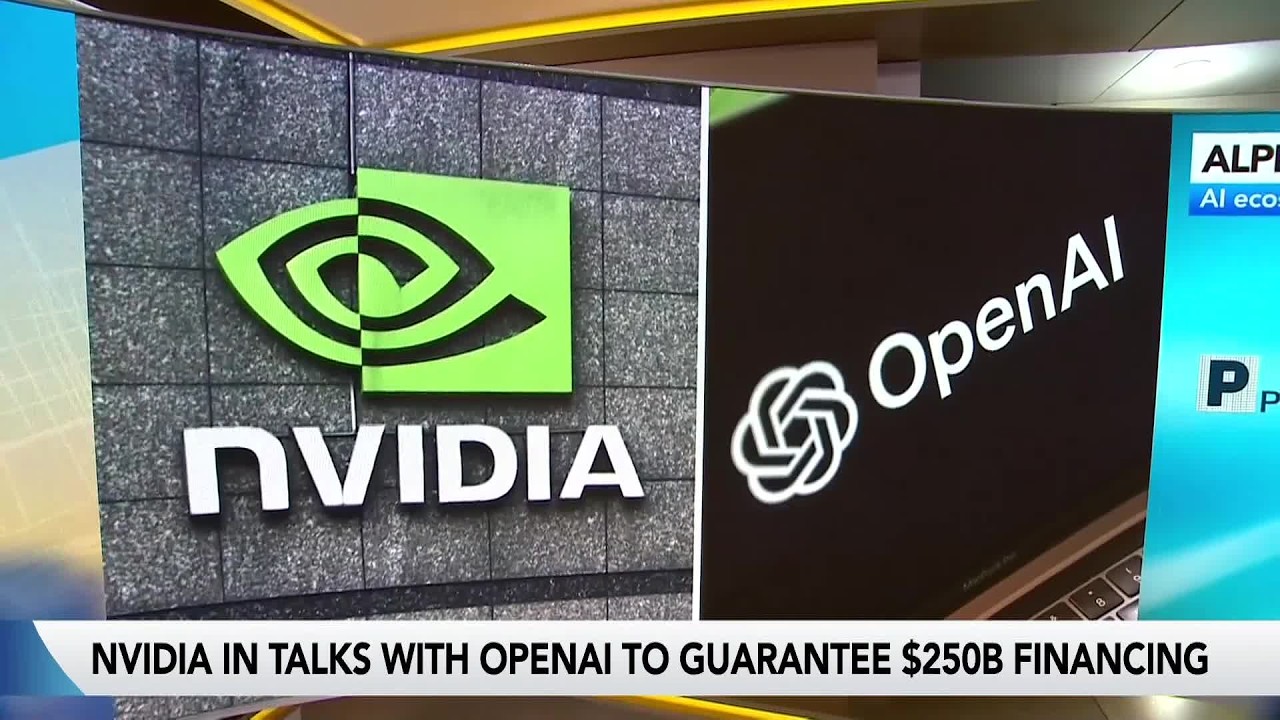
The Wall Street Journal reported, and Bloomberg subsequently reported with additional detail, that Nvidia is in talks to provide a financing guarantee of roughly $250 billion supporting OpenAI’s lease of a planned 10-gigawatt AI campus in Piketon, Ohio. Separately, Nvidia is reported to be discussing financing for up to $350 billion of OpenAI chip purchases — a second, distinct instrument.
The reported structure matters. The guarantee is understood to cover OpenAI’s lease obligations and the underlying construction debt, and explicitly not the Nvidia chips that would fill the data halls. The site is a former uranium-enrichment facility, developed by SoftBank through its energy subsidiary SB Energy. Total project cost is anticipated to exceed $500 billion. The first phase is expected to deliver roughly 800 megawatts and to begin operating in 2028.
These terms are not final. Negotiations are ongoing and there is no assurance a transaction is completed. Nvidia did not respond to a request for comment on the initial reports. Everything in this section should be read with that caveat attached.
Fact Box
Nvidia–OpenAI Ohio arrangement: confirmed vs. reported
- Reported, not confirmed: Nvidia guarantee of approximately $250 billion covering OpenAI lease obligations and construction debt
- Reported, not confirmed: a separate arrangement financing up to $350 billion of chip purchases
- Reported: the guarantee does not extend to the Nvidia hardware itself
- Reported: site is a former uranium-enrichment facility in Piketon, Ohio, developed by SoftBank via SB Energy
- Reported: 10 gigawatts total planned capacity; first phase approximately 800 MW targeted for 2028; total project cost above $500 billion
- Status: negotiations ongoing; terms not finalized; no assurance of completion
Original source: Reporting on the Nvidia guarantee and chip financing discussions
Two ways to read it
The constructive interpretation, which drove Monday’s rally in neocloud and chip names, is that this removes a funding overhang. The central anxiety in the AI trade has been that financing for the next wave of data centers dries up. A guarantee from the most creditworthy participant in the ecosystem tells lenders that banks can underwrite against Nvidia’s balance sheet rather than against an unprofitable AI lab’s projections. Projects move. Wheels get greased. That is a real effect, and it is why the announcement lifted the complex.
The skeptical interpretation is harder to dismiss. A guarantee of this scale is only necessary if the debt markets would not fund the project on OpenAI’s own credit. That is close to definitional. The structure tells you something specific about how lenders assess OpenAI’s ability to service $500 billion of infrastructure obligations against current revenue, and the answer implied is not flattering.
The circularity concern also compounds with each transaction. Nvidia already holds a substantial equity stake in OpenAI and has previously extended a large rolling investment commitment. It now proposes to guarantee OpenAI’s lease obligations and to finance OpenAI’s chip purchases — chips it manufactures and sells. Nvidia’s consistent response, when asked, is that it does not contractually require counterparties to spend the financing on Nvidia hardware; they are free to buy from whomever they choose. That is a fair and literally accurate answer. It is also not a complete answer to the accounting question, which is how much of Nvidia’s revenue growth is ultimately underwritten by Nvidia’s own balance sheet.
This is not unprecedented — vendor financing has a long history in technology and telecommunications, and Broadcom has reportedly done similar backstop arrangements with OpenAI and Anthropic. What is new is the magnitude. A $250 billion guarantee in a single location, alongside separate chip financing at $350 billion, is a different category of exposure from anything the sector has previously attempted.
Nvidia’s stock rose less than 1% in premarket trading on the news, which is itself informative. The market read the arrangement as solving a funding problem without meaningfully changing Nvidia’s earnings trajectory. Guaranteeing an obligation is a use of balance-sheet capacity, not a sale.
Why OpenAI, and why Ohio
A fair question raised in Monday’s discussion: other companies — including Google and Amazon — were reportedly interested in leasing this capacity, and have more immediately obvious compute needs. Why route it to OpenAI?
Two explanations are available, and neither requires cynicism. Commercially, OpenAI is Nvidia’s most visible customer and the most prominent face of the AI trade; preserving its momentum has strategic value beyond the individual transaction. And OpenAI is a plausible IPO candidate, which makes supporting its infrastructure position a potential equity story as well as a commercial one.
Politically, the arrangement checks several boxes simultaneously: Japanese capital invested in the United States, a facility sited in the industrial Midwest on land with federal history, and a project scale that supports the administration’s reindustrialization messaging. OpenAI executives are expected at the White House this week, at a moment when the administration has been reported to be weighing equity stakes in a number of AI companies. Those facts do not establish that political considerations drove the structure. They do establish that the structure is politically convenient, which is worth stating plainly.
The precedent everyone reaches for, and how well it actually fits
Whenever vendor financing appears at scale, someone invokes the telecom equipment bust. The comparison is worth taking seriously rather than deploying as a rhetorical device, because it is instructive in both directions — it explains a real failure mode, and it also differs from the present situation in ways that matter.
What happened between 1999 and 2001
In the late 1990s, equipment manufacturers lent money to the carriers buying their gear. Lucent Technologies committed roughly $8.1 billion in customer financing. Nortel Networks extended about $3.1 billion, with $1.4 billion outstanding. Cisco Systems committed around $2.4 billion. The vendors booked the resulting shipments as revenue.
The mechanism worked beautifully while the carriers survived. When they did not, the losses arrived in two forms at once: the loan went bad and the revenue it had generated turned out to have been fictitious. Lucent’s bad loans rose from 2.6% of total loans at the end of 2000 to 60% by the end of 2001. Nortel’s went from 25.5% to 80%. Lucent had publicly described its roughly $2 billion financing arrangement with Winstar Communications as a long-term strategic relationship; when Winstar failed in April 2001, analysts estimated it owed Lucent more than $800 million.
The underlying problem was not that vendor financing is inherently fraudulent. It is that vendor financing removes the credit check from the demand signal. A manufacturer that funds its own customers cannot distinguish real demand from demand it has manufactured, and neither can its investors. Revenue growth stops being information.
What is similar now
The structural resemblance is real. Nvidia holds an equity stake in OpenAI, has extended a large rolling investment commitment, and is now reported to be negotiating both a lease guarantee and chip-purchase financing for the same counterparty. Its arrangements with the neocloud layer go further still: under an agreement with an initial value of roughly $6.3 billion running through April 2032, Nvidia is contractually obligated to purchase CoreWeave’s unsold computing capacity if CoreWeave cannot find buyers for it. Nvidia also holds equity in CoreWeave, having purchased approximately $2 billion in additional shares in January 2026 on top of prior stakes.
That last arrangement is the one that most closely rhymes with 2000. A capacity backstop means Nvidia has agreed to absorb the consequences if end demand for compute falls short of what its customer built. It converts a customer’s demand risk into the supplier’s balance-sheet risk while leaving the supplier’s revenue recognition intact.
What is genuinely different
Three differences are substantial enough that the analogy should not be treated as a forecast.
First, the counterparties. Winstar and the other competitive carriers of 1999 were speculative startups with no revenue and no path to any. Microsoft, Meta, Amazon and Alphabet are among the most profitable businesses in history, and their AI spending is funded overwhelmingly from operating cash flow supplemented by investment-grade debt at modest leverage. OpenAI is the weakest large credit in the chain and is the one requiring a guarantee — which is precisely the point of the guarantee.
Second, the utilization picture. Telecom’s fatal flaw was dark fiber: enormous capacity built and never lit, because demand arrived a decade later than the buildout assumed. The current constraint runs the other way. Microsoft has stated its cloud business would have grown several percentage points faster with additional capacity. Data centers are being sold out before they are completed. That does not guarantee the situation persists, but it is the opposite of the 2001 condition.
Third, the accounting. Nvidia’s reported revenue comes from chips shipped and paid for, not from loans booked as sales. The guarantees under discussion are contingent liabilities, disclosed as such. That is more transparent than what Lucent was doing.
Where the analogy still bites
The honest concern is not that Nvidia is Lucent. It is that the layer beneath Nvidia looks considerably more like 1999 than the hyperscalers do, and that is where the leverage has concentrated.
CoreWeave illustrates the point. Its total debt rose by more than $3 billion in the first quarter of 2026 to approximately $24.9 billion. In that same quarter it generated roughly $2.98 billion of operating cash flow against $7.7 billion of capital expenditure, producing free cash flow of negative $4.71 billion in three months. It has raised approximately $28 billion of combined debt and equity in the twelve months through March 2026, including an $8.5 billion facility closed in March described as the first investment-grade-rated financing secured by high-performance computing infrastructure.
That last detail deserves a moment. The collateral is GPUs. Lenders are underwriting the residual value of semiconductors on a depreciation schedule, in a market where each new architecture generation reduces the economics of the prior one. This is a genuinely new asset class, priced on assumptions that have never been tested through a downturn. If utilization falls or if hardware obsolescence proves faster than modeled, the recovery value on that collateral is not obviously what the models assume.
The systemic question follows from there. Investment-grade ratings on this paper make it eligible for institutional portfolios, including pension allocations. That is how a narrow sector problem becomes a broader one — not through the hyperscalers, whose balance sheets can absorb a great deal, but through the leveraged layer that has been financed against them.
The China dimension: a moat that just got tested twice
Two developments this week bear on the export-control regime that has shaped the semiconductor trade for three years, and they point in uncomfortable directions.
The first is CXMT’s listing, discussed below. The second is quieter: DeepSeek has reportedly put its latest fundraising plans on hold, with sources describing the founder as frustrated over Chinese media posts about a June funding round — unverified reports discussing the company’s reliance on Nvidia chips and China’s position in AI relative to the United States. That is a private-company financing matter with no confirmed figures attached, and it should not be over-read. What it does suggest is that the question of Chinese AI capability relative to American hardware access remains contested enough inside China to be politically sensitive.
Nvidia’s chief executive has been unusually direct on the underlying issue. Jensen Huang has argued that China is producing more AI researchers than perhaps anywhere else, framing the country as manufacturing intelligence itself — and has said publicly that U.S. companies should use excellent open-source models regardless of origin. At a CSIS event he claimed roughly half the world’s AI researchers are Chinese, with China accounting for approximately 70% of recent AI patent publications. Those figures come from an executive with an obvious commercial interest in a permissive export regime, and should be weighed accordingly. They are nonetheless a striking public position from the chief executive of the company whose products the controls are designed to restrict.
The memory dimension is where policy meets the current inflation problem most directly. U.S. export controls have maintained a moat around advanced memory. CXMT’s listing — the largest mainland semiconductor offering on record, raising $8.6 billion explicitly to advance domestic capability — represents Beijing funding its way around that moat with public capital markets. The strategic reading is straightforward: restricting access accelerated the incentive to build alternatives, and the alternatives are now being financed at scale by retail and institutional investors rather than by state banks alone.
Whether that succeeds technically is a separate question from whether it is funded. DRAM at the leading edge is difficult, and CXMT’s profits currently come predominantly from lower-end chips sold into consumer products. But the capital is now there, and capital is usually the binding constraint in semiconductors.
CXMT’s 466% debut and the memory squeeze reaching your phone
The most extreme price move of the day happened in Shanghai, and it connects back to the inflation debate in a way that is easy to miss.
ChangXin Memory Technologies — CXMT — surged 466% in its Shanghai trading debut, closing at 49 yuan against an offer price of 8.66 yuan, after an intraday high of 55.03 yuan. That gave the Hefei-based DRAM manufacturer a market capitalization of roughly 3.3 trillion yuan, overtaking Industrial and Commercial Bank of China’s 2.6 trillion yuan to become China’s largest onshore-listed company.
The offering raised 57.92 billion yuan, or about $8.6 billion, making it Asia’s largest IPO so far in 2026 and the biggest mainland Chinese semiconductor offering on record, surpassing SMIC’s $7.5 billion Shanghai sale in 2020. CXMT is the world’s fourth-largest DRAM producer, behind Samsung Electronics, SK Hynix and Micron Technology.
A note on some figures circulating about this listing: CXMT overtook ICBC, not Tencent, in market value among China-listed companies, and the offering is more accurately described as the largest mainland semiconductor IPO on record than as the second-largest Chinese IPO in history. Both details have been reported imprecisely.
What the debut actually signals
A 466% first-day move is not primarily a statement about CXMT’s business. It is a statement about the absence of alternatives. Global investors have been able to express a view on the memory cycle through Samsung, SK Hynix and Micron for years. Onshore Chinese investors have had no comparable vehicle. When one arrived, in a market where retail participation is heavy and the offering was reportedly oversubscribed many times over, the price discovery was violent.
For context on how unusual that is: SpaceX’s June 2026 listing — the largest IPO ever, raising approximately $75 billion at $135 per share for a valuation near $1.8 trillion — was reported to be more than four times oversubscribed. That was considered exceptional demand. CXMT operated in a different regime entirely.
The uncomfortable question for anyone long the memory trade globally is whether this marks a top. Memory names outside China have run five- to ten-fold over recent periods on a genuine shortage. If CXMT deploys $8.6 billion of fresh capital into capacity expansion, and if Beijing continues subsidizing domestic supply as part of its self-sufficiency push, the supply response eventually arrives. Memory is a cyclical commodity business. It has always resolved this way.
The link back to inflation
Here is why a Shanghai IPO belongs in an article about the Fed.
DRAM prices have risen sharply because AI infrastructure consumes memory at unprecedented rates. Microsoft explicitly attributed roughly $25 billion of its raised fiscal 2026 capex guidance to higher component prices. That same shortage is why handset and PC prices have been rising. It is a clean example of AI capital spending transmitting directly into consumer goods prices — not through some abstract wealth channel, but through the bill of materials.
This is the mechanism some Fed officials have in mind when they describe AI as an inflation input. A trillion-dollar concentrated investment program running into a supply-constrained economy at 4.2% unemployment produces price pressure, and it would be treated as obviously inflationary if a government were doing it. Because it is being done by private corporations funded in capital markets, it has taken longer to enter the policy conversation.
The counterargument, which Fed officials also weigh, is that the same investment is disinflationary over a longer horizon if it delivers the productivity gains its proponents promise. Both propositions can be true on different timelines, and reconciling them is genuinely hard. That difficulty is a substantial part of why this committee is split.
Where the money is rotating
If the concentrated AI trade is losing its grip on index returns, the practical question becomes where capital goes. Several distinct arguments are being made, and they do not all point the same direction.
AI beneficiaries rather than AI builders. The Morgan Stanley thesis described earlier — margin expansion at companies that adopt the technology rather than fund it. Banks are the cleanest expression, and the eight-week run in bank stocks suggests the market has been acting on this for some time. The vulnerability is that it depends on enterprises being willing to pay for AI products at prices that justify hyperscaler spending. Corporate procurement is trending the other way — toward the cheapest adequate model rather than the frontier one, and toward model routing and efficiency rather than raw capability. That is good for adopters and problematic for the economics underpinning the buildout.
Inflation-protected equity. Subramanian’s argument is demographic as much as financial. Roughly $7 trillion sits in cash, much of it accumulated by savers since the Fed began raising rates. At current inflation rates that cash carries a negative real return. Cash is a poor place to be during sustained above-target inflation. The natural destination for retirees seeking real income is not megacap technology — it is REITs, MLPs, and cyclical businesses that can grow with inflation and return capital. That is an argument for large-cap value.
Defensive income within equities. Shalett described Morgan Stanley Wealth Management moving toward energy, utilities, REITs, healthcare and selectively consumer staples, funded partly by taking profits in semiconductors. Utilities in particular have a dual claim: defensive characteristics plus direct exposure to data-center power demand.
Outside the United States. Seema Shah of Principal Asset Management has argued that the supplier and beneficiary layers of the AI stack extend well beyond the U.S., South Korea and Taiwan, and that Europe offers exposure at valuations that have not repriced to the same degree.
One caution applies to all of these. Every rotation argument currently in circulation depends on the economy holding together. Shah made the point directly: the rotation into other market segments has been driven by a constructive economy, and a sequence of rate hikes would test it. Defensive rotation works when the problem is confined to one sector. If the Fed tightens into an already-decelerating labor market, the rotation trade and the AI trade fail together.
Risks and what would change the assessment
Several things could invalidate the reading above, and it is worth being explicit about them.
- The pause collapses. Nothing about the Iran situation is resolved. The blockade holds, no vessels are transiting Hormuz, and the president has said explicitly that he is “locked and loaded.” A resumption of strikes would put crude back above $100 quickly, and one credible sell-side scenario has oil considerably higher in a full escalation case. The absence of a durable diplomatic off-ramp is the base case, not the risk case.
- The Fed hikes without a framework. The overshoot mechanism described earlier is the specific danger. A move with no strategy attached could see markets price three hikes within hours, tightening conditions far more than intended.
- Capex guidance moves sharply higher. If Microsoft, Meta and Amazon collectively raise 2027 spending well beyond current expectations, the funding math changes and credit spreads likely widen further. Both equity and credit would be repricing the same news simultaneously.
- Financing conditions tighten for the buildout. Bond coverage ratios on hyperscaler deals have already fallen from roughly five times to below two times since February. If that continues, the marginal project gets more expensive, and the companies with weaker balance sheets — Oracle being the obvious case — face genuine constraints.
- The labor market deteriorates further. Payroll growth below 60,000 with consecutive downward revisions is not a comfortable starting point for a tightening cycle. Another weak print in early August would substantially complicate the September hike now largely priced.
- The AI returns story fails to materialize. The entire structure rests on enterprises eventually paying enough for AI products to justify hundreds of billions in infrastructure. That has not yet been demonstrated at the required scale.
- Memory supply normalizes faster than expected. Good for consumer prices and for Apple’s cost base; painful for the memory names that have run five- to ten-fold and for the capex assumptions built on current component pricing.
What to watch, in order
The confirmed calendar, followed by the genuinely open questions.
Tuesday, July 28: FOMC meeting begins. Treasury auctions seven-year notes, roughly $44 billion. Visa and Coca-Cola report. Netanyahu is scheduled to meet the president at the White House.
Wednesday, July 29: FOMC statement at 2:00 p.m. ET; press conference at 2:30 p.m. ET. Microsoft and Meta report after the close.
Thursday, July 30: Apple and Amazon report after the close.
Within that, three specific things carry disproportionate information.
First, the dissent line at the bottom of Wednesday’s statement. Who dissents, and for what, is the clearest available read on September.
Second, whether Warsh offers any conditional framing at the press conference. He has resisted even if-then formulations. If he supplies one, the September pricing recalibrates immediately.
Third, the reaction function to Microsoft’s capex disclosure. Not the number — the reaction. If the market punishes the strongest returns story in the group, the structural interpretation of this selloff gains considerable weight.
Frequently asked questions
Will the Fed raise interest rates in July 2026?
Most economists expect a hold. Fed funds futures implied roughly a 38% probability of a quarter-point increase as of July 23, with the target range currently at 3.50%–3.75%. The higher-conviction market bet is on September, priced near 82%. No outcome is guaranteed, and the absence of forward guidance from Chair Kevin Warsh means the range of plausible outcomes is wider than usual for an FOMC meeting.
When is the July 2026 Fed decision announced?
The FOMC statement is released at 2:00 p.m. ET on Wednesday, July 29, 2026, followed by a press conference at 2:30 p.m. ET. This is not a projection meeting, so there is no updated dot plot or Summary of Economic Projections.
What is the current US inflation rate?
Headline CPI ran at 3.5% year over year in June 2026, down from 4.2%, with core CPI at 2.6%. The Fed’s preferred measure, core PCE, reached 3.4% year over year in May 2026 — the highest since October 2023. Core PCE has been above the Fed’s 2% target every month since March 2021.
Why did oil prices fall on July 27, 2026?
The U.S. and Iran paused reciprocal strikes for a third consecutive night. Brent fell roughly 7%–8% toward the high $80s and WTI dropped about 7.7% to near $82.43. The naval blockade of Iran remains in place and the Strait of Hormuz remains disrupted, so the decline reflects reduced escalation risk rather than a resolution.
Why did Alphabet stock fall after beating earnings?
Alphabet reported 24% revenue growth but also its first negative free cash flow quarter since its 2004 IPO — negative $5.9 billion — after capital expenditures doubled to $44.9 billion. It simultaneously raised full-year capex guidance to $195 billion–$205 billion. Roughly $99 billion of its $112.1 billion reported net income came from unrealized gains on Anthropic and SpaceX stakes rather than operations.
Did Intel beat earnings expectations?
Yes. Intel reported Q2 2026 revenue of $16.13 billion, up 25% year over year — its fastest growth since 2011 — and adjusted EPS of $0.42 against consensus near $0.21. On a GAAP basis it reported a net loss of approximately $11 billion, driven by a $12.5 billion non-cash mark-to-market loss on escrowed shares tied to its CHIPS Act agreement. The stock closed down about 2.46% on July 24.
When do Microsoft, Meta, Apple and Amazon report earnings?
Microsoft (fiscal Q4) and Meta (Q2) report Wednesday, July 29, 2026, after the close. Apple (fiscal Q3) and Amazon (Q2) report Thursday, July 30, after the close. The four companies represent roughly a fifth of the S&P 500 by index weight.
Has the Nvidia–OpenAI $250 billion deal been completed?
No. It has been reported as under negotiation. The reported structure involves Nvidia guaranteeing approximately $250 billion covering OpenAI’s lease obligations and construction debt for a 10-gigawatt campus in Piketon, Ohio, plus separate discussions on financing up to $350 billion of chip purchases. Terms are not final and there is no assurance a transaction closes.
What is CXMT and why did its stock surge 466%?
CXMT is a Hefei-based DRAM manufacturer, the world’s fourth-largest behind Samsung, SK Hynix and Micron. Its Shanghai debut closed at 49 yuan against an 8.66 yuan offer price, giving it a market capitalization near 3.3 trillion yuan and making it China’s largest onshore-listed company. The scale of the move largely reflects the absence of any comparable domestic memory-sector listing for onshore Chinese investors.
Is the US labor market strong right now?
It is mixed and frequently mischaracterized. June payrolls rose just 57,000 against a 115,000 consensus, with April and May both revised down substantially. Unemployment fell to 4.2%, but primarily because labor force participation declined. Jobless claims are low, around 215,000–226,000. The accurate description is low firing and low hiring, not acceleration.
What is the risk if the Fed hikes without forward guidance?
Analysts including Evercore ISI’s Krishna Guha have argued that a hike delivered without an explanatory framework would likely cause markets to price a sequence of increases — plausibly two to three — rather than a single move. The resulting tightening in financial conditions would exceed what the committee intended. Chair Warsh has generally declined to provide the conditional guidance that would contain such a reaction.
Would higher rates actually slow AI spending?
Probably not much, and this is one of the weaker arguments in the hawkish case. Companies pursuing the AI buildout have framed expected returns on capital at levels high enough that one or two percentage points of additional borrowing cost does not change the deployment decision. Front-end rate increases pass through fastest to consumer credit and small business borrowing — the sectors least connected to hyperscaler capital expenditure.
Is the AI buildout a repeat of the telecom bubble?
The vendor-financing resemblance is real but the counterparties differ substantially. In 1999–2001, Lucent and Nortel lent billions to speculative carriers with no revenue; Lucent’s bad loans reached 60% of its loan book by the end of 2001 and Nortel’s reached 80%. Today’s largest AI spenders are among the most profitable companies in existence and are funding capex primarily from operating cash flow. The closer parallel sits in the neocloud layer, which is genuinely leveraged, and in the practice of collateralizing debt against GPU residual values — an asset class untested through a downturn.
What are neoclouds and why do they matter to this story?
Neoclouds are specialist providers renting GPU compute capacity, sitting between chipmakers and end users. CoreWeave is the largest listed example. Its debt rose above $24.9 billion in Q1 2026, with free cash flow of negative $4.71 billion in that quarter alone against $7.7 billion of capital expenditure. Nvidia holds equity in CoreWeave and, under an agreement with an initial value of roughly $6.3 billion running to 2032, is contractually obligated to purchase unsold CoreWeave capacity. This layer carries the leverage that the hyperscalers largely do not.
Final assessment
The most consequential thing that happened in markets over the past week was not a policy decision or a geopolitical development. It was an accounting line: Alphabet’s free cash flow going negative for the first time in twenty-two years as a public company, while revenue grew 24%.
That single number did more to change the market’s framework than any commentary about it. For three years, AI capital spending was costless in the way that mattered to shareholders — funded from surplus, invisible on the cash flow statement, purely additive to the story. It is no longer costless. Once spending shows up as cash out the door, investors have to underwrite the return, and underwriting a return requires believing something specific about how much enterprises will eventually pay for these products. That belief has not been tested at the required scale, and the market has begun to notice.
The strongest evidence that this is real, rather than a positioning wobble, is that it shows up in three unrelated places at once. Equity prices refusing to reward good results. Credit spreads on the best-rated borrowers in the market widening while the broad index stays tight. Bond deal coverage falling from five times to below two times in five months. Those are different investor bases reaching similar conclusions independently.
The strongest evidence against a genuinely bearish reading is equally concrete. Bank stocks do not rally for eight straight weeks into a downturn. The equal-weight index has held up while the cap-weighted index fell. This has the shape of a rotation from the spenders to the beneficiaries, and there is a defensible thesis underneath it about where AI margin gains actually accrue.
What is genuinely unresolved is the Fed’s role, and the committee deserves more sympathy than it usually gets this week. It faces an inflation rate above target for five years, an energy shock it cannot forecast, a labor market that is decelerating rather than accelerating, and a private investment program running at a scale that would be treated as obviously inflationary if a legislature had authorized it. The tools available do not map cleanly onto any of those problems. Raising rates to slow the AI buildout would hit household credit long before it touched a hyperscaler’s capital budget.
The most likely outcome Wednesday is a hold with visible internal disagreement, which sets up September as the real decision point. What would change that assessment is not the statement language but the reaction function on display Wednesday and Thursday evening — specifically, whether the market punishes Microsoft for disclosing the same thing it punished Alphabet for. Microsoft is the cleanest test available: the company with the most identifiable revenue attached to its spending and a cloud business that is capacity-constrained rather than speculative. If good news fails there, the case that something structural has shifted in the AI trade becomes substantially harder to argue against.
Sources
- Federal Reserve Board — meeting calendar and 2026 FOMC schedule
- U.S. Bureau of Labor Statistics — Employment Situation Summary, June 2026
- CNBC — Fed rate decision: odds surge for hike as oil rips higher
- Forbes — Markets price in rising odds of a July Fed rate hike
- CNBC — June 2026 Fed meeting recap and Warsh task force announcements
- CNBC — Warsh declines to hint at July decision, says inflation ‘too high’
- Fortune — Preview of the July FOMC ‘family feud’
- CNBC — Consumer Price Index report, June 2026
- CNBC — Core PCE inflation report, May 2026
- CNBC — June 2026 jobs report: payrolls up 57,000, unemployment at 4.2%
- CNBC — Oil prices slide, Brent below $90 as U.S.–Iran pause holds
- NBC News — Oil slides as U.S. and Iran pause strikes to give diplomacy ‘space’
- CNBC — Strait of Hormuz traffic under renewed U.S.–Iran conflict
- CNBC — Netanyahu and Zelenskyy travel to Washington amid Iran conflict
- Intel Corporation — Second-quarter 2026 financial results
- CNBC — Intel Q2 2026 earnings report
- Investing.com — Alphabet Q2 2026 results and capex guidance
- CNBC — Microsoft guides to $190 billion of 2026 capital spending
- Tom’s Hardware — Nvidia weighs $250 billion guarantee for OpenAI’s Ohio campus
- Reuters via Yahoo Finance — Nvidia in talks to guarantee $250 billion financing, WSJ reports
- CNBC — CXMT’s 466% debut makes it China’s most valuable listed company
- Bloomberg — China chipmaker CXMT jumps 466% in debut after blockbuster IPO
- Fortune — Investor demand falls as hyperscalers ramp up bond issuance
- Forbes — Bond investors push back as AI debt heads toward $570 billion
- Yahoo Finance — Oracle’s credit risk nears an 18-year high
- CNBC — Oracle credit default swaps and AI financing plans
- CNBC — BofA’s Savita Subramanian sets a 7,100 S&P 500 target for 2026
- Bloomberg via Yahoo Finance — Morgan Stanley’s Wilson on AI adoption and profit margins
- Bloomberg — Goldman Sachs names BlackRock’s Amanda Lynam chief credit strategist
- Bloomberg — SpaceX IPO more than four times oversubscribed
- Federal Reserve — Chairman Warsh’s June 17, 2026 press conference transcript (PDF)
- CNBC — How Kevin Warsh has set out to remake the Fed
- CNBC — Analysis: Warsh’s task forces are the key to understanding the new Fed
- Newsweek — contemporaneous reporting on telecom vendor financing and the loan bubble
- Analysis comparing Nvidia’s financing commitments with Lucent and Nortel vendor financing data
- Quartz — GPU-collateralized debt explained and AI financing risks
- Sacra — CoreWeave revenue, debt and financing data
- Axios — Jensen Huang on Chinese open-source AI models
This article is provided for general informational purposes and does not constitute financial, investment, tax, or legal advice.
Affiliate disclosure: Businessfinance.news may earn compensation from qualifying actions completed through selected links on this website, at no additional cost to the reader. Affiliate relationships do not influence our editorial reporting, analysis, or conclusions.
——-
SEO-PACKAGE
SEO-TITLE: Fed Rate Hike Odds Meet Big Tech Earnings: July 2026 Preview
URL-SLUG: july-2026-fed-rate-hike-big-tech-earnings
WORDPRESS TAGS:
IMPORTANT PEOPLE MENTIONED: Kevin Warsh, Jensen Huang, Savita Subramanian, Lisa Shalett, Mike Wilson, Krishna Guha, Amanda Lynam, Tyler Radke, Seema Shah, Victoria Coates, Donald Trump, Mike Waltz
FOCUS KEYWORD: July 2026 Fed rate hike
META DESCRIPTION: A July 2026 Fed rate hike is priced near 38% as Microsoft, Meta, Apple and Amazon report, with markets no longer rewarding Big Tech good news.