Last updated: July 28, 2026, 4:00 p.m. Eastern Time
South Korea’s benchmark Kospi index closed 10.8% lower at 6,023.66 on Tuesday, July 28, 2026, its worst single session in years, after a report that a state-backed Chinese manufacturer had begun mass-producing immersion deep ultraviolet lithography machines. Samsung Electronics fell 13.4%. SK Hynix dropped 14.7%. Between them, the two companies account for close to half the index. Trading was halted briefly by a circuit breaker before resuming lower.
The trigger was a single story published on Monday, July 27, by the subscription technology publication The Information, which reported that a Shanghai-based company had started producing immersion DUV scanners and would deliver the first units this year to SMIC, Hua Hong Semiconductor and ChangXin Memory Technologies. The report cited two people familiar with the program. It put output at roughly five machines in 2026 and about 20 in 2027. It did not name the manufacturer.
That is the entire factual basis for a move that erased hundreds of billions of dollars of market value across four countries in about eighteen hours. Understanding why so little information produced so much price action is the more interesting question, and it has less to do with lithography than with what the AI trade had become by late July 2026.
Key Takeaways
- Main development: The Information reported on July 27, 2026 that a Shanghai-based, state-backed manufacturer has begun mass-producing immersion DUV lithography systems, with first deliveries to SMIC, Hua Hong and CXMT expected in 2026. Roughly five machines are targeted this year and about 20 in 2027.
- Key figures: The Kospi closed down 10.8% at 6,023.66 on July 28. Samsung Electronics fell 13.4%, SK Hynix 14.7%. Japan’s Nikkei 225 lost 4% to 62,364.92 and Taiwan’s Taiex fell 4.7%. ASML shares fell as much as 6.5% in Amsterdam on July 27 and closed at their lowest level since early June.
- Market response: Nvidia closed July 27 at $196.51, down 4.99%, while the annual cost of insuring its debt against default rose by roughly 0.14 percentage point to about 0.82 percentage point, according to Bloomberg. AMD fell as much as 8%, Micron 5% and Intel 3.7%.
- Why it matters: Immersion DUV is the workhorse tool of the semiconductor industry. ASML holds an effective monopoly in it. If China can build and qualify its own scanners at volume, the export-control regime that has governed the chip war since 2018 loses one of its two main levers.
- What is not confirmed: The manufacturer has not been named by the original report, no third party has independently verified the production numbers, no machine has been publicly qualified on a customer production line, and analysts who cover the sector put the performance gap at anywhere from five years to the mid-2030s.
- What comes next: SK Hynix reports second-quarter results on July 29, Samsung Electronics on July 30, and the Federal Open Market Committee announces its decision on July 29.
What The Information Actually Reported
The original story is narrow, and the narrowness matters. According to The Information, a state-backed company in Shanghai has begun mass-producing immersion deep ultraviolet lithography machines and is due to deliver the first units this year to three customers: Semiconductor Manufacturing International Corporation, Hua Hong Semiconductor and ChangXin Memory Technologies. Output targets are approximately five machines in 2026 and roughly 20 in 2027. The reporting rests on two unidentified people familiar with the program.
The Information did not name the manufacturer. Its sources described an operation that had absorbed DUV development teams from several Chinese companies, one of them the state-backed startup Shanghai Yuliangsheng Technology. Most components in the new systems are domestically produced, though some critical parts still come from Japan, and delays among local suppliers have held back output during 2026.
Several outlets that picked up the story went further than the original. Agence France-Presse reported flatly that “Chinese company Shanghai Yuliangsheng is making immersion deep ultraviolet (DUV) lithography machines,” and said that when contacted, Yuliangsheng did not immediately respond, nor did SiCarrier or Huawei, two companies with ties to the group. Tom’s Hardware, which summarized the report in detail, identified Shanghai Aishengna Electronic Technology Group in some secondary coverage as the entity leading the effort. Neither identification has been confirmed by the original reporting.
This is a meaningful distinction for anyone trying to price the news. There is a difference between “a company we can name has shipped a qualified tool” and “two people say an unnamed state-backed entity is building roughly five machines.” Markets treated the second statement as though it were the first.
What is independently corroborated is the surrounding context. The Financial Times has reported that SMIC has been testing a Yuliangsheng immersion lithography system since September 2025. Reuters has separately reported on China’s domestic extreme ultraviolet program, which remains at the prototype stage. Chinese fabs have spent two years extending the life of their installed ASML fleet through upgrades and secondary channels. None of that is new. What was new on July 27 was the claim of serial production.
Fact Box
The DUV report: confirmed, reported, and unconfirmed
- Reported: A state-backed Shanghai company has begun mass-producing immersion DUV lithography systems, per The Information, citing two people familiar with the program.
- Reported: First deliveries this year to SMIC, Hua Hong Semiconductor and CXMT; approximately five machines in 2026 and 20 in 2027.
- Reported: Most components domestic, some critical parts still imported from Japan; local supplier delays have slowed output.
- Independently corroborated: SMIC has been testing a Shanghai Yuliangsheng immersion tool since September 2025, per the Financial Times.
- Not confirmed: The manufacturer’s identity, the tools’ resolution and overlay specifications, whether any unit has been qualified for production, and whether the 2027 target is achievable.
Original source: The Information, “China Starts Mass Producing Homegrown DUV Chipmaking Tools”
Why a DUV Scanner Is Worth More Than It Sounds
Lithography is the step in chip manufacturing where a pattern is projected onto a silicon wafer coated in light-sensitive resist. The finer the pattern a machine can resolve, the smaller the transistors and the denser the circuit. Resolution depends principally on the wavelength of the light and the numerical aperture of the optics.
Deep ultraviolet lithography uses a 193-nanometer argon fluoride laser. Immersion DUV adds a layer of purified water between the final lens and the wafer, raising the effective numerical aperture and improving resolution. Extreme ultraviolet lithography, which ASML alone produces, uses 13.5-nanometer light generated by vaporizing tin droplets with a high-power laser inside a vacuum chamber. The engineering gap between the two is not incremental.
Here is the practical consequence. An immersion DUV scanner can print roughly 28-nanometer-class features in a single exposure. To go below that, a fab uses multipatterning: exposing the same wafer several times with offset masks so that the combined pattern is finer than any single exposure could produce. Chinese foundries have used this technique to reach 7-nanometer-class nodes without EUV. SMIC’s third-generation 7nm process, analyzed by teardown specialists, shows a smaller metal pitch than Intel 18A and higher transistor density than TSMC N6, achieved entirely without EUV.
Multipatterning works, but it is expensive. Each additional exposure adds process steps, consumes tool time, and compounds overlay error, the misalignment between successive layers. Yields fall. Cycle times lengthen. Cost per good die rises. ASML chief executive Christophe Fouquet made the inverse point on the company’s July earnings call, noting that rising lithography intensity in DRAM partly reflects customers replacing multipatterning with cheaper single-exposure EUV.
So the strategic value of a domestic immersion scanner is not that it lets China build chips it could not build before. It is that it lets China build them without asking permission, and at scale. A fab that needs six DUV exposures instead of one EUV exposure simply needs six times the DUV capacity. Under export controls, that capacity is capped by the size of the installed fleet and by whatever can be obtained through secondary channels. Domestic production removes the cap.
That is the argument the market ran with on July 28. It is a reasonable argument. It is also an argument about 2029 and 2030, priced into 2026 share prices in a single session.
ASML: What the Company’s Own Numbers Say About China Exposure
ASML is the company whose moat the report threatens, so it is worth starting with what ASML has actually disclosed rather than with what the market assumed.
On July 15, 2026, ASML reported second-quarter total net sales of €9.3 billion and net income of €2.9 billion, with a gross margin of 54.0%. Both sales and margin came in above the company’s own guidance, driven primarily by higher-than-expected Installed Base Management sales, ASML’s term for service and field-option revenue on tools already in customers’ fabs. Installed Base Management sales were €2,762 million in the quarter, up from €2,488 million in the first quarter. The company sold 86 new lithography systems and five used systems in the quarter.
ASML raised its full-year outlook for the second time in 2026, guiding to total net sales between €43 billion and €45 billion with a gross margin between 54% and 56%. Third-quarter guidance is €11.0 billion to €12.0 billion at a 55% to 57% gross margin. Basic earnings per share were €7.59 in the second quarter. The company purchased roughly €1.1 billion of its own shares during the quarter under the 2026 to 2028 buyback program and declared an interim 2026 dividend of €1.88 per ordinary share, payable August 5.
The capacity commentary in that release is the part that matters for the China question. Fouquet said ASML plans to add 30% to its 2026 low-NA EUV capacity of around 65 units for 2027, and is investigating a further 30% for 2028. On the DUV side, he said the company plans to add 30% to its 2026 immersion capacity of around 130 systems for 2027, with another 30% under investigation for 2028.
Read those two numbers side by side. ASML expects to build roughly 130 immersion systems in 2026 and to have capacity for around 170 in 2027. The Chinese program, as reported, targets five in 2026 and 20 in 2027. Even taking the reported figures at face value and assuming perfect execution, the domestic Chinese output in 2027 would be equivalent to about 12% of ASML’s immersion capacity for that year, going entirely to Chinese customers who are already substantially cut off from new ASML immersion tools.
Fact Box
ASML second quarter 2026, reported July 15
- Total net sales: €9,326 million, up from €8,767 million in Q1 2026
- Net income: €2,918 million; gross margin 54.0%; basic EPS €7.59
- Installed Base Management sales: €2,762 million
- New lithography systems sold: 86 units; used systems: five units
- Full-year 2026 guidance raised to €43 billion–€45 billion in net sales, 54%–56% gross margin
- 2027 capacity plans: approximately 85 low-NA EUV systems and approximately 170 DUV immersion systems, each 30% above 2026 levels
Original source: ASML Q2 2026 financial results press release
The China revenue share is already falling, and for a reason
China accounts for around 20% of ASML’s net sales in 2026, down from 33% in 2025, driven mainly by mainstream logic demand. Within the year the trajectory is steeper still: China’s contribution to net system sales fell to 14% in the second quarter from 19% in the first.
That decline is not primarily a competitive story. It reflects the digestion of a 2023 and 2024 pull-forward, when Chinese customers bought aggressively ahead of tightening export rules, combined with the export restrictions themselves and a mix shift toward EUV-heavy advanced logic and DRAM orders from customers outside China. ASML’s China business has been shrinking as a proportion of a rapidly growing total for two years.
This is the context for the stress test that circulated widely during Tuesday’s Asian session. Analysts at Bloomberg Intelligence, discussing the report on Bloomberg Television, framed the downside as follows: if ASML’s entire China revenue went to zero, sales could fall roughly 20%, with a comparable hit to operating profit. One Bloomberg Intelligence analyst, speaking from Tokyo, added that the impact would depend heavily on timing. If the erosion happens over ten years, he argued, the effect would be small and manageable. He also noted that the analyst community still regards the reported machines as prototypes rather than production-qualified tools.
A 20% revenue haircut is not trivial for any company. But three things blunt it. First, it is a ceiling, not a base case: it assumes total loss of a business that is already declining as a share of revenue and that includes servicing of an installed base ASML would not automatically stop supporting. Second, ASML’s order book for 2027 is largely committed, with Fouquet describing order intake as “extremely strong” in the first half and saying the company is close to having all the orders it needs for 2027. Third, the demand that is replacing China is coming from EUV, where ASML’s position is not merely dominant but unique.
The service revenue nobody talks about
One underappreciated line in ASML’s disclosure is Installed Base Management. At €2,762 million in the second quarter, service and field options were nearly 30% of total net sales, and they were the specific reason the quarter beat guidance. This revenue is annuity-like, tied to the roughly 6,000 systems ASML has shipped over its history, and it is far stickier than system sales.
It is also the line most directly exposed to a piece of legislation that has received less attention than it deserves. The MATCH Act, introduced in April 2026 and reported out of the House Foreign Affairs Committee on April 22, with a Senate companion filed as S. 4281, would strip the Commerce Department of discretion over certain chip export decisions and write restricted-entity designations into statute. House Resolution 8170 designates SMIC, Hua Hong, CXMT, Huawei and YMTC as restricted entities in law. Three of those five are the named first customers for the domestic Chinese scanner.
The MATCH Act’s immersion DUV provisions cover servicing and technical assistance, not only new exports. That extends their scope to tools already installed and running in Chinese fabs. If enacted in that form, the legislation would do something the current rules do not: force ASML to walk away from an installed base it currently services, and simultaneously hand Chinese fabs an urgent reason to qualify a domestic replacement whether or not that replacement is as good.
There is a plausible reading of Monday’s report in which the two developments are connected. A Chinese program racing to serial production and a U.S. Congress racing to cut off servicing are not independent events. Each strengthens the case for the other.
How the Selloff Actually Unfolded
The sequence matters because it shows how a report with a narrow factual base propagated through a market that was already fragile.
Monday, July 27, European hours. ASML shares fell as much as 6.5% in Amsterdam and closed at their lowest level since early June. BE Semiconductor Industries and other European semiconductor equipment names fell in sympathy.
Monday, July 27, U.S. hours. The Philadelphia Semiconductor Index fell 2.2%. AMD dropped as much as 8%, Micron 5% and Intel 3.7%. Sandisk fell 11%. Nvidia closed at $196.51, down 4.99%, weighed by both the China story and a separate set of headlines about its own financing commitments. The broad indices barely moved: the S&P 500 finished essentially flat at 7,413.18, the Dow Jones Industrial Average rose 0.51% to 52,210.08, and the Nasdaq Composite slipped 0.18% to 24,932.08. That divergence is the tell. This was a sector event, not a market event, at least on day one.
Tuesday, July 28, Asian hours. Korea took the brunt. The Kospi opened sharply lower, triggered a sidecar on futures, and was later paused by a 20-minute circuit breaker. It closed down 10.8% at 6,023.66. Samsung Electronics fell 13.4% and SK Hynix 14.7%. Japan’s Nikkei 225 fell 4% to 62,364.92, with Kioxia down 18% and Advantest and Tokyo Electron each down about 11%. Taiwan’s Taiex fell 4.7%, with TSMC down 3%.
The regional divergence was as striking as the magnitude. Hong Kong’s Hang Seng Index gained 0.3% to 25,289.04. The Shanghai Composite fell 1.2% to 3,813.31, a fraction of the damage done in Seoul and Tokyo. Australia’s S&P/ASX 200 rose 0.6%.
If the news were purely about Chinese technological ascendancy, Chinese equities should have rallied hard and Korean equities should have fallen. Instead Chinese equities fell modestly while Korean equities collapsed. That asymmetry points to something other than a clean read-through on competitive positioning.
The moves, in one place
| Index or security | Session | Move | Level |
|---|---|---|---|
| Kospi (South Korea) | Close, July 28 | −10.8% | 6,023.66 |
| Nikkei 225 (Japan) | Close, July 28 | −4.0% | 62,364.92 |
| Taiex (Taiwan) | Close, July 28 | −4.7% | n/a |
| Hang Seng (Hong Kong) | Close, July 28 | +0.3% | 25,289.04 |
| Shanghai Composite | Close, July 28 | −1.2% | 3,813.31 |
| Samsung Electronics | Close, July 28 | −13.4% | n/a |
| SK Hynix | Close, July 28 | −14.7% | n/a |
| Nvidia (NVDA) | Close, July 27 | −4.99% | $196.51 |
| Philadelphia Semiconductor Index | Close, July 27 | −2.2% | n/a |
| ASML (Amsterdam) | Intraday, July 27 | as much as −6.5% | lowest since early June |
Index levels are closing values in local currency. Sources: Associated Press market report of July 28, 2026; Agence France-Presse; Bloomberg; Yahoo Finance quote data. Percentage moves are versus the prior session’s close.
Why Korea Broke Hardest
A 10.8% index decline in a developed market is rare. Understanding it requires three separate explanations layered on top of each other: concentration, valuation, and leverage.
Concentration
Samsung Electronics and SK Hynix together represent close to half of the Kospi’s market capitalization. There is no other major developed-market index where two companies in the same industry, exposed to the same demand cycle and the same competitive threat, carry that weight. When both fall 13% to 15% on the same day, an index decline above 10% is arithmetic rather than panic.
This concentration is a recent phenomenon in its current extreme form. Both stocks had run hard: Samsung’s shares rose more than 150% in the first half of 2026, and in June SK Hynix overtook Samsung to become the most valuable company on the Kospi for the first time, closing at 2,919,000 won on June 22. The index peaked in June and had at one point been the world’s best-performing major equity market for 2026.
Valuation and the memory cycle
The memory business is the most cyclical corner of the semiconductor industry, and 2026 has been its best year on record. SK Hynix is expected to report second-quarter operating profit of around 64.1 trillion won, roughly $43.7 billion, when it announces on July 29, which would be an all-time high. Samsung Electronics is expected to report on July 30. The head of Samsung’s semiconductor division reportedly told an internal meeting that 2026 profit alone would exceed the cumulative profit the company has generated across four decades in semiconductors.
Those are extraordinary numbers, and they are the problem. When a cyclical business is earning peak margins on peak pricing, the market applies a low multiple precisely because it does not believe the earnings persist. A guest strategist on Bloomberg Television’s The China Show put the issue plainly on Tuesday, noting that flash memory names in both the United States and Korea are running roughly 80% gross margins, a historic high, above what Nvidia itself earns, and that the sustainability of those margins is the central question. The DUV report supplies a mechanism by which they might not be sustained: more Chinese capacity, in memory in particular, pressuring price.
Note the causal chain here, because it is longer than the headline suggests. Chinese immersion scanners do not compete with Samsung and SK Hynix. They enable Chinese memory makers, principally CXMT, to expand DRAM capacity without export-controlled equipment. More DRAM capacity means lower DRAM prices at some point in the future. Lower DRAM prices compress the margins that justify current Korean valuations. Each link in that chain is plausible. The chain as a whole spans years.
Leverage, and the regulator who saw it coming
The third factor is the one least visible from outside Korea. Retail investors have been trading Korean chip exposure through single-stock leveraged exchange-traded funds at a scale that alarmed the Financial Services Commission well before Tuesday.
In mid-July the FSC banned the launch of new single-stock leveraged ETFs and tripled the minimum cash deposit required to buy them, from 10 million won to 30 million won, roughly $20,300, effective from early August. The rule applies to additional purchases by existing holders, not only to new investors. Korean retail money then rotated toward triple-leveraged U.S.-listed products such as SOXL and TQQQ, which the domestic rules do not reach.
On July 28, as the index was falling, FSC chairman Lee Eog-weon told a meeting with local brokerages and asset managers in Seoul that the regulator would review and prepare additional measures to curb demand for these products, including a possible cap on the total value of each individual’s investment.
Announcing new investment limits during a crash is an unusual choice, and it may explain a detail noted on Tuesday’s broadcast: despite the scale of the decline, trading volumes on the Kospi were running roughly 40% below normal. Falling prices plus uncertainty about what instruments will remain available is a combination that keeps buyers on the sidelines. Thin volume amplifies moves in both directions.
Fact Box
Korea’s leveraged ETF clampdown
- Minimum cash deposit for single-stock leveraged ETFs raised from 10 million won to 30 million won (approximately $20,300), effective early August 2026.
- Requirement applies to additional purchases by existing investors, not only new accounts.
- New single-stock leveraged ETF listings suspended.
- FSC chairman Lee Eog-weon said on July 28 that further measures, including per-investor caps, are under review.
- Reported side effect: retail flows rotated into U.S.-listed triple-leveraged products outside the FSC’s reach.
Original source: KED Global, “Korea tightens rules on single-stock leveraged ETFs”
The CXMT Listing: The Other Half of the Self-Sufficiency Story
The DUV report did not land in a vacuum. It landed the day after ChangXin Memory Technologies, China’s largest DRAM maker, completed one of the most extraordinary market debuts in recent memory.
CXMT listed on the Shanghai Stock Exchange’s STAR Market on July 27. Priced at 8.66 yuan per share, the stock climbed as much as 471.6% intraday to 49.50 yuan, lifting the company’s market capitalization to roughly 3.3 trillion yuan, about $487 billion, and making it the most valuable listed company in China. That valuation exceeded Intel’s roughly $464 billion and Cisco’s roughly $450 billion at the time.
The offering raised at least 57.9 billion yuan, approximately $8.6 billion, making it Asia’s largest IPO of 2026 and the largest in the STAR Market’s history, surpassing SMIC’s 53.2 billion yuan offering in 2020. If the over-allotment option is exercised in full, total proceeds could reach 66.6 billion yuan. The deal was oversubscribed 212 times.
CXMT’s financial turnaround is real and dramatic. Its IPO prospectus guides to first-half 2026 net profit between 50 billion and 57 billion yuan, against a net loss of 2.3 billion yuan in the same period a year earlier. The swing reflects the memory price cycle more than anything company-specific, but the company has also been executing: TrendForce attributes meaningful quality and output gains to CXMT’s transition to its G4 process. In the first quarter of 2026, CXMT ranked fourth among DRAM suppliers by revenue with 7.6% market share, against a combined 89.7% for Samsung, SK Hynix and Micron. Reuters reported that CXMT signed a five-year supply agreement worth more than $7 billion with ByteDance in July.
Put the two events together and you get the narrative that drove Tuesday’s trading. On Monday China listed a memory champion at a valuation above Intel’s. On Monday evening, news broke that China may be able to build the tools that memory champion needs. A mainland investor quoted on Chinese social media and cited on Bloomberg Television framed it as China “systematically dismantling U.S. hardware hegemony,” and pointed to further potential breakthroughs in high-end GPUs, CPUs and high-bandwidth memory.
Narratives of that kind are how markets reprice years of expected cash flow in a day. They are also how markets get things wrong.
What a 471% first-day pop actually tells you
Very little about fundamentals, and quite a lot about the mechanics of the STAR Market.
Chinese IPOs are routinely priced well below where they trade, producing enormous first-day gains that accrue to allocated investors rather than to the issuing company. A columnist for Bloomberg Opinion made the obvious point on Tuesday: CXMT left a great deal of money on the table. Raising $8.6 billion on a stock that immediately traded at more than five times the offer price means the company financed itself at a fraction of the price the market was willing to pay.
The beneficiaries are the institutions that received allocations. Among them are two vehicles run by Liang Wenfeng, the founder of DeepSeek: High-Flyer Quant Investment Management (Ningbo) LP and High-Flyer Asset Management (Zhejiang) Co. Bloomberg reported that the two firms were awarded a combined 20.2 million shares, the largest allocation among more than 100 Chinese private funds that participated. Across its 153 private fund products, High-Flyer Quant submitted bids for a combined 12.55 billion shares.
Liang’s funds are among the largest quantitative managers in China, overseeing more than 70 billion yuan, roughly $10 billion, and posting an average return of 56.6% across their products in 2025. High-Flyer’s profits are what financed DeepSeek’s research without outside capital. There is a symmetry that Chinese commentators noticed immediately: the hedge fund that bankrolled China’s most famous AI lab was also the biggest fund winner in the listing of China’s most important memory maker.
The dispersion of sell-side price targets on CXMT in the days after listing tells you how little consensus exists on what the company is worth. On Tuesday, published targets ranged from roughly 44 yuan to 80 yuan, with one house at about half the level of another. On Bloomberg Television, the anchors noted that a company briefly more valuable than Tencent was covered by only four analysts on their terminal. Price targets that far apart are not a disagreement about discount rates. They are an admission that nobody has a model yet.
The Second Shock: Nvidia’s $750 Billion and the Circularity Question
The DUV story would have moved semiconductor equipment stocks on its own. What turned it into a broad AI-complex selloff was that it collided with a separate set of headlines about how the AI buildout is being financed.
Bloomberg reported on July 27 that Nvidia is pursuing more than $750 billion in new and potential AI agreements. The components, as reported:
- SK Group. A partnership with the South Korean conglomerate whose Hynix unit supplies memory, expected to generate more than $500 billion of business between the two companies. The plan includes more than 2 gigawatts of AI data centers on the Korean Peninsula, with the first AI factory to be built by SK Telecom and expected to open in 2027. Nvidia will also work with SK Hynix on future high-bandwidth memory products.
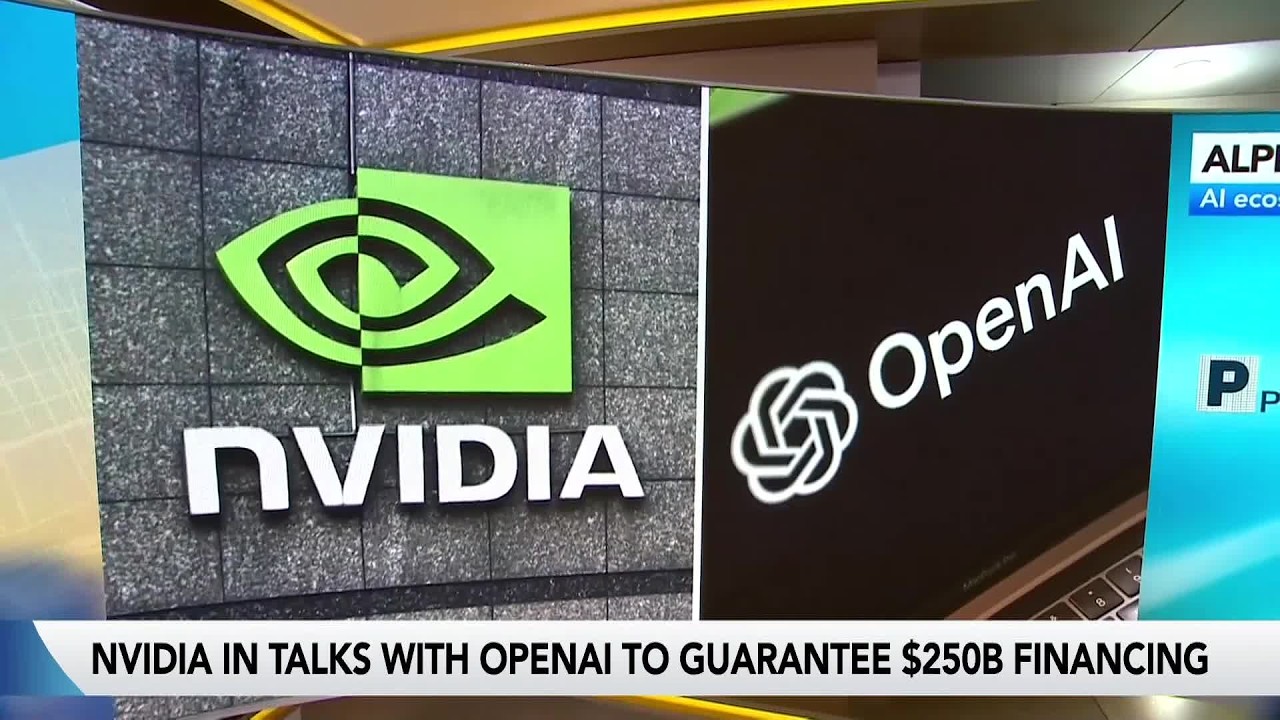
- OpenAI lease backstop. Nvidia is in discussions to guarantee as much as $250 billion to help OpenAI lease a proposed $500 billion, 10-gigawatt data center hub being developed in southern Ohio by SB Energy, a SoftBank Group subsidiary, on the site of a decommissioned uranium-enrichment facility roughly 50 miles south of Columbus.
- OpenAI chip financing. A separate, parallel discussion under which Nvidia would help finance approximately $350 billion of OpenAI’s purchases of Nvidia processors for the same project.
- Naver. A $1 billion investment in the South Korean internet and cloud company to support an AI data center being developed with Brookfield. Naver shares rose more than 8% in Seoul on the announcement.
- Safe Superintelligence. A $5 billion investment in Ilya Sutskever’s research company, announced July 27, which also gives SSI access to Nvidia’s Vera Rubin platform.
Bloomberg’s reporting is explicit that the OpenAI negotiations are preliminary and could change or collapse. That qualification matters and was widely dropped in secondary coverage.
Why “circular” is the word investors reached for
The structural objection is easy to state. Nvidia sells accelerators. OpenAI buys accelerators. SoftBank builds the buildings the accelerators sit in. If Nvidia guarantees the lease OpenAI signs with SoftBank, and separately finances OpenAI’s purchase of Nvidia chips, then Nvidia is on both sides of a large share of its own revenue growth. Nvidia also holds an equity stake in OpenAI. Money leaves Nvidia’s balance sheet, travels through a data center developer and a model company, and returns as revenue.
Jensen Huang has rejected the characterization, arguing that Nvidia’s investments represent only a small portion of the money its customers ultimately need to raise. That defense has force. If OpenAI must raise, say, $500 billion for a project and Nvidia guarantees $250 billion of a lease, the remaining capital still has to come from third parties who are making an independent judgment about the economics. A backstop is not the same as a purchase.
The counterargument is about marginal pricing rather than totals. In a market where the incremental buyer sets the clearing price, a guarantee from the equipment vendor lowers the cost of capital for a project that might otherwise not clear. That does not make the demand fake. It does mean the observed demand is partly a function of vendor credit rather than purely of end-user economics, and it means the vendor’s balance sheet absorbs risk that would otherwise sit with lenders.
An Asian equities reporter on Bloomberg Television described the flow on Tuesday morning in Hong Kong: Nvidia money accelerating a buildout in Ohio, the capacity leased to OpenAI, in which Nvidia holds a stake, and OpenAI remaining one of Nvidia’s largest customers. “So that money really goes around,” she said. “It is becoming more concerning, because it is inflating demand and potentially poses more of a risk.”
The Credit Market Got There First
For most of the past two years the AI trade was an equity story. In July 2026 it became a credit story, and the credit market’s verdict has been considerably less enthusiastic than the equity market’s.
On July 27, the annual cost of protecting Nvidia’s debt against default rose by as much as roughly 0.14 percentage point to around 0.82 percentage point, according to Bloomberg. In market shorthand, Nvidia’s five-year credit default swap spread widened about 14 basis points to roughly 82 basis points. Secondary market coverage described it as the largest single-day move since the contract began trading in late 2025, a characterization we have not independently verified.
A basis point is one hundredth of a percentage point. A CDS spread of 82 basis points means it costs about $82,000 a year to insure $10 million of Nvidia debt against default for five years. In absolute terms that is still a very safe credit. Investment-grade industrials routinely trade wider. The signal is not the level. It is the direction and the speed.
Nvidia is a highly rated investment-grade issuer and generates substantial free cash flow. Nobody serious is arguing that the company is at risk of default. What CDS is pricing is something narrower and more useful: the market’s assessment of how much balance-sheet risk Nvidia is absorbing on behalf of its customers, and how quickly that exposure is growing.
The issuance wave
The context for the CDS move is a corporate bond supply shock. Amazon, Alphabet, Nvidia, Meta, Oracle and SpaceX have collectively issued approximately $182 billion of investment-grade bonds in 2026, an increase of roughly 1,300% year over year, accounting for something like 15% of total U.S. investment-grade corporate issuance.
A guest on Bloomberg Television on Tuesday, the global head of securitized products and asset-based finance at a large asset manager, gave the scale of the shift in historical terms. Hyperscalers as a group had never issued more than about $50 billion of investment-grade debt in a year until 2025. This year the projection is around $250 billion. “This financing is pervading all markets,” she said. “As we crowd out other types of debt, it impacts spreads across corporate markets.”
Crowding out is a real mechanism, and it is worth being precise about what it does and does not mean. It does not mean the money is unavailable. It means that a fixed pool of investment-grade demand is being asked to absorb a very large amount of new paper concentrated in a handful of correlated names, which pushes spreads wider across the whole index and makes the marginal borrower pay more. That is a repricing, not a funding crisis.
The credit strategist on the same broadcast made a related observation about market plumbing: dealer inventory has not moved much despite the issuance, which implies that real-money credit investors are still absorbing the supply rather than dealers warehousing it. That is a sign of demand, not distress.
Where the strain is showing
The strain is concentrated, not systemic. Oracle was downgraded by S&P Global Ratings to BBB−, the lowest investment-grade rung, with its CDS widening to around 215 basis points. SoftBank’s CDS has been elevated for some time, and its bonds trade with wide intraday and intra-week ranges that reflect thin two-way liquidity as much as credit deterioration.
A credit portfolio manager speaking from Hong Kong on Tuesday made a point about the liquidity dimension that gets lost in spread charts. SoftBank has a large, well-known bond curve. When dealers pull back, bid-ask widens, and investors who want out find that exiting costs more than the spread move alone suggests. The volatility that results attracts short sellers using the bonds as a beta expression, which amplifies the move again. In Asian credit, she argued, SoftBank paper has become the primary vehicle for expressing a view on the AI trade in either direction.
Outside that cluster, the credit universe is calm. As one Bloomberg strategist put it on air, this is a sector-specific dynamic, and the rest of the credit market is relaxed. Emerging market and Asian corporate credit is seeing more upgrades than downgrades, and corporate balance sheets outside the AI complex are not showing stress.
The transmission mechanism worth watching
The reason credit matters for equity investors here is a specific feedback loop, and it is the most analytically interesting thing to come out of Tuesday’s session.
If the cost of financing AI infrastructure rises at the margin, and there is a large debt capital markets backlog scheduled for the back half of 2026, then the pricing of those deals comes into question. If deals price wider or get pulled, planned capital expenditure gets trimmed. If capital expenditure gets trimmed, demand for semiconductor equipment, GPUs, CPUs and memory falls. That flows straight back into the equity side.
Put simply: for two years, cheap credit validated aggressive equity valuations in semiconductors. The correlation is now capable of running the other way. A Bloomberg strategist framed the open question for the second half of 2026 as whether money continues to flow from fixed income into equities on the AI semiconductor trade, or whether the direction reverses.
The DUV report is relevant to that loop in an indirect but important way. Until July, demand for AI compute was not seriously questioned; the debate was about supply, power and timing. What the combination of Chinese lithography progress and cheap, capable Chinese open-weight models does is introduce a demand question. A Bloomberg strategist put it directly on Tuesday: Nvidia’s credit had traded relaxed for a long time because demand was not in question, and “right now you are getting demand becoming a question in the market because of the rise of Chinese LLMs.”
The Demand-Side Shock Nobody Priced
The lithography story is about supply. The story running alongside it is about demand, and it may matter more.
On July 26, 2026, Moonshot AI released the weights for Kimi K3 for free public download, a day ahead of its own announced schedule. The model has 2.8 trillion parameters and a context window of 1,048,576 tokens. The weights run to roughly 594 gigabytes in native MXFP4 format, and up to about 1.4 terabytes depending on quantization. They are hosted on Hugging Face under a modified MIT license, self-hostable without restriction. It is the largest open-weight model publicly available. Together AI and Modal shipped day-zero hosting.
Kimi K3 had already caused a stir before the weights dropped by outperforming Anthropic’s Fable 5 and OpenAI’s GPT-5.6 Sol on coding benchmarks. Releasing the weights turned a benchmark result into an economic fact: any developer anywhere can now run a frontier-adjacent model on their own hardware at the cost of electricity.
Follow that through to the semiconductor demand curve and you get an ambiguous answer, which is precisely why it unsettles markets. On one hand, cheap capable models expand usage and could increase aggregate inference demand. On the other, a model that runs efficiently on commodity infrastructure erodes the pricing power of closed-model providers, and it is those providers’ revenue expectations that justify the largest data center commitments.
An analyst on Bloomberg Television connected the threads explicitly on Tuesday, arguing that China is affecting both supply and demand at once: adding capacity for commodity components while simultaneously pressuring compute demand through more efficient labs. That is a genuinely new configuration. For most of the AI boom, the bear case required believing that either demand would disappoint or supply would arrive. Now both arguments are live at the same time.
Washington’s Open-Weight Fight, and Why It Belongs in a Markets Story
The policy argument that broke out in Washington the same week is usually filed under technology politics. It belongs in a markets story because it determines whether the demand-side shock described above is something U.S. companies can use or something they are forbidden to touch.
On Wednesday, July 22, the newly formed Little Tech Association sent letters to President Trump, Commerce Secretary Howard Lutnick and White House Office of Science and Technology Policy director Michael Kratsios, signed by nearly 200 venture-backed startups. Signatories include Y Combinator and the privacy company Proton. Politico reported the letters first. The ask was that the administration not restrict American access to Chinese open-weight models, and instead use targeted safeguards.
The association’s executive director, Harry Godfrey, described the position as wanting “a scalpel rather than a sledgehammer”: the lightest intervention that addresses genuine security concerns without raising costs or blocking access. Suhail Doshi, founder of the startup Particle and an association member, was blunter about the commercial stakes: “There’ll be hundreds of companies that instantly die. It’s great for Anthropic. We’re all going to have to spend money on Anthropic.”
Appearing on Bloomberg Television from Washington on July 28, Godfrey said the association represents roughly 200 startups, digital innovators and investors, that the letter had been received and that a dialogue was under way. He made three substantive arguments worth separating from the advocacy.
The first was that the geographic framing is misleading. Once weights are published, a model is downloaded and run locally; the nationality of the lab that trained it does not travel with the file. If Chinese labs stopped releasing models tomorrow, he argued, the open-weight models already in circulation would remain available and in use.
The second was a security argument that runs opposite to intuition. Godfrey said the ability to inspect an open model, deconstruct it, strip out identified risks and host it on a local server behind an organization’s own perimeter is precisely why regulated sectors want open weights. He cited rural hospitals handling sensitive patient data and defense suppliers as examples of users who would rather keep inference inside their own fence line than send data to a closed model hosted elsewhere.
The third was a competition argument: that American leadership depends on out-innovating rivals, that out-innovating requires real competitive pressure, and that pressure requires both open and closed models remaining available.
On distillation, the practice at the center of the U.S. government’s complaints, Godfrey was more careful than the advocacy framing suggests. Intellectual property theft is a serious issue for large and small companies alike, he said, and where there is a serious allegation it should be thoroughly investigated and adjudicated on the evidence. He also cautioned against an overreaction disproportionate to what has actually been established.
Anthropic’s response, and what it changes
On July 27, Anthropic chief executive Dario Amodei published a post titled “Our position on open-weights models” that directly addressed the accusation that his company had been lobbying for a ban.
“Anthropic has never advocated for a ban on open-weights models,” he wrote. Open-weight models without dangerous capabilities are “a public good,” he added, because they cost nothing beyond the compute to run them and provide value to businesses, developers and researchers.
Amodei set out two concerns he does hold. The first is that authoritarian governments build models more powerful than those built in the United States and use them for military advantage or domestic repression, a risk he argued is unaffected by whether models are open or closed. The second is misuse of powerful models for cyber or biological attacks, where he acknowledged open weights present a higher risk because guardrails cannot be applied or withdrawn after release, while arguing that banning U.S. business use does nothing to address it because “bad actors are unlikely to be legitimate US businesses.”
His prescription was three specific measures: not selling advanced chips or chipmaking equipment to China and cracking down on smuggling; targeting industrial-scale distillation operations; and mandatory pre-release safety testing for all sufficiently capable models, open and closed, with less capable models from startups and academia exempt.
Amodei also engaged directly with the industry open letter circulated by Nvidia and signed by a range of companies. He agreed that open weights expand access to the AI economy, strengthen competition in some use cases and give customers greater control. He disagreed with the letter’s claims that open weights necessarily make safeguards easier to develop or that broad capability access helps defenders more than attackers, arguing those are empirical questions for pre-release testing rather than assumptions.
The chip-control plank of Amodei’s position is the direct link back to lithography. His argument that China “cannot build more powerful models than the US without US chips” rests on China’s limited domestic production capacity. A credible domestic immersion DUV program is, over time, an argument that the constraint loosens.
Fact Box
Open-weight policy: where things stand, July 28, 2026
- July 22: Little Tech Association letters to President Trump, Commerce Secretary Lutnick and OSTP director Kratsios, signed by nearly 200 startups.
- Industry letter: An open letter supporting open-weight models circulated with backing from Nvidia and other technology companies.
- July 26: Moonshot AI publishes Kimi K3 weights for free download under a modified MIT license.
- July 27: Anthropic CEO Dario Amodei states that the company “has never advocated for a ban on open-weights models” and calls such models without dangerous capabilities “a public good.”
- Status: No ban has been proposed in rule or statute. A White House official has characterized reports of one as “baseless speculation.”
Original source: Anthropic, “Our position on open-weights models,” July 27, 2026
How Far Behind Is China, Really?
This is the question the market attempted to answer in a single session, and it deserves a more careful treatment than the price action gave it.
The estimates in circulation vary widely, which is itself informative.
Sell-side analysts covering ASML have generally put the gap at seven to ten years before Chinese tools match what ASML can do. That range circulated widely on Tuesday and formed the basis of the “market is getting ahead of itself” argument. Independent analysis from the AI Futures Project, published in June 2026, was more conservative still, placing commercial-scale Chinese immersion DUV in the mid-2030s and noting that ASML holds 98.7% of the immersion market.
A Bloomberg Intelligence analyst offered a useful decomposition on Tuesday. Rather than treating “semiconductor equipment localization” as one number, he split it by tool type. His estimate was that China’s overall localization ratio for semiconductor equipment was roughly 22% in 2025 and could reach something like 37% by 2030. But the dispersion inside that average is enormous: some categories were already near 47% localized in 2025 and could reach 76% by 2030, while lithography, process control and inspection tools are expected to make much slower progress. Etch and deposition are relatively tractable. Lithography and metrology are not.
He also noted that a DUV tool can address a range from roughly 45 nanometers down to something like 7.5 nanometers depending on configuration, and that the reports do not establish where in that range the Chinese machines sit, nor whether they are prototypes or production units.
TrendForce made the argument that is probably the most important one, and it is not about the machine at all. ASML’s leadership, in its view, is built less on specifications than on an ecosystem developed over decades: computational lithography software, resists, masks, metrology, process integration support and service. It cited TSMC chairman and chief executive C.C. Wei’s line that semiconductor manufacturing is “not like buying milk at a convenience store.” As an illustration of the lag between capability and adoption, TrendForce pointed out that ASML delivered its first low-NA EUV prototypes to key customers including TSMC as early as 2007 and 2008, but TSMC did not use EUV in mass production until 2018, at the 7-nanometer node.
Eleven years elapsed between prototype delivery and production use, at the world’s most capable foundry, with the vendor’s full cooperation. Chinese fabs will move faster than that because they have no alternative and because state support removes the commercial hurdle. But qualifying a new lithography tool on a production line is a matter of many months at minimum, and the first units of any scanner platform are not the ones that make money.
TrendForce’s own conclusion is worth quoting in substance: for China, mass-producing lithography machines is ultimately a matter of time, capital and resource commitment. The harder question comes afterward. How quickly can the systems be commercialized, how cost-competitive are they, and can the chips they produce compete on performance, power efficiency and die area?
The Legislative Backdrop: HR 8170 and the MATCH Act
Export controls on China’s semiconductor industry have been administered largely through Commerce Department discretion since 2018. Entity List designations, license requirements and country-wide rules have been layered on top of one another, adjusted case by case, and occasionally loosened for commercial reasons. Two bills now moving through Congress would change that architecture.
House Resolution 8170 would designate SMIC, Hua Hong Semiconductor, CXMT, Huawei and YMTC as restricted entities in statute rather than by administrative action. Writing designations into law removes the executive branch’s ability to grant relief without going back to Congress.
The MATCH Act, introduced in April 2026, was reported out of the House Foreign Affairs Committee on April 22 and has a Senate companion filed as S. 4281. It would strip Commerce of discretion over specified chip export decisions. Its immersion DUV provisions extend to servicing and technical assistance, not merely new equipment sales.
That last point is the one with commercial teeth. Under current rules, ASML cannot sell its most advanced immersion tools into China but continues to service a substantial installed base there. Chinese fabs have spent two years squeezing additional capability out of those older tools through upgrades and secondary-market components. Cutting off servicing would degrade that fleet over time and give Chinese fabs an immediate operational reason to qualify a domestic replacement, whatever its specifications.
Three of the five entities named in HR 8170 are the reported first customers for the domestic scanner. That is not a coincidence so much as a demonstration that both governments are optimizing against the same list.
For ASML shareholders, the legislative risk and the competitive risk point in the same direction but arrive on different schedules. Competitive erosion, on the most aggressive published estimates, is a five-to-ten-year problem. A statutory servicing ban could take effect within a year of enactment. The market on July 27 and 28 was pricing the competitive story. The legislative story received almost no attention.
China’s Ministry of Commerce, for its part, has pushed back against potential new U.S. sanctions and characterized American allegations of intellectual property theft as a smear campaign.
Who Actually Gets Hurt: Reading the Selloff by Position in the Supply Chain
The most revealing feature of Tuesday’s trading was which stocks fell hardest, because the pattern does not match a simple “China threatens ASML” narrative.
Semiconductor equipment names fell, as expected: ASML in Amsterdam, Advantest and Tokyo Electron in Tokyo, each down roughly 11%. Nikon, one of the two Japanese lithography companies that historically competed with ASML, was singled out on Bloomberg Television as a notable mover.
But the damage ran well past the equipment makers. Memory producers fell harder than equipment makers. SK Hynix dropped 14.7%, Samsung 13.4%, Kioxia 18%. Packaging and component suppliers fell. And, in what one analyst called the biggest surprise of the day, Chinese domestic chip ecosystem names also got hit, which is difficult to reconcile with the story that China had just achieved a strategic breakthrough.
The explanation offered on air was a reframing rather than a revaluation. Many of these names, the argument went, have been priced as structural growth stories: companies whose earnings would compound because AI demand was open-ended and supply was constrained. If China can pump volume into commodity chips using a larger domestic DUV fleet from 2027 onward, then a whole tier of components reverts to being cyclical, priced the way capacitors, passives and motors were priced in the smartphone and laptop eras.
That is a multiple story, not an earnings story, and multiple stories reprice instantly. It also explains why the least differentiated products were hit hardest and why more differentiated products, high-end GPUs and CPUs, held up comparatively better. The same analyst argued that differentiated silicon should ultimately separate from the pack, while China pressures demand for commodity compute through more efficient labs.
The rotation that was already under way
One detail from the U.S. session on July 27 deserves more attention than it received. While semiconductor stocks were falling, Apple, Amazon, Microsoft and Oracle traded up. The consumers of AI chips outperformed the producers of AI chips on the same day.
That is not noise. If the market genuinely believes AI compute is about to get cheaper and more abundant, the logical trade is short the toll-taker and long the toll-payer. A Bloomberg strategist flagged exactly this on Tuesday as a possible new dynamic for the second half of 2026: the buyers of chips may start to benefit from precisely the developments that hurt the sellers.
Whether that rotation persists is the single most testable claim to come out of this week. It has a clear falsification: if hyperscaler capital expenditure guidance in the coming earnings season comes down, the toll-payers do not benefit, because the reason compute got cheaper was that nobody wanted it.
Positioning: The Part of the Story That Isn’t About China at All
A 10.8% index move requires a mechanical explanation as well as a narrative one, and the mechanical explanation is deleveraging.
The Asia equity strategist who appeared on Bloomberg Television on Tuesday morning described the framework his team uses to judge how far a deleveraging has run: how much leverage is in the system, what kind of outflows are occurring, whether margin calls are being triggered, and whether outflows have moved from index products into single stocks. Single-stock outflows, he said, were now visible, and his assessment was that the process was “well advanced.”
He also drew a distinction that has been getting lost. There are two Korean equity markets. One is semiconductors, where deleveraging is under way and caution is warranted. The other is everything else, trading at low valuations against a backdrop of corporate governance reform. Investors focused entirely on the first, he argued, are missing the second.
His preferred expression across Asia was diversification away from concentration: a call on Japan, where the Topix offers broad sector representation including well-represented banks and financials rather than returns dominated by three names, and where the earnings outlook is improving. His characterization was memorable in its precision: bearish on the market, bullish on earnings.
On the crowded-trade point, the Japanese semiconductor complex offers the sharpest illustration. One name discussed on Tuesday’s broadcast was down roughly 18% on the day and had fallen substantially from a peak set only weeks earlier. Crowded trades unwind faster than they build, and Japan’s chip equipment names had become among the most crowded positions in Asia.
Korean retail investors, meanwhile, had bought heavily from foreign sellers in the preceding period and were sitting on immediate double-digit losses. The strategist’s open question was how much pain global retail can absorb before capitulating, and whether that capitulation has happened yet.
Where the index actually sits now
The Kospi peaked in June 2026 and had at one stage been the best-performing major equity market in the world for the year. By Tuesday’s close it had fallen roughly a third from that peak, dropping it out of the top spot and, on the day’s numbers, to around fifth globally. Taiwan was close behind and, on Bloomberg Television’s arithmetic, would overtake Korea as Asia’s best performer if the losses continued.
Samsung and SK Hynix have each fallen close to 50% from all-time highs set the previous month. Both are still up substantially for 2026. Both are about to report the best quarterly results in their histories. That combination, record earnings and a halved share price inside six weeks, is the clearest possible statement that the market is not arguing about this quarter.
The MSCI Asia Pacific index fell about 3% on Tuesday. On figures cited by Bloomberg Television during the session, that took the benchmark to roughly 10% below the peak it set on June 22, the threshold conventionally described as a technical correction on a region-wide basis.
The Macro Overlay: Oil, Iran and a Fed Meeting That Could Go Either Way
Two macro stories ran underneath the chip selloff, and both were pulling in the opposite direction from the equity market’s mood.
The first was the Middle East. The United States and Iran paused reciprocal strikes for a third day, and President Trump said aboard Air Force One that there was “a good chance that something could happen,” adding, “I have a lot of patience. We’ll see what happens.” Oman and Iran were reported to be working toward an agreement to restart shipping through the Strait of Hormuz, through which roughly a fifth of global oil and liquefied natural gas normally passes. The war began in late February following a breakdown in diplomacy over Tehran’s blockade of the strait.
Crude fell hard on the news. Brent lost more than 8% on Monday and West Texas Intermediate more than 7%. Both fell more than 1% again in Asian trading on Tuesday, with WTI at $81.15 a barrel and Brent at $86.89 around 03:30 GMT.
On any normal day, an 8% drop in oil driven by de-escalation of a shooting war in the Gulf would be the lead story and equities would rally. Instead it was buried. That tells you how completely the AI complex has come to dominate global equity risk appetite.
The second macro story was the Federal Open Market Committee, which began a two-day meeting on July 28 with a decision due July 29. The federal funds target range stands at 3.50% to 3.75%. Consensus expects no change, but the distribution is unusually wide for a July meeting: market-implied probability of a 25 basis point hike has been running somewhere between roughly 25% and 38% depending on the day and the measure, having climbed sharply as oil prices spiked earlier in the month.
Under chair Kevin Warsh, the committee has adopted a more hawkish posture. The median year-end 2026 federal funds rate projection was revised up to 3.8% from 3.4% in the March projections, with nine of eighteen participants expecting at least one hike this year. This meeting does not include an updated Summary of Economic Projections, so there will be no dot plot to parse.
A credit investor interviewed on Bloomberg Television on Tuesday said she regarded a hike as overpriced and expected a hawkish pause with dissent, while acknowledging the case on the other side: oil climbing back up, crack spreads pointing to higher fuel prices, and an argument for a preemptive move. She was skeptical of the Fed-credibility rationale for hiking, noting that the dollar index remains relatively high, which does not suggest a credibility problem. Her view was that if Warsh does not move in July, September comes very much into play, and the debate shifts from when to how many.
On communication style, she characterized Warsh’s approach as “Greenspan 2.0”: keeping the market guessing, which maximizes flexibility and gives each utterance more signal value, at the cost of transparency. What she wanted from this meeting was at minimum a characterization of the internal debate, so that observers understand what the committee is watching without being handed a predetermined path.
The AI question intersects monetary policy through productivity. Warsh has spoken about AI’s potential productivity effects. If AI genuinely raises productivity, it is disinflationary through the supply side over the medium term, which would argue for patience. The same investor noted the difficulty: there is evidence of widespread AI adoption across industries, but the productivity gain has not yet shown up in the data, and the Fed has to decide how long to wait for it. That is the same unresolved question equity investors are asking, arriving at a different institution.
The Case That the Selloff Was Overdone
Set out fairly, the argument that Tuesday was an overreaction rests on five points.
The reported volumes are small. Five machines in 2026 and 20 in 2027, against ASML immersion capacity of roughly 130 this year and approximately 170 planned for next. Even flawless execution leaves China with a scanner fleet that is a rounding error against global installed capacity within the forecast horizon.
The specifications are unknown. No public information establishes the resolution, overlay, throughput or availability of these tools. A machine that prints 45-nanometer features is a different commercial proposition from one that prints 7.5-nanometer features, and nothing in the reporting distinguishes between them. Bloomberg Intelligence’s analyst said plainly that the industry still regards the reported units as prototypes.
Qualification takes time. Introducing a new lithography platform into a running fab requires months of process development, recipe transfer and yield learning. TSMC’s eleven-year gap between EUV prototype delivery and production adoption is the extreme case, but even compressed timelines are measured in quarters, not weeks.
ASML’s demand is not China-dependent. China is around 20% of 2026 net sales and 14% of second-quarter system sales, both trending down, while the company raised full-year guidance twice this year on AI-driven demand from customers outside China and is expanding both EUV and immersion capacity by 30% for 2027.
The near-term fundamentals are intact. As Stephen Innes of SPI Asset Management wrote on Tuesday, “The immediate fundamentals of semiconductors have not collapsed. Demand for high-bandwidth memory remains strong, hyperscalers are still spending, and the largest technology companies have not yet abandoned their capital expenditure plans.”
Jing Jie Yu, an equity analyst at Morningstar, offered a similar read, saying the market “was likely spooked by the progress of China’s chipmaking equipment capabilities, and was worried that this progress would threaten the competitive position of global chipmaking and chip equipment leaders,” while adding that the selloff appeared to be largely a knee-jerk reaction and overdone, with the dominant position of global chipmaking leaders unlikely to be threatened meaningfully.
The Case That the Selloff Was Rational
The opposite argument is not that China has caught up. It is that a specific assumption embedded in valuations has been falsified.
The monopoly assumption was doing real work. Until Monday, most models of ASML and the equipment complex assumed that Chinese immersion lithography was a research program with an indefinite timeline. Under that assumption, the terminal value of ASML’s DUV franchise is large and the probability of competitive entry is close to zero. What changed is not the size of the near-term threat but the existence of a credible starting point from which a gap can close. A monopoly with a defined competitor on a timeline is worth less than a monopoly without one, even if the competitor is a decade behind.
Innes described the mechanism precisely. “What has changed is the market’s willingness to capitalise those promises at almost any price. The AI trade spent the past several years behaving like a flywheel: rising equity values encouraged more spending, more spending validated higher earnings expectations, and those expectations pushed valuations higher again. Now that same wheel is beginning to throw investors off at speed.”
Memory margins near 80% invite competition by construction. Peak-cycle margins are self-correcting. Anything that credibly accelerates Chinese DRAM capacity accelerates the correction. CXMT held 7.6% DRAM market share in the first quarter of 2026 and has just raised $8.6 billion. The equipment story and the capacity story are the same story.
The financing question is independent and real. Nvidia’s CDS did not widen because of Chinese lithography. It widened because Nvidia is extending credit and guarantees to its own customers at very large scale. Even if the China story is entirely wrong, the circular financing question stands on its own, and it is the question the credit market has been asking since before this week.
Positioning was the accelerant, and positioning is a fact. Retail leverage in Korea, crowded semiconductor trades in Japan, and index concentration in both markets are structural features that existed independently of the news. Any catalyst was going to produce an outsized move. This one happened to arrive first.
Timeline: How the Week Built
The July 27 report was the trigger, but the pressure had been accumulating for weeks. The chronology below separates what happened from when it was reported.
- September 2025: SMIC begins testing a Shanghai Yuliangsheng immersion DUV lithography system, per the Financial Times. This is the earliest public marker of the program that produced this week’s news.
- December 2025: Reuters reports that China has built a domestic extreme ultraviolet prototype, assembled in part from older ASML components, with production chips targeted for 2028.
- April 2026: The MATCH Act is introduced in Congress and reported out of the House Foreign Affairs Committee on April 22. A Senate companion is filed as S. 4281.
- June 2026: The Kospi sets its record high. SK Hynix overtakes Samsung Electronics as the most valuable company on the index for the first time, closing at 2,919,000 won on June 22. The AI Futures Project publishes analysis placing commercial-scale Chinese immersion DUV in the mid-2030s.
- July 15, 2026: ASML reports second-quarter results, beats guidance, and raises its full-year outlook for the second time in 2026. China falls to 14% of second-quarter net system sales from 19% in the first quarter.
- Mid-July 2026: Korea’s Financial Services Commission bans new single-stock leveraged ETF listings and triples the minimum cash deposit to 30 million won, effective early August.
- July 22, 2026: The Little Tech Association sends letters signed by nearly 200 startups to President Trump, Commerce Secretary Lutnick and OSTP director Kratsios opposing restrictions on Chinese open-weight models. Politico reports the letters first.
- July 26, 2026: Moonshot AI publishes the Kimi K3 weights for free public download, a day early.
- July 27, 2026, morning Europe: The Information publishes its report on Chinese immersion DUV mass production. ASML falls as much as 6.5% in Amsterdam.
- July 27, 2026, Shanghai: CXMT debuts on the STAR Market, rising as much as 471.6% intraday to a market capitalization of roughly $487 billion.
- July 27, 2026, U.S. hours: Bloomberg reports Nvidia is pursuing more than $750 billion of new and potential AI deals. Nvidia’s five-year CDS widens roughly 14 basis points to about 82. Nvidia closes down 4.99% at $196.51. Nvidia separately announces a $5 billion investment in Safe Superintelligence.
- July 27, 2026, evening: Anthropic CEO Dario Amodei publishes “Our position on open-weights models.”
- July 28, 2026, Asia: The Kospi falls 10.8% to 6,023.66, triggering a circuit breaker. Nikkei 225 falls 4.0%, Taiex 4.7%. The FSC signals possible per-investor caps on leveraged ETFs. The FOMC begins its two-day meeting.
Historical Comparisons, and Where They Break Down
Analogies are being reached for aggressively this week. Two are useful. One is misleading.
The DeepSeek moment, January 2025
The closest structural precedent is DeepSeek’s R1 release in January 2025, which triggered a sharp single-day selloff in AI infrastructure names on the argument that Chinese labs could achieve frontier-adjacent performance at a fraction of the training cost. The parallel is close: a Chinese capability announcement, a rapid repricing of American infrastructure assets, and a subsequent debate about whether the news changed the demand curve or merely the sentiment.
What happened afterward is instructive in both directions. AI infrastructure spending did not fall; it accelerated through 2025 and into 2026. But the specific claim that efficiency gains would reduce compute demand was never really tested, because demand grew faster than efficiency improved. The Jevons paradox argument, that cheaper compute increases total compute consumption, won that round.
The difference this time is that the supply side is also involved. DeepSeek was purely a demand-side argument about how much compute a given capability requires. The DUV report is a supply-side argument about who can build the compute. Those compound rather than offset.
Huawei and the 2019 entity listing
The second useful comparison is what happened after Huawei was placed on the Entity List in 2019. The consensus expectation was that Huawei’s handset and networking businesses would be crippled. The handset business was, for a period. What was not expected was the intensity of the domestic substitution effort that followed, culminating in the Kirin 9000s built on SMIC’s 7-nanometer process in 2023, a chip that was not supposed to be manufacturable under the controls in force.
The lesson from that episode is not that export controls fail. It is that they impose costs and buy time rather than establishing permanent barriers, and that the response function is faster and better funded than Western forecasters typically model. Anyone modeling a ten-year Chinese lithography timeline should adjust for the possibility that the estimate is systematically optimistic, in the same way that pre-2023 estimates of Chinese 7-nanometer capability were.
The comparison that does not work: the 2000 telecom bust
The dot-com and telecom capital expenditure bust is being invoked frequently, and the fit is poor. The fibre buildout of 1999 and 2000 was financed heavily by vendor financing to customers with no revenue, in an environment where capacity utilization on completed networks was in the low single digits. Today’s hyperscalers are among the most profitable companies in history, generating substantial operating cash flow, and their data centers are running at high utilization with waiting lists for capacity.
The legitimate point of contact is narrower and worth stating precisely: vendor financing. Lucent’s customer financing to competitive local exchange carriers is the historical analogue to Nvidia guaranteeing OpenAI’s lease. That is a real parallel, and it is the reason the credit market is paying attention. But the parallel applies to one financing structure, not to the industry’s underlying economics.
The Risks Worth Tracking
Rather than a comprehensive risk-factor recitation, here are the exposures that would actually change the analysis, roughly in order of how quickly they could bite.
Memory pricing. The single most important variable for Korean and Japanese equities. DRAM and NAND contract prices have driven record profits. Any evidence of contract price rollover, from CXMT capacity additions, from demand normalization, or from customers working down inventory, would validate the market’s decision to derate. Watch contract prices, not spot.
Hyperscaler capital expenditure guidance. Microsoft, Meta, Apple and Amazon report this week. Guidance on 2027 capital spending is the highest-information data point available in the near term. A cut would confirm the bear case on demand. An increase would leave the AI infrastructure complex looking oversold.
Credit spreads in the AI cluster. If Nvidia’s CDS keeps widening and issuance in the back half of 2026 prices materially wider, the financing cost of the buildout rises and capital expenditure plans come under pressure regardless of demand. This is the transmission channel that turns a sentiment problem into an earnings problem.
Legislative action on servicing. Enactment of the MATCH Act with its servicing provisions intact would create an immediate, quantifiable revenue impairment for ASML’s Installed Base Management line in China, on a much faster timeline than competitive displacement.
Verification of the DUV claims. Independent confirmation of the manufacturer’s identity, tool specifications, or a customer qualification would move this from a single-sourced report to an established fact. So would a credible denial. Either would be material.
Korean retail deleveraging. If the FSC imposes per-investor caps while the market is falling, forced selling and reduced liquidity can extend the decline beyond what fundamentals justify. Thin volume cuts both ways, and Tuesday’s volumes were reportedly running about 40% below normal.
Concentration risk in unexpected places. One of the more thoughtful observations from Tuesday’s programming came from a securitized credit manager, who pointed out that AI exposure now arrives through channels most risk systems were not built to aggregate: investment-grade bonds, commercial real estate lending, project and infrastructure finance, GPU-backed lending, and tenancy in buildings. Being able to see total exposure to a single name across all those wrappers is, she argued, one of the new challenges for risk managers. That is a plumbing problem that only becomes visible under stress.
Data center asset life. The same manager raised a question that deserves more attention than it gets: is it appropriate to finance a data center over ten years when it might be functionally obsolete in five? Financing tenor mismatched to asset life is one of the more reliable precursors of credit trouble, and it applies to GPU-backed lending with even more force than to buildings.
The Companies at the Center of This
Five organizations do most of the work in this story, and their positions are easy to confuse.
ASML Holding NV
Headquartered in Veldhoven, the Netherlands, with more than 44,500 full-time employees, ASML supplies the lithography systems on which essentially all advanced semiconductor manufacturing depends. It is listed on Euronext Amsterdam and Nasdaq under the symbol ASML and reports under U.S. GAAP.
Its business has three layers that behave differently. New system sales are lumpy, order-driven and highly visible. Used system sales are small. Installed Base Management, covering service and field options, is recurring, high-margin and tied to the installed fleet rather than to new orders; it was €2,762 million in the second quarter of 2026, roughly 30% of revenue, and was the reason the quarter beat guidance.
ASML holds a monopoly in EUV and something close to one in immersion DUV, where independent analysis has put its share at 98.7%. It also sells metrology and inspection tools and computational lithography software. The company will update its longer-term outlook at a Capital Markets Day scheduled for June 10, 2027.
Shanghai Yuliangsheng Technology
A state-backed lithography startup, identified in secondary coverage as a participant in the domestic immersion program and named directly by Agence France-Presse as the manufacturer, though not by The Information. SMIC has been testing a Yuliangsheng immersion tool since September 2025. Yuliangsheng did not respond to AFP’s request for comment, nor did SiCarrier or Huawei, two companies described as having ties to the group.
Some secondary coverage has identified Shanghai Aishengna Electronic Technology Group as the state-owned entity leading production after absorbing teams from several Chinese lithography startups. That identification has not been confirmed by the original reporting, and readers should treat the manufacturer’s identity as unresolved.
SMIC
Semiconductor Manufacturing International Corporation is China’s largest foundry and the most technically advanced. It reached 7-nanometer-class production without EUV using DUV multipatterning, and analysis of its third-generation 7-nanometer node has shown a smaller metal pitch than Intel 18A and higher transistor density than TSMC’s N6. It is named in HR 8170 as a restricted entity and is a reported first customer for the domestic scanner.
Hua Hong Semiconductor
China’s second-largest foundry, historically focused on mature and specialty nodes. Also named in HR 8170 and a reported first customer.
ChangXin Memory Technologies
China’s leading DRAM producer, now publicly listed after the largest IPO in STAR Market history. It ranked fourth globally in DRAM revenue in the first quarter of 2026 with 7.6% share, has been transitioning to its G4 process, and has shifted its product mix away from mobile DRAM toward server DRAM as smartphone shipments weakened. Its IPO prospectus guides to first-half 2026 net profit of 50 billion to 57 billion yuan. It is named in HR 8170, is a reported first customer for the domestic scanner, and signed a five-year, $7 billion-plus supply agreement with ByteDance in July.
The through-line is that the same three companies appear on the U.S. restricted list and on the delivery schedule for the domestic tool. Export controls created a captive customer base for a domestic lithography industry that would otherwise have struggled to find buyers willing to accept a less capable machine.
Why Lithography Is Structurally Hard to Enter
Semiconductor equipment is not a monolithic industry, and understanding why lithography is different from etch or deposition explains most of the disagreement about timelines.
An etch tool removes material. A deposition tool adds it. Both involve difficult chemistry and precision engineering, and Chinese suppliers such as AMEC and Naura have made genuine progress in those categories. That is why localization ratios in some equipment segments were already approaching half in 2025 and could plausibly reach three-quarters by 2030.
A lithography scanner is a different class of machine. It combines a high-power excimer laser, an optical column of aspheric lenses manufactured to sub-nanometer surface tolerances, a wafer stage that accelerates and positions to picometer-scale accuracy while the wafer is moving, an immersion hood that maintains a bubble-free water layer at high scan speeds, and a control system that keeps overlay error within a few nanometers across hundreds of wafers per hour. The optics come, for ASML, from Carl Zeiss SMT, a partnership built over decades and effectively unavailable elsewhere.
Then there is everything around the machine. A scanner is useless without matched resists, masks, pellicles, computational lithography software that pre-distorts the mask to compensate for optical effects, metrology to measure what was actually printed, and a service organization that keeps availability high enough to justify the capital. That is the ecosystem TrendForce points to when it argues ASML’s lead is not primarily about specifications.
None of this makes domestic Chinese lithography impossible. It does explain why credible estimates range from five years to the mid-2030s, and why “mass production has begun” and “the gap has closed” are separated by a great deal of engineering.
It also explains the specific significance of the detail that some critical components still come from Japan. A scanner that is 90% domestic is not a sovereign capability if the remaining 10% is subject to the same export-control regime the program exists to escape. Japanese optical and precision component suppliers sit in a position that is about to become considerably more uncomfortable.
What Happens Next
The near-term calendar is unusually dense, and most of it is scheduled rather than speculative.
Confirmed events
- July 29: SK Hynix reports second-quarter results before 9:00 a.m. Korea time. Consensus expects roughly 84.1 trillion won of revenue and about 64.1 trillion won of operating profit, which would be a record.
- July 29: The FOMC announces its decision. The target range is 3.50% to 3.75%. No Summary of Economic Projections accompanies this meeting.
- July 30: Samsung Electronics reports second-quarter results.
- This week: Kioxia reports, alongside Microsoft, Meta, Apple and Amazon in the United States.
- June 10, 2027: ASML Capital Markets Day, at which the company will update its longer-term views.
What to listen for
On the memory calls, the numbers themselves are close to irrelevant. Records are already expected. What matters is what management says about contract pricing into 2027, about capacity plans, and about how they assess Chinese supply. Any commentary on CXMT’s ramp will be read closely.
On the hyperscaler calls, capital expenditure guidance is the variable. The bear case on AI infrastructure requires spending to slow. If it does not slow, the flywheel Innes described keeps turning for at least another quarter.
On ASML, there is no scheduled event before the third-quarter results in October, which leaves a long gap for the narrative to develop without company input. Management commentary at investor conferences in the interim will carry more weight than usual.
Editorial scenarios, clearly labeled as such
Three paths seem plausible from here, and it is worth being explicit that these are interpretations rather than forecasts.
In the first, the report proves broadly accurate but commercially slow. Machines ship, qualification takes eighteen months, specifications turn out to be mid-range, and by 2028 China has a modest domestic scanner fleet serving mature-node capacity. ASML’s China revenue continues its gradual decline without an inflection. This week’s move looks, in retrospect, like a valuation reset that happened to use a lithography story as its trigger.
In the second, verification arrives quickly and favorably for China: the manufacturer is confirmed, a customer qualification is announced, and the 2027 target of twenty units looks achievable. In that case Tuesday’s repricing was an early and partial adjustment, and the equipment complex has further to derate.
In the third, the report is substantially overstated. Deliveries slip, the tools underperform, and by year-end the story has quietly disappeared. Equipment names recover, and the episode is remembered mainly for what it revealed about positioning.
The available evidence does not currently favor one of these strongly over the others, which is an uncomfortable but honest place to be.
What the Price Action Implies, Arithmetically
It is worth doing a little arithmetic on what the market moved, because the numbers make the disproportion visible.
Take ASML first. The most aggressive published downside case is that the company’s entire China business disappears, taking roughly 20% of revenue and a comparable share of operating profit with it. That is the Bloomberg Intelligence stress test, and it is a scenario, not a forecast. A permanent 20% earnings impairment, in a simple perpetuity framework and holding the multiple constant, is worth roughly 20% of enterprise value. ASML fell as much as 6.5% on July 27.
On that arithmetic, the market moved as if it had raised the probability of total China loss by something in the region of a third, in one session, on a single-sourced report about five machines. Reasonable people can argue that is too much or too little. It is at least a coherent order of magnitude, which is more than can be said for the moves in Seoul.
Samsung and SK Hynix have no China lithography exposure. They do not sell equipment. Their exposure is second-order: more Chinese scanners eventually enable more Chinese DRAM, which eventually pressures memory prices, which compresses their margins. Yet they fell two to three times as much as ASML, the company whose product is directly threatened.
That gap is not explained by fundamentals. It is explained by positioning, leverage and index concentration, which is precisely the argument the Asia strategist made on Bloomberg Television when he described Korea as being well advanced into a deleveraging process rather than into a fundamental repricing.
The same test applied to the memory names gives a useful frame for what would have to be true. If the market is discounting a return to mid-cycle memory margins, and current margins are near 80% against a long-run average far below that, then a halving of the equity value from June’s peak is not obviously irrational. It is a statement that this cycle’s peak earnings are worth roughly one turn of a normal cycle rather than being capitalized as a growth stream. Whether that is right depends entirely on whether AI memory demand is structural or cyclical, and nobody knows yet.
One more piece of arithmetic, on the financing side. Nvidia’s discussed commitments, as reported, total roughly $600 billion between the OpenAI lease guarantee and the chip financing, against a company whose annual revenue is a fraction of that. Bloomberg’s reporting is clear that these are preliminary discussions that could change or collapse, and a guarantee is a contingent liability rather than a cash outlay. But the scale is why a 14 basis point CDS move on a highly rated issuer was treated as news rather than noise.
Frequently Asked Questions
What did The Information actually report about China’s DUV machines?
That a state-backed company in Shanghai has begun mass-producing immersion deep ultraviolet lithography systems, with first deliveries this year to SMIC, Hua Hong Semiconductor and CXMT. Output targets are roughly five machines in 2026 and about 20 in 2027. The report cited two people familiar with the program and did not name the manufacturer. Most components are domestic, some critical parts still come from Japan, and local supplier delays have slowed output.
Why did the Kospi fall 10.8%?
Three reasons stacked on top of each other. Samsung Electronics and SK Hynix together represent close to half the index and fell 13.4% and 14.7% respectively. Both had run enormously in the first half of 2026 on record memory earnings that the market doubts are sustainable. And Korean retail investors had built large positions through single-stock leveraged ETFs, which the Financial Services Commission had already begun restricting in July.
How much of ASML’s revenue comes from China?
Around 20% of net sales in 2026, down from 33% in 2025. Within the year, China’s share of net system sales fell to 14% in the second quarter from 19% in the first. The decline reflects the digestion of earlier pull-forward buying, export restrictions, and a mix shift toward EUV-heavy demand from customers outside China.
Could ASML really lose 20% of its sales?
That figure comes from a stress test, not a forecast. Bloomberg Intelligence analysts have framed the extreme case as: if all China revenue went to zero, sales could fall roughly 20%, with a similar impact on operating profit. It assumes total loss of a business that is already shrinking as a share of revenue. The same analysts have stressed that timing matters enormously and that an erosion spread over ten years would be manageable.
What is the difference between DUV and EUV lithography?
DUV uses 193-nanometer light from an argon fluoride laser; immersion DUV adds a water layer between lens and wafer to improve resolution. EUV uses 13.5-nanometer light and is far more complex to produce. Immersion DUV prints roughly 28-nanometer features in a single exposure and can reach 7-nanometer-class nodes through multipatterning, at the cost of more process steps, greater overlay error and lower yield. ASML is the only supplier of EUV systems.
How far behind ASML is China?
Estimates vary widely, which is itself the honest answer. Sell-side analysts covering ASML have generally cited seven to ten years. The AI Futures Project put commercial-scale Chinese immersion DUV in the mid-2030s in June 2026 analysis. Bloomberg Intelligence expects lithography to localize far more slowly than etch or deposition. No independent verification of the reported machines’ specifications exists.
Why did Nvidia fall if the news was about lithography?
Largely for a separate reason. On the same day, Bloomberg reported Nvidia was pursuing more than $750 billion in new and potential AI agreements, including a possible $250 billion guarantee on an OpenAI data center lease and roughly $350 billion of financing for OpenAI’s chip purchases. That revived concerns about circular financing. Nvidia closed down 4.99% at $196.51 and its five-year CDS widened about 14 basis points to roughly 82.
What is circular financing and why does it matter?
It describes an arrangement in which a supplier finances or guarantees the purchases of its own customers, so that revenue growth is partly funded by the supplier itself. Critics argue this inflates apparent demand and concentrates risk. Jensen Huang has rejected the characterization, arguing Nvidia’s investments are a small share of what its customers must raise elsewhere. The credit market has been treating it as a genuine risk factor since well before this week.
Did Anthropic call for a ban on Chinese open-weight AI models?
No. In a post published July 27, 2026, CEO Dario Amodei wrote that “Anthropic has never advocated for a ban on open-weights models” and described open-weight models without dangerous capabilities as “a public good.” He said the company supports chip export controls, action against industrial-scale distillation, and mandatory pre-release safety testing for sufficiently capable models, open or closed.
What is CXMT and why does its IPO matter here?
ChangXin Memory Technologies is China’s largest DRAM maker. It listed on Shanghai’s STAR Market on July 27, rising as much as 471.6% intraday from an 8.66 yuan offer price to reach a market capitalization of roughly $487 billion. It raised at least 57.9 billion yuan, the largest listing in STAR Market history. It matters because CXMT is a reported first customer for the domestic lithography tools and because more Chinese DRAM capacity is the mechanism by which the lithography story becomes a memory pricing story.
Is the AI trade over?
Nothing in this week’s news establishes that. Demand for high-bandwidth memory remains strong, hyperscalers are still spending, and no major technology company has publicly abandoned its capital expenditure plans. What has changed, as Stephen Innes of SPI Asset Management put it, is the market’s willingness to capitalize those promises at almost any price. The test comes in this week’s earnings guidance.
What should investors watch from here?
SK Hynix on July 29 and Samsung on July 30 for memory contract pricing commentary; U.S. hyperscaler capital expenditure guidance this week; the FOMC decision on July 29; credit spreads across the AI cluster; progress on the MATCH Act’s servicing provisions; and any independent verification or denial of the DUV report. This article is journalism and analysis, not investment advice.
Final Assessment
Strip away the price action and the week produced one genuinely new piece of information: two people told a reporter that a state-backed Chinese company has started building immersion DUV scanners at low volume, and that three specific customers will receive them this year. Everything else that moved markets was already known, already priced, or is a matter of interpretation.
That single fact is nonetheless important, and the market was right to treat it as important. Not because five machines matter, and not because twenty machines in 2027 matter. They do not, on any capacity arithmetic. It matters because until Monday the base case for Chinese immersion lithography was an open-ended research program, and the base case is now a production program with a delivery schedule. Those are different objects to model. A monopoly facing a competitor that is a decade behind is worth measurably less than a monopoly facing no competitor at all, and the difference shows up in terminal value, which is where most of the value in a company like ASML sits.
What the market got wrong, in this reading, was distribution rather than direction. ASML fell 6.5% and the memory makers fell 13% to 15%. The company whose product is directly threatened fell least. The companies whose exposure runs through a three-step causal chain spanning several years fell most. That is not a fundamental judgment. It is what happens when a catalyst hits a market carrying too much leverage in too few names, and Korea was carrying more of both than anywhere else.
The most useful frame for what happened is the one the Asia equity strategist offered on Tuesday morning: this is a deleveraging process, and it is well advanced rather than beginning. Korean retail had bought aggressively from foreign sellers into the June peak, largely through leveraged products the regulator was already trying to restrain. Japanese semiconductor equipment had become one of the most crowded trades in the region. The DUV report did not create those positions. It gave them a reason to close.
The second thing worth taking seriously is that the credit market has been ahead of the equity market for weeks, and its concern is not about China at all. Roughly $182 billion of investment-grade issuance from a handful of correlated technology names, up something like 1,300% year over year and accounting for around 15% of the U.S. investment-grade market, is a supply shock in its own right. Nvidia extending guarantees and financing to its own customers at a reported scale of several hundred billion dollars is a structural question that exists whether or not any Chinese scanner ever ships. Oracle’s downgrade to BBB− is a fact. These things do not depend on lithography, and they are unlikely to resolve this quarter.
What remains genuinely uncertain is substantial. Nobody outside the program knows what the Chinese machines can print, whether any has been qualified on a production line, whether the 2027 target is realistic, or even, with confidence, who is building them. The estimates of the technology gap span from five years to the mid-2030s, and the honest position is that the range is that wide because the underlying information is that thin. Anyone offering a precise number is expressing a prior, not a calculation.
Equally uncertain is whether memory’s record margins are a cycle or a regime. SK Hynix will report roughly $43.7 billion of quarterly operating profit on July 29 and its stock has halved in six weeks. Both of those facts are true simultaneously, and only one of them can be the right guide to the next two years.
The thing to watch is not the next headline about Chinese lithography. It is the capital expenditure guidance in this week’s earnings, and the pricing of AI-related debt in the back half of the year. The DUV story changes what the semiconductor industry looks like in 2030. Hyperscaler spending and the cost of financing it change what it looks like in 2027, and the market is currently trading 2027.
One final observation. The most under-covered element of this week was legislative. The MATCH Act’s servicing provisions would impair a real, currently-earned revenue line at ASML on a timeline measured in quarters, while the competitive threat that moved the stock operates on a timeline measured in years. Markets priced the slow risk and largely ignored the fast one. That is a common pattern when a story arrives with a compelling narrative attached, and it is usually where the more interesting analysis sits.
Sources
- The Information — “China Starts Mass Producing Homegrown DUV Chipmaking Tools” (July 27, 2026)
- Tom’s Hardware — “China begins mass production of homegrown immersion chipmaking machines, report claims” (July 27, 2026)
- Reuters — “China begins making home-grown DUV chipmaking tools, The Information reports”
- TrendForce — “China Reportedly Mass-Produces Immersion DUV Tools; SMIC, Hua Hong, CXMT Deliveries Expected This Year”
- ASML — Q2 2026 financial results press release (July 15, 2026)
- ASML Holding NV — Form 6-K, second-quarter 2026 results, U.S. Securities and Exchange Commission
- Associated Press — “Asian shares skid, led by 10.8% plunge in South Korea’s Kospi, as AI and chip worries flare” (July 28, 2026)
- Agence France-Presse via Malay Mail — “Kospi collapses 10pc as chip slump sparks region-wide sell-off across Seoul and Tokyo”
- Agence France-Presse via Malay Mail — “AMD down 8pc, Nvidia nearly 5pc as China chip breakthrough report sparks US tech sell-off”
- Bloomberg — “Nvidia’s $750 Billion Deals Revive Fear of AI Circular Financing”
- Bloomberg — “ASML Shares Drop After Report of China Producing DUV Chipmaking Tools”
- Bloomberg — “DeepSeek Founder’s Hedge Funds Are Among Big Winners of CXMT IPO”
- Bloomberg — “Nvidia to Invest $5B in Ilya Sutskever’s Safe Superintelligence”
- TrendForce — “CXMT’s 471% STAR Debut Makes It China’s Top Listed Firm”
- CXMT IPO prospectus, Shanghai Stock Exchange disclosure (July 22, 2026)
- Anthropic — “Our position on open-weights models,” by Dario Amodei (July 27, 2026)
- Politico — “Startup founders urge Trump not to shut off Chinese open weight AI” (July 22, 2026)
- The Next Web — “Startups urge Trump not to ban Chinese open-weight AI” (July 24, 2026)
- Industry open letter — “Open Weights and American AI Leadership”
- TechNode — “Moonshot AI to make Kimi K3 available for public download”
- KED Global — “Korea tightens rules on single-stock leveraged ETFs; cash deposit requirement tripled”
- Seoul Economic Daily — “Korea Fast-Tracks Curbs on Single-Stock Leverage ETF Frenzy”
- The Korea Times — “SK hynix expected to post record $43.7 bil. in Q2 operating profit”
- TrendForce — “Q2 Memory Earnings Preview: What to Watch From Samsung, SK hynix, and Kioxia”
- CNBC — “What more expensive corporate debt could mean for the AI buildout”
- Benzinga — “Big Tech’s $182 Billion AI Debt Spree”
- CNBC — “Anthropic CEO Dario Amodei says AI company isn’t advocating for ban of open-weight models”
- Financial Times — reporting on SMIC’s testing of a Yuliangsheng immersion lithography system
- Reuters — “How China built its ‘Manhattan Project’ to rival the West on AI chips”
- Tom’s Hardware — “Congress moves to strip Commerce of chip export discretion with the MATCH Act”
- Forbes — “Markets Price In Rising Odds Of July Fed Rate Hike”
- Morningstar — “What to Expect from the July Fed Meeting”
This article is provided for general informational purposes and does not constitute financial, investment, tax, or legal advice.
Affiliate disclosure: Businessfinance.news may earn compensation from qualifying actions completed through selected links on this website, at no additional cost to the reader. Affiliate relationships do not influence our editorial reporting, analysis, or conclusions.