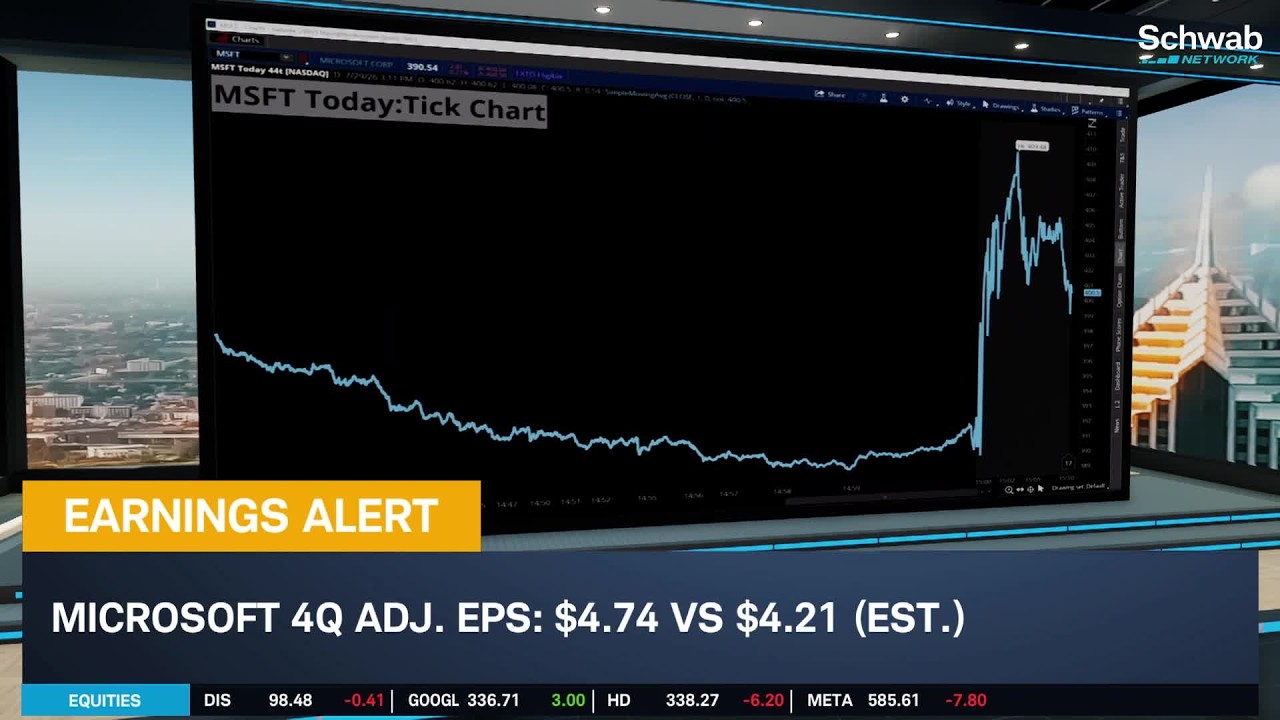
Microsoft’s shares rose 15.6% in regular Nasdaq trading on July 30, 2026, adding approximately $450 billion to the company’s market value in a single session after fiscal fourth-quarter results showed faster Azure growth, strong operating leverage and guidance that exceeded Wall Street’s cloud expectations. The move lifted Microsoft’s market capitalization to roughly $3.35 trillion and established a new record for the largest one-day increase in value by a publicly traded company.
On the same day, Amazon’s autonomous-vehicle subsidiary Zoox received a temporary federal exemption permitting the commercial deployment of its purpose-built robotaxis, which have no steering wheel, pedals or conventional driver position. The National Highway Traffic Safety Administration authorized up to 2,500 vehicles annually for two years, subject to an adaptable oversight structure and continued compliance with federal, state and local requirements. Zoox said it planned to begin charging for rides in Las Vegas, with other markets to follow after additional approvals.
The two developments were not identical in scale, maturity or financial importance. Microsoft presented investors with evidence that years of spending on data centers, graphics processors and AI software were already translating into faster cloud revenue, expanding contracts and substantial cash generation. Zoox crossed a regulatory threshold that may allow Amazon to test whether a technically ambitious vehicle can become a repeatable transportation business. One story concerned monetization at enormous scale. The other concerned permission to begin proving a business model.
Together, however, they captured the central question facing the technology sector in 2026: when does expensive artificial-intelligence infrastructure become an economic asset rather than a perpetual capital requirement? Microsoft answered part of that question with reported revenue, margins, bookings and cash flow. Zoox advanced to the stage where operational reliability, utilization, pricing and public acceptance can begin producing a commercial answer.
Last updated: July 31, 2026, 4:35 a.m. EDT. Market prices and rapidly changing operational information are stated as of the dates and times identified below.
Key Takeaways
- Microsoft’s market reaction: Microsoft closed at approximately $451.10 on July 30, up 15.6% from the previous regular-session close, increasing its market value by about $450 billion to roughly $3.35 trillion.
- The earnings catalyst: Fiscal fourth-quarter revenue reached $90.0 billion, up 18% year over year, while Azure and other cloud-services revenue increased 43%.
- The guidance surprise: Microsoft forecast about 45% constant-currency Azure growth for the first quarter of fiscal 2027, above the approximately 40.9% analyst estimate cited by Reuters from Visible Alpha.
- The spending test: Microsoft reported $41 billion of quarterly capital expenditure, yet generated $55.4 billion in operating cash flow and $19.6 billion in free cash flow during the quarter.
- The Zoox decision: NHTSA granted Zoox a two-year temporary exemption allowing commercial deployment of up to 2,500 vehicles in each 12-month period, with continuing federal oversight.
- What the approval does not prove: It does not establish that Zoox can operate profitably, scale cheaply, secure every local authorization or match the service density already achieved by Waymo.
- The broader lesson: Investors are increasingly distinguishing between AI spending supported by measurable demand and AI spending that still depends primarily on future adoption.
Fact Box
Microsoft Fiscal Q4 2026 at a Glance
- Revenue: $90.0 billion, up 18% year over year.
- Operating income: $40.6 billion, up 18%.
- GAAP net income: $35.8 billion, up 31%.
- GAAP diluted earnings per share: $4.81, up 32%.
- Microsoft Cloud revenue: $59.3 billion, up 27%.
- Azure and other cloud-services revenue growth: 43%.
- Commercial remaining performance obligation: $678 billion, up 84%.
- Quarterly operating cash flow: $55.4 billion.
- Quarterly free cash flow: $19.6 billion.
Original source: Microsoft’s fiscal 2026 fourth-quarter earnings release
Why Microsoft Stock Surged After Earnings
The Microsoft stock surge was not simply a reaction to revenue and earnings exceeding consensus estimates. The more important change was in the perceived relationship between spending and output. For much of the AI investment cycle, large technology companies had asked shareholders to accept extraordinary capital expenditure on the premise that demand would eventually justify it. Microsoft’s fourth quarter offered evidence that the company was converting additional capacity into revenue almost as soon as it became available.
Chief Financial Officer Amy Hood said Azure growth exceeded the company’s expectations because Microsoft improved efficiency across its CPU and GPU fleet and brought new capacity online earlier than planned. She added that the incremental capacity was quickly monetized. That detail mattered because it addressed two investor concerns at once. First, it suggested that spending was not creating idle infrastructure. Second, it indicated that operational improvements, not only new construction, could increase the revenue generated from existing hardware.
Azure and other cloud-services revenue grew 43% year over year in the quarter. Microsoft does not disclose Azure revenue as a standalone dollar figure, so the growth rate should not be treated as directly comparable with Amazon Web Services’ reported sales. Even so, the acceleration was difficult to dismiss. Intelligent Cloud segment revenue increased 32% to $39.3 billion, while Microsoft Cloud revenue across the company reached $59.3 billion, up 27%.
The forward outlook reinforced the quarter. Microsoft forecast approximately 45% constant-currency Azure growth for the September quarter, its fiscal first quarter of 2027. Reuters reported that Visible Alpha’s analyst estimate was about 40.9%. The gap between guidance and expectations was unusually meaningful for a business of Azure’s scale. It implied that capacity additions, efficiency gains and customer commitments were supporting continued acceleration rather than a one-quarter release of delayed demand.
The result also arrived after a period of relative weakness in Microsoft shares. Reuters calculated that the stock had fallen more than 18% in 2026 through the July 29 close. The earnings report therefore encountered a market in which expectations had become less demanding than the company’s underlying operating momentum. When evidence contradicted the cautious positioning, the revaluation was abrupt.
Microsoft’s closing price of approximately $451.10 represented a gain of roughly $61.06 from the previous close of about $390.04. Multiplying a price change of that magnitude by approximately 7.43 billion shares outstanding produces a market-value increase near the widely reported $450 billion figure. Market capitalization is always an estimate because share counts change through repurchases, stock compensation and other activity, but the calculation is sufficiently close to establish the scale of the move.
The prior record belonged to Nvidia, which added about $441 billion on April 9, 2025, after the announcement of a 90-day pause in certain U.S. tariffs. Microsoft surpassed that record by delivering a company-specific operating result rather than benefiting mainly from a broad policy reversal. That distinction helps explain why the session was interpreted as a referendum on AI economics rather than merely another high-beta technology rally.
The market was buying evidence, not just enthusiasm
Technology investors have become familiar with management teams describing AI demand as unprecedented, transformational or supply constrained. Those descriptions have value only when they appear in revenue, contracts, pricing or cash flow. Microsoft provided several measurable indicators.
Commercial remaining performance obligation, or RPO, increased 84% to $678 billion. RPO represents contracted revenue that has not yet been recognized, although timing and cancellation terms vary. Microsoft said roughly 30% of the total would be recognized during the next 12 months and that RPO excluding OpenAI increased 25%. The distinction is important. The headline growth rate was heavily influenced by large OpenAI commitments, but Microsoft also reported that all sequential RPO growth came from customers outside frontier-model companies.
Microsoft 365 Copilot passed 30 million paid seats, with net paid-seat additions more than doubling sequentially. This was not a disclosure of Copilot revenue, average selling price or renewal rate, so it does not answer every monetization question. It nevertheless showed that enterprise customers were buying premium AI functionality at a scale beyond limited pilot programs.
GitHub Copilot consumption was stronger than Microsoft expected after a June change that aligned pricing more closely with usage and value. Management said the new model improved margins through the quarter. This is a small but revealing example of how AI economics may evolve. Per-seat subscriptions provide predictable revenue, while usage-based pricing better captures heavy consumption and the computing costs associated with it. Microsoft is increasingly combining both models.
The company also reported that customer demand continued to exceed available Azure capacity. Supply constraints are not automatically favorable. They can delay revenue, frustrate customers and allow competitors to gain share. In this quarter, however, Microsoft’s ability to release capacity and monetize it quickly signaled that demand was real rather than hypothetical.
Microsoft’s Quarter in Detail
Microsoft reported revenue of $90.007 billion for the three months ended June 30, 2026, compared with $76.441 billion in the prior-year quarter. The 18% reported increase was 17% in constant currency. Operating income rose 18% to $40.603 billion, producing an operating margin of approximately 45.1%. The margin was slightly higher than a year earlier even as the company absorbed a large increase in AI-related infrastructure and product-development expense.
GAAP net income increased 31% to $35.766 billion, and GAAP diluted earnings per share rose 32% to $4.81. Microsoft’s formal non-GAAP presentation excluded the effect of its OpenAI investments, resulting in non-GAAP net income of $35.286 billion and diluted earnings per share of $4.74. The company emphasized that the non-GAAP adjustment concerned OpenAI; it also separately identified a $3.2 billion gain from an Anthropic investment and several employment and Xbox-related items that collectively benefited earnings per share by $0.27 relative to the guidance provided in April.
That accounting distinction deserves attention. A large investment gain can increase net income without demonstrating stronger demand for Microsoft’s products. The quarter’s quality therefore rests more convincingly on revenue, operating income, cash generation and cloud bookings than on the full increase in GAAP net income. Investors focusing solely on the 31% growth in net income would miss the role played by non-operating gains.
| Metric | Fiscal Q4 2026 | Fiscal Q4 2025 | Year-over-year change |
|---|---|---|---|
| Revenue | $90.007 billion | $76.441 billion | 18% |
| Operating income | $40.603 billion | $34.323 billion | 18% |
| GAAP net income | $35.766 billion | $27.233 billion | 31% |
| GAAP diluted EPS | $4.81 | $3.65 | 32% |
| Operating cash flow | $55.441 billion | $42.647 billion | 30% |
| Cash additions to property and equipment | $35.802 billion | $17.079 billion | 109% |
| Free cash flow | $19.6 billion | Approximately $25.6 billion | Down, reflecting higher capital expenditure |
Currency: U.S. dollars. Microsoft’s free cash flow is calculated as operating cash flow less cash additions to property and equipment. Values are reported or calculated from Microsoft’s July 29, 2026 earnings materials; rounded figures may not sum precisely.
Productivity and Business Processes remained the profit anchor
Revenue in Productivity and Business Processes increased 14% to $37.847 billion. The segment generated $21.9 billion of operating income, an operating margin near 58%. Its combination of Microsoft 365, LinkedIn and Dynamics continues to provide the recurring, high-margin revenue that helps finance cloud and AI infrastructure.
Microsoft 365 Commercial cloud revenue increased 14% as reported and 16% after normalizing for a prior-year revenue-recognition benefit. Paid commercial seats grew 6%, led by small and medium businesses and frontline-worker offerings. Premium products, including Copilot, E5 and early E7 adoption, increased average revenue per user.
The mix matters. Seat growth alone is no longer the only driver. Microsoft is attempting to raise the value of each customer relationship by layering security, compliance, analytics and AI onto products already embedded in corporate workflows. This distribution advantage is difficult for standalone AI vendors to replicate. Microsoft does not have to persuade an enterprise to adopt an entirely new productivity environment before selling AI; it can place Copilot inside software the enterprise already licenses.
That advantage comes with cost. Microsoft said increased Copilot usage pressured gross margin, although efficiency gains and pricing changes offset part of the impact. AI features are not software in the old sense, where an additional user often costs very little to serve. Generative AI requires inference computing, and the expense rises with usage. The commercial challenge is to price the feature above the incremental computing and support cost while delivering enough productivity improvement to justify renewal.
LinkedIn revenue increased 12% as Marketing Solutions performed well, while Dynamics 365 revenue rose 13%. Management noted that customer-relationship-management sales cycles remained longer, even as enterprise-resource-planning bookings stayed healthy. That divergence illustrates why the quarter should not be described as uniformly strong. Some software categories remained exposed to cautious corporate purchasing decisions.
Intelligent Cloud delivered the acceleration investors wanted
Intelligent Cloud revenue rose 32% to $39.306 billion, with operating income increasing 31% to $15.955 billion. The segment’s operating margin remained approximately 41%. Azure’s 43% growth was the central result, but the margin performance provided the credibility. Microsoft did not achieve the acceleration by allowing segment profitability to collapse.
The company said the segment’s gross-margin percentage declined because Azure represented a larger share of sales and because Microsoft continued to build AI infrastructure ahead of demand. Efficiency gains partially offset those pressures. This pattern is likely to persist: AI can accelerate revenue while reducing gross-margin percentage, especially as a company shifts from highly profitable software licenses toward compute-intensive services.
The relevant question is not whether margins remain unchanged every quarter. It is whether additional gross-profit dollars and operating income grow fast enough to compensate for a lower percentage margin. In the fourth quarter, Intelligent Cloud gross-margin dollars increased 24%, operating income grew 31% and the operating margin remained stable. That is a favorable combination.
More Personal Computing showed the limits of the quarter
Revenue in More Personal Computing declined 4% to $12.854 billion. Windows OEM and Devices revenue fell 7%, and Xbox content and services revenue decreased 10%. Search advertising revenue excluding traffic-acquisition costs increased 10%, but it was not enough to offset weaker Windows and gaming performance.
Microsoft also recorded severance expense and impairment charges in Xbox and said it was resetting the business for long-term growth. Management expected Xbox to return to growth in fiscal 2027, but that is guidance rather than an achieved result. The segment’s operating income increased modestly for the full fiscal year, yet quarterly operating income declined from $3.19 billion to $2.75 billion.
This weakness did not dominate the market response because the company’s valuation is increasingly driven by cloud, enterprise software and AI. It still matters. A diversified technology company can tolerate a soft segment, but persistent deterioration in gaming or Windows would reduce the cash and strategic optionality available elsewhere.
The Full-Year Numbers Show How Rapidly Microsoft Has Changed
For the fiscal year ended June 30, 2026, Microsoft reported revenue of $331.839 billion, up 18% from $281.724 billion in fiscal 2025. Operating income increased 21% to $155.237 billion, and GAAP net income rose 31% to $133.749 billion. The annual operating margin was approximately 46.8%.
Two years earlier, in fiscal 2024, Microsoft generated $245.122 billion of revenue. The company therefore added roughly $86.7 billion of annual revenue in two years, an increase of about 35%. Much of that growth came from cloud services, enterprise software and AI-related demand rather than from the mature Windows franchise that once defined the company.
Annual operating cash flow reached $182.935 billion, up from $136.162 billion. Cash additions to property and equipment climbed to $115.948 billion from $64.551 billion. A simple free-cash-flow calculation using those figures produces approximately $67.0 billion for fiscal 2026, down from about $71.6 billion in fiscal 2025 despite the large increase in operating cash flow.
That is the central financial tension. Microsoft’s operations generated approximately $46.8 billion more cash than a year earlier, but cash infrastructure spending increased by about $51.4 billion. The company remained highly cash generative, yet nearly all of the incremental operating cash was absorbed by property and equipment.
Investors rewarded the stock because the spending coincided with accelerating demand and management forecast continued growth. The same capital intensity would be interpreted differently if Azure slowed, pricing weakened or utilization fell. Microsoft has not escaped the economics of infrastructure. It has demonstrated, for now, that the infrastructure is productive.
Capital Expenditure Is the Core of the Microsoft AI Debate
Microsoft reported $41 billion of capital expenditure in the fourth quarter when finance leases were included. About two-thirds was allocated to short-lived assets, primarily CPUs and GPUs. The remainder supported long-lived assets such as data-center sites and buildings. Cash paid for property and equipment was $35.8 billion, while finance leases added another $5.6 billion.
Calling processors short-lived assets does not mean they become useless quickly. It reflects their depreciation profile and the pace at which advanced computing hardware is replaced or economically superseded. The distinction matters because a fleet weighted toward expensive accelerators creates recurring replacement requirements. Data-center buildings may operate for decades, but the computing equipment inside them is subject to rapid performance and efficiency changes.
Microsoft expects fiscal 2027 capital expenditure to increase year over year. Reuters reported that the company projected approximately $50 billion of capital expenditure for the September quarter and about $175 billion during calendar 2026. These numbers show why one strong earnings report cannot settle the debate. Microsoft must continue investing heavily to meet customer commitments, maintain performance, secure power and compete with Amazon, Google, Oracle and specialized AI clouds.
The bullish case is that Microsoft is building scarce infrastructure into a market where demand exceeds supply. Under this interpretation, capital expenditure is a constraint on near-term free cash flow but a source of future revenue, pricing power and strategic control. The company’s ability to monetize newly available capacity supports that case.
The skeptical case is that AI infrastructure may become less scarce as competitors add capacity, chips become more efficient and customers optimize workloads. If the unit cost of inference falls faster than demand expands, pricing could decline. If enterprises discover that only a subset of AI applications produces sufficient returns, utilization may disappoint. Hardware can then become a depreciating asset without the revenue originally expected.
Both cases can be true at different points in the cycle. Microsoft may earn attractive returns on current capacity while later additions face lower incremental returns. Investors therefore need more than aggregate capital-expenditure figures. They need evidence on utilization, revenue per unit of compute, contract duration, customer concentration, gross-margin progression and the proportion of spending required merely to replace existing hardware.
Free cash flow remains positive, but its quality has changed
Microsoft generated $19.6 billion of free cash flow in the fourth quarter and said it expected to remain free-cash-flow positive during fiscal 2027. That assurance is useful but modest. A company of Microsoft’s scale and profitability should remain positive under a wide range of conditions. The more important question is how much free cash flow remains after sustaining the infrastructure required to deliver contracted services.
Quarterly operating cash flow was $55.4 billion, up 30%. Strong cloud billings and collections drove the increase. Yet cash property-and-equipment additions more than doubled to $35.8 billion, leaving free cash flow below the prior-year level. Free cash flow represented roughly 21.8% of quarterly revenue, still a strong margin but far below the operating margin.
Microsoft returned $10.2 billion to shareholders through dividends and repurchases in the quarter and more than $43 billion for the full fiscal year. The company could fund those distributions while investing heavily because its operating cash engine is so large. Even so, repurchases should be assessed against stock valuation and employee stock issuance, not simply celebrated as cash returns.
Azure, OpenAI and the Concentration Question
Microsoft’s relationship with OpenAI is simultaneously a competitive advantage, a source of demand, an investment exposure and a reporting complication. The company’s RPO grew 84% partly because of large OpenAI commitments. Microsoft said RPO excluding OpenAI increased 25%, and that all sequential growth came from customers outside frontier-model companies. Those disclosures were designed to demonstrate that the backlog was not dependent on one AI laboratory.
The distinction is essential because contracted revenue from an affiliated or strategically connected company can carry different risks from demand spread across thousands of independent enterprises. OpenAI’s ability to meet commitments depends on its own revenue, financing, product competitiveness and capital structure. Microsoft’s economics may also involve reciprocal arrangements, investment gains or losses and revenue-sharing terms that make the relationship more complex than a conventional cloud-customer contract.
At the same time, excluding OpenAI entirely would understate Microsoft’s strategic position. The relationship helped Azure become a leading platform for frontier-model training and inference. It attracted developers, accelerated product integration and gave Microsoft early access to technologies used across Copilot products. The correct approach is not to ignore OpenAI demand but to separate it from broader customer demand when assessing durability.
Microsoft reported that nearly 90% of its full-year cloud revenue came from customers outside frontier-model companies. That figure suggests the cloud business is much broader than AI laboratories. It also reminds investors that traditional database, application, security, productivity and infrastructure workloads remain economically important. AI is an accelerator layered onto an already enormous commercial platform.
What Microsoft’s $450 Billion Gain Really Means
A one-day market-capitalization increase is visually dramatic, but it should not be mistaken for cash entering Microsoft. No $450 billion was deposited on the company’s balance sheet. The figure represents the change in the market price of outstanding shares multiplied by the share count. It measures how investors revalued the company’s future cash flows, risks and growth prospects in one session.
The gain was larger than the total market value of most S&P 500 constituents. That comparison conveys scale, but it can also encourage a misleading sense of permanence. Market capitalization can reverse quickly if growth disappoints, interest rates rise or valuation multiples contract. The record tells readers more about the size and concentration of modern equity markets than it does about the certainty of Microsoft’s future profits.
Microsoft ended the session at roughly 26.9 times trailing earnings based on available market data. A trailing price-to-earnings ratio is imperfect because reported earnings included investment gains and because the market values future rather than historical results. Still, the multiple was not obviously detached from the company’s growth rate after the rally. Revenue had increased 18%, operating income 21% for the year and Azure 43% in the latest quarter.
The valuation argument depends on duration. If Microsoft can sustain double-digit revenue growth, preserve operating leverage and convert AI demand into recurring contracts, a premium multiple may be defensible. If Azure growth normalizes rapidly while capital expenditure remains elevated, free-cash-flow growth could lag earnings and the multiple would become harder to support.
Interest rates also matter. Technology valuations reflect the present value of cash expected many years into the future. Higher Treasury yields increase the discount rate applied to those cash flows and create more attractive alternatives for investors. Microsoft’s rally occurred even as long-term U.S. yields remained elevated, suggesting that the earnings surprise was strong enough to overcome a less supportive valuation backdrop. That does not remove rate sensitivity from the stock.
The record was also a lesson in index concentration
Microsoft’s move contributed materially to the major U.S. indexes because the company carries a large weight in the S&P 500, Nasdaq Composite and Nasdaq-100. Reuters reported that the Nasdaq rose 2.8%, the S&P 500 gained 1.7% and the Dow Jones Industrial Average advanced 1.2% on July 30. A handful of mega-cap companies can therefore create a strong index session even when many individual stocks decline.
This concentration complicates the interpretation of “the market.” An investor holding an equal-weighted basket can experience a different day from an investor holding a capitalization-weighted index. Microsoft’s record gain was economically real for shareholders, but it did not necessarily indicate broad improvement in corporate earnings expectations across the economy.
The same concentration amplifies risk. If several mega-cap technology companies disappoint simultaneously, index-level declines can be large even when the median company performs reasonably well. Microsoft’s quarter reduced one source of concern, but it also reinforced how dependent benchmark returns have become on the capital-allocation decisions of a small number of AI infrastructure providers.
The Strongest Bullish Interpretation of Microsoft’s Results
The most favorable reading is that Microsoft has reached the stage at which AI demand reinforces every layer of its commercial model. Customers buy Azure compute to train and operate models. They purchase Microsoft 365 Copilot to apply AI in workplace tasks. Developers use GitHub Copilot and Azure tools. Security, data and application services become more valuable as enterprises integrate AI into controlled environments. Each product can increase demand for another.
This creates a distribution loop. Microsoft can use its installed base to introduce AI products, use those products to stimulate cloud consumption and use cloud scale to improve unit economics. Large customer contracts deepen switching costs because applications, data, identities, compliance systems and employee workflows become connected to the same platform.
The $678 billion commercial RPO provides visibility, although not certainty. A meaningful share will be recognized over several years, and some contracts may include consumption assumptions rather than fixed minimums. Nevertheless, the backlog suggests that customers are making commitments long enough to justify infrastructure construction.
Microsoft also has several ways to monetize the same investment. A data center can support Azure infrastructure, first-party software, model training, inference and internal research. Capacity can be allocated across products as demand changes. This flexibility may generate better returns than a specialized operator serving only one workload.
Finally, the company’s balance sheet and cash flow allow it to invest through downturns. Microsoft ended June with $76.8 billion in cash, cash equivalents and short-term investments, compared with approximately $40.3 billion of current and long-term debt. It is not dependent on external financing to complete its near-term buildout. That financial strength is a competitive advantage when power, chips and construction capacity are scarce.
The Strongest Skeptical Interpretation of Microsoft’s Results
A skeptical investor would begin with capital intensity. Cash additions to property and equipment rose to $115.9 billion for the year, almost 35% of revenue. Property and equipment on the balance sheet increased to $313.1 billion from $205.0 billion. Depreciation, amortization and related charges rose to $38.5 billion from $29.4 billion. These costs will continue flowing through the income statement even if growth slows.
The skeptic would also question how much of Azure’s acceleration reflects a release of constrained capacity rather than a sustainable increase in underlying demand. When supply catches up, customers may gain bargaining power. Cloud workloads can be optimized, delayed or shifted among providers. Enterprises may also use smaller, more efficient models that consume less computing power for a given task.
Copilot’s 30 million paid seats sound impressive, but Microsoft did not disclose revenue, active usage, retention, discounting or the percentage of seats purchased through broad enterprise agreements. A paid seat that is rarely used may not renew at full price. AI adoption within companies often begins with centralized purchases before employees establish durable habits.
RPO concentration remains another concern. The 84% headline increase included major OpenAI contracts, and only about 30% of total RPO is expected to become revenue within 12 months. Long-duration commitments can improve visibility, but they also require Microsoft to build capacity before all revenue is recognized. Contract quality matters as much as contract size.
There are also regulatory and competitive risks. Microsoft operates across cloud infrastructure, productivity software, cybersecurity, gaming, advertising and AI. That breadth attracts antitrust scrutiny. Customers and governments may resist platform bundling or require interoperability. Open-source models and lower-cost inference providers could reduce Microsoft’s ability to charge premium prices.
None of these concerns invalidates the quarter. They explain why one earnings beat cannot permanently resolve the return-on-investment debate. The market’s reaction showed that expectations changed. The next several quarters must show that cash returns can grow alongside the physical asset base.
Amazon’s Zoox Approval Was a Different Kind of AI Milestone
While Microsoft demonstrated current economic returns, Zoox obtained permission to begin testing commercial economics. NHTSA granted Temporary Exemption No. 2026-01 for the company’s purpose-built robotaxi, formally described in the decision as the Zoox sedan. The exemption is effective through July 31, 2028 and covers specified portions of eight Federal Motor Vehicle Safety Standards.
The vehicle does not have a steering wheel, conventional pedals or a human driver position. It is symmetrical from front to rear, can travel in either direction and uses carriage-style seating in which four passengers face the center. Sensors include lidar, radar, cameras, long-wave infrared cameras, microphones and other equipment. Zoox describes the system as SAE Level 4 automation within a defined operational design domain, meaning it performs the driving task and fallback without expecting a passenger to intervene.
Legacy vehicle rules assume a human driver. Requirements for manually operated turn signals, headlamp controls, windshield wiping, rear visibility and brake activation therefore do not map neatly onto a vehicle designed exclusively for an automated driving system. NHTSA concluded that exemptions from the specified provisions would not reduce the overall safety level compared with an otherwise identical compliant vehicle operated by an automated system.
The wording is narrower than a declaration that Zoox is safer than every human-driven car. NHTSA evaluated whether the exempted design provided an overall safety level at least equal to a comparable nonexempt vehicle for the requirements at issue. The agency also imposed conditions and retained the ability to modify, suspend or revoke the exemption.
Fact Box
What NHTSA Authorized for Zoox
- A temporary commercial-deployment exemption effective through July 31, 2028.
- Up to 2,500 exempt vehicles introduced into interstate commerce for commercial deployment during each 12-month period.
- Use of the purpose-built Zoox sedan without conventional manually operated driving controls.
- Exemptions from specified portions of eight Federal Motor Vehicle Safety Standards.
- An adaptable Operational Authorization governing where and under what conditions exempt vehicles may operate.
- Continuing data access, inspection, reporting and compliance obligations.
- No sale or transfer of the vehicles to consumers; Zoox must maintain operational control.
Original source: NHTSA’s notice granting Zoox’s temporary exemption
What the Zoox Approval Does and Does Not Do
The approval allows Zoox to manufacture and commercially deploy a limited number of nonconforming vehicles under federal law. It removes a barrier created by safety standards written for human-driven automobiles. It also permits Zoox to charge passengers, provided its operations satisfy the applicable Operational Authorization and all other legal requirements.
The exemption does not create a nationwide right to operate on any street. State and local rules still apply. Each vehicle must be permitted where required, and Zoox must coordinate with law enforcement and other public agencies in deployment regions. The initial Operational Authorization can limit the number of vehicles simultaneously operating, geographic areas, routes, speeds, weather conditions or other aspects of the operational design domain.
The statutory cap of 2,500 vehicles per 12-month period is not the same as an immediate fleet of 2,500 robotaxis. Zoox must manufacture the vehicles, commission them, secure local approvals, establish charging and maintenance systems, train remote-assistance personnel and build enough rider demand to use the fleet efficiently. The authorization sets an upper boundary. It does not guarantee that the company will reach it.
The decision also does not certify the commercial model. NHTSA regulates vehicle safety, not profitability. It did not determine the cost per mile, required fare, fleet utilization, insurance expense, cleaning cost, maintenance burden, customer-acquisition expense or capital return. Those factors will decide whether Zoox becomes a meaningful Amazon business.
Nor does the approval eliminate recall obligations. The vehicles remain subject to federal defect and reporting requirements. NHTSA can inspect them and can take action, including terminating the exemption, if Zoox violates its terms or if a modification undermines the safety-equivalence finding.
The Operational Authorization is as important as the exemption
NHTSA introduced a more dynamic oversight approach because automated-driving systems can change through software updates and can expand into new operational domains. Instead of establishing one static permission for the entire two-year period, the agency can issue and revise Operational Authorizations tailored to particular areas, routes or operating conditions.
Zoox must provide vehicle, automated-driving-system and other data required by those authorizations. The authorizations are to be made publicly available in the exemption docket. A material change to the vehicle or its capabilities may require a formal modification of the exemption, including public notice and comment.
This framework attempts to solve a regulatory problem. A fixed rule can become obsolete as software changes, yet unrestricted self-certification can leave the public with too little visibility. Dynamic authorization gives NHTSA a mechanism to permit limited deployment while maintaining leverage over expansion.
The trade-off is complexity. A company may face uncertainty about how quickly an authorization can be expanded, while the public may struggle to understand which conditions apply in each city. The quality of the framework will depend on transparency, timely reporting and the agency’s willingness to restrict operations when evidence justifies it.
Why Zoox Built a Vehicle Without Human Controls
Most robotaxi programs began with a conventional passenger vehicle and added sensors, computers and redundant systems. Waymo’s fleet, for example, has used modified vehicles that retain a familiar forward-facing layout and conventional controls. Tesla’s service began with production cars. This approach reduces manufacturing risk and allows a safety driver to operate the vehicle during development.
Zoox chose a ground-up design. Removing the driver position creates more usable interior space within a compact footprint. Bidirectional operation and four-wheel steering can simplify maneuvering in dense areas. Sliding doors can reduce the risk of opening into traffic. A symmetrical vehicle can arrive without needing to turn around before the next trip.
The purpose-built design may also improve accessibility and passenger experience. Riders face one another, and the cabin can be optimized for ride-hailing rather than private ownership. There is no need to preserve a dashboard, steering column or front seat for a driver who is not expected to exist.
The cost is that Zoox must solve vehicle manufacturing and autonomous driving simultaneously. It cannot rely entirely on an established automaker’s production line, crash architecture, service network and supply chain. A design that works in a small fleet may reveal new problems at thousands of units. Parts availability, repair time and manufacturing yield become central to service reliability.
The lack of manual controls also removes a fallback. A passenger cannot take over when the system encounters an unusual scene. Zoox uses remote assistance, but NHTSA’s decision distinguishes remote guidance from direct remote driving in normal operations. Remote personnel can provide contextual information, suggest paths or initiate a stop, while the automated system decides how and when to execute the guidance.
This architecture can scale only if remote interventions are infrequent. If one remote assistant must continuously supervise a small number of vehicles, labor savings diminish. The economic goal is not zero human involvement; it is a sufficiently low level of human support per vehicle mile that the total system costs less than a driver-based service while maintaining safety.
Zoox’s Route From Startup to Amazon Subsidiary
Zoox was founded in 2014 around the idea that autonomous ride-hailing should use a vehicle designed from the beginning for passengers rather than adapt a car designed for a human driver. Amazon announced an agreement to acquire the company in June 2020. Zoox continued as a standalone business led by Chief Executive Aicha Evans and co-founder and Chief Technology Officer Jesse Levinson.
The acquisition gave Zoox access to a parent with substantial financial resources, cloud infrastructure, logistics expertise and a long investment horizon. It also gave Amazon a strategic option beyond e-commerce, advertising and cloud computing. Autonomous mobility could become a consumer service, a logistics capability, a platform for local commerce or some combination of the three.
Amazon has not disclosed Zoox as a separate financial segment. Its revenue, operating loss, capital expenditure and employee costs are therefore embedded within broader corporate reporting. This makes external valuation difficult. Investors can observe regulatory progress and fleet expansion but cannot calculate a clean return on invested capital.
The absence of separate disclosure is understandable at an early stage, yet it limits accountability. As paid service expands, useful metrics would include autonomous miles, rides, active vehicles, utilization, revenue per ride, service-area size, remote-assistance rate, collisions, insurance cost, maintenance expense and capital cost per vehicle. Without those measures, the market may overreact to milestone announcements without understanding the underlying economics.
The production facility created capacity before commercial permission
In June 2025, Zoox opened a serial-production facility in Hayward, California. The company said the installed line could eventually assemble more than 10,000 robotaxis annually at full scale. That potential capacity exceeded the number permitted under the new federal exemption, which is capped at 2,500 vehicles in each 12-month period.
The difference between production capacity and legal deployment illustrates the sequencing risk in autonomous vehicles. A company needs enough manufacturing capability to scale after approval, but building too early can create underused assets. Regulatory delay can strand equipment, while rapid approval can expose supply shortages.
Zoox’s current position is better than waiting for permission before designing a factory. It can begin increasing output while validating quality and field performance. Still, a capacity statement is not a production forecast. Reaching 10,000 units requires suppliers, trained workers, acceptable yields, working capital and demand across enough approved markets.
Amazon’s Earnings Put Zoox in Financial Context
Amazon reported second-quarter results after the July 30 market close. Net sales increased 20% to $200.6 billion, operating income rose 43% to $27.5 billion and AWS sales increased 37% to $42.2 billion. The cloud segment generated $16.6 billion of operating income, compared with $10.2 billion a year earlier.
Net income reached $62.6 billion, but that figure included $53.4 billion of non-operating pre-tax income primarily related to Amazon’s Anthropic investments. As with Microsoft, the statutory profit figure was influenced by investment valuations that did not represent operating revenue. Amazon’s operating income provides a cleaner view of business performance.
The more relevant constraint was cash investment. Amazon reported trailing-12-month operating cash flow of $161.4 billion, up 33%, but free cash flow moved to an outflow of $7.6 billion from an inflow of $18.2 billion. The company attributed the decline primarily to a $66.1 billion year-over-year increase in property-and-equipment purchases, net of sales and incentives, largely reflecting AI investment.
Zoox therefore competes for capital inside a company already spending heavily on data centers, chips, logistics and fulfillment. The robotaxi program is unlikely to determine Amazon’s near-term earnings, but it must eventually demonstrate that its strategic value justifies continued funding alongside AWS and retail automation.
Amazon’s scale provides patience. A smaller company might need to generate external enthusiasm or raise capital after every regulatory delay. Amazon can fund years of development from operating cash flow. Patience, however, does not guarantee success. It can also allow a project to accumulate cost without facing the discipline of separate financial reporting.
| Measure | Microsoft | Amazon | Interpretation |
|---|---|---|---|
| Latest reported quarter | Fiscal Q4 ended June 30, 2026 | Calendar Q2 ended June 30, 2026 | The periods align, although fiscal labels differ. |
| Total revenue | $90.0 billion | $200.6 billion | Amazon is larger by sales because retail is a high-volume business. |
| Operating income | $40.6 billion | $27.5 billion | Microsoft’s software-heavy mix produces a much higher operating margin. |
| Cloud indicator | Azure growth 43%; Azure revenue not disclosed | AWS sales $42.2 billion, up 37% | The metrics are not directly comparable because disclosure definitions differ. |
| Cash-investment signal | Quarterly cash property-and-equipment additions $35.8 billion | Trailing free cash flow negative $7.6 billion after large AI investment | Both companies are converting operating cash into infrastructure at exceptional rates. |
| Autonomous-vehicle exposure | Not a material disclosed operating platform | Zoox subsidiary received commercial exemption | Amazon is funding a long-duration option outside its current core segments. |
Currency: U.S. dollars. Company figures are reported values. Cloud comparisons are imperfect because Microsoft reports Azure growth without standalone Azure revenue, while Amazon reports AWS segment sales.
How Zoox Compares With Waymo and Tesla
Zoox’s approval makes it a more credible commercial competitor, but it does not make the company the scale leader. Waymo entered 2026 with a large head start in paid rides, public-road miles and city operations. In February 2026, Waymo said it was providing more than 400,000 rides each week across six major U.S. metropolitan areas and had surpassed 20 million lifetime rides. The company planned operations in more than 20 additional cities during the year.
Waymo’s advantage is operational learning. Every paid ride generates information about rider behavior, pickup locations, road construction, weather, cleaning, fleet balancing and edge cases. Scale also spreads fixed costs across more miles. Zoox must build a comparable operating system, not merely an autonomous-driving system.
Zoox’s potential advantage is vehicle design. A purpose-built cabin may produce a better passenger experience and lower operating cost once manufactured at scale. Bidirectional movement can reduce turning and repositioning. The absence of driver controls can increase usable space. These benefits remain hypotheses until utilization and maintenance data become available.
Tesla follows another strategy. It uses a camera-led autonomy system and production vehicles, with a longer-term plan for purpose-built Cybercab vehicles. Its large installed fleet and manufacturing scale could reduce vehicle cost and accelerate geographic expansion. The key uncertainty is whether its autonomous system can consistently meet the safety and regulatory requirements for unsupervised operation across varied environments.
The companies also differ in business integration. Waymo is part of Alphabet, Zoox is part of Amazon and Tesla is both the vehicle manufacturer and service operator. Alphabet can connect Waymo with mapping, advertising and cloud capabilities. Amazon can connect Zoox with Prime, local commerce, logistics and AWS. Tesla can connect ride-hailing demand with vehicle production and ownership. None of these integrations guarantees favorable unit economics, but each provides a different route to scale.
| Company | Vehicle approach | Commercial position by July 2026 | Principal strategic question |
|---|---|---|---|
| Waymo | Modified conventional vehicles with lidar, radar and cameras | Large paid-ride base and multi-city operations | Can service density and safety performance produce durable profitability? |
| Zoox | Purpose-built bidirectional vehicle without human controls | Temporary federal commercial exemption; paid Las Vegas launch planned | Can the ground-up design scale reliably and economically? |
| Tesla | Production vehicles initially, purpose-built Cybercab planned | Expanding robotaxi operations with a manufacturing-scale advantage | Can a camera-led system achieve broad unsupervised deployment safely? |
Safety Evidence Will Decide Whether Zoox Can Scale
Autonomous-vehicle debates often collapse into two overly simple claims: computers never become distracted, or software can never understand the complexity of roads. Neither statement is sufficient. Safety performance depends on the specific system, operational domain, road conditions, fleet procedures, reporting definitions and comparison benchmark.
Zoox argues that its vehicle combines redundant hardware, a custom autonomy stack and sensors positioned to reduce blind spots. NHTSA reviewed confidential crash-test and technical information before finding an equivalent overall safety level for the exempted requirements. The agency’s decision also recorded public concerns about crashworthiness, limited transparency, emergency response and independent validation.
Some evidence remains unavailable because Zoox treated portions of its testing data as confidential business information. NHTSA said the material addressed commenters’ concerns in enough detail to support the exemption. That may be legally adequate, but it leaves outside researchers unable to reproduce every part of the assessment.
Commercial operation should generate more observable evidence. Useful data include miles between crashes, injury severity, fault allocation, interactions with vulnerable road users, emergency-scene performance, unexpected stops, remote-assistance frequency and the distribution of incidents by city and road type. Aggregate miles alone can mislead because one mile on a simple low-speed route is not equivalent to one mile in dense traffic during poor weather.
The exemption’s adaptable oversight structure recognizes this problem. NHTSA can require reporting, inspect vehicles and revise authorizations as the system changes. A responsible commercial rollout would expand only after performance in the initial domain supports the next step.
Emergency responders and unusual scenes remain a difficult test
Automated vehicles can perform well in routine traffic yet struggle when the environment departs from the rules encoded in maps and planning systems. Emergency scenes may include hand signals, partially blocked roads, temporary lanes, smoke, debris, damaged signals and instructions that conflict with ordinary traffic rules.
NHTSA emphasized emergency-responder interaction in its 2026 automated-vehicle policy work. The agency’s broader guidance focuses on remote assistance, post-crash behavior and safety-management systems. These subjects are directly relevant to Zoox because passengers cannot take control and the vehicle lacks traditional driver interfaces.
A robotaxi that stops safely when confused may prevent a collision, but repeated unexpected stops can obstruct traffic and create secondary hazards. A system that proceeds too aggressively may create a more immediate risk. The commercial standard is therefore more demanding than avoiding a crash in a laboratory scenario. The service must respond predictably, communicate with officials and recover without imposing unreasonable burdens on public roads.
Transparency is an economic issue as well as a safety issue
Public confidence affects utilization. Riders who distrust a service will not use it often enough to support attractive fleet economics. Cities that lack operational information may limit service areas or impose additional requirements. Insurers may charge more when risk cannot be measured accurately.
Transparent reporting can therefore reduce the cost of capital and speed regulatory expansion. Companies may resist disclosure when it reveals proprietary information or creates misleading comparisons. A workable compromise would publish standardized safety and operational outcomes while protecting source code, detailed maps and sensitive system architecture.
NHTSA’s planned work with an SAE consortium to develop performance standards may improve comparability. Today, companies often publish metrics using different definitions, exposure periods and benchmarks. A national framework could clarify what must be measured before an automated-driving system expands into new conditions.
The Robotaxi Business Model Is Harder Than Removing the Driver
Human drivers represent a large share of ride-hailing cost, which makes autonomy economically attractive. Removing the driver does not remove labor, vehicle, insurance or operating expense. A robotaxi network requires charging, cleaning, maintenance, customer support, remote assistance, fleet repositioning, depots, mapping, software development, communications and regulatory compliance.
The cost per passenger mile depends heavily on utilization. A vehicle that completes paid rides for most of the day can spread depreciation and fixed overhead across many miles. A vehicle that waits between trips, travels empty to pickups or spends time out of service can remain expensive even without a driver.
Empty miles are particularly important. A fleet must balance supply across neighborhoods and time periods. Morning commuter demand may move vehicles in one direction, while evening demand moves them back. Events create temporary surges. Airport and hotel traffic can be concentrated. Efficient dispatch and pricing are therefore as important as autonomous driving.
Cleaning is another constraint. A privately owned car can accumulate minor disorder without immediate revenue loss. A shared vehicle must maintain a consistent standard for every passenger. Spills, lost items, vandalism and illness can remove a vehicle from service. Interior sensors may detect problems, but many require human intervention.
Maintenance economics may favor a purpose-built vehicle if components are modular and designed for high mileage. They may work against it if specialized parts are expensive or repairs require centralized technicians. Zoox has not published enough commercial data to determine which outcome will dominate.
Pricing will reveal the target customer
Zoox could price below human-driven ride-hailing to stimulate demand, match competitors while offering a differentiated cabin, or charge a premium for reliability and privacy. Each choice has implications.
Lower fares may increase utilization but delay profitability. Premium pricing requires a service advantage consumers can recognize. Matching conventional ride-hailing fares may produce attractive margins only if vehicle and support costs are sufficiently low.
Las Vegas is a logical launch market because trips are concentrated around hotels, entertainment districts and the airport. Visitors may be willing to try a novel service, and repeated routes can simplify fleet operations. The same features can limit the initial evidence. Success in a constrained tourist zone does not automatically translate to suburban commuting, winter weather or complex regional travel.
Fleet ownership changes the capital model
Traditional ride-hailing platforms rely heavily on drivers who own or lease vehicles. This keeps much of the vehicle capital off the platform’s balance sheet, although it creates driver-supply and labor-policy challenges. Zoox plans to maintain control of its exempt vehicles and may not sell them to consumers under the exemption.
Fleet ownership gives Zoox control over maintenance, software, branding and service quality. It also makes the business capital intensive. Amazon must finance vehicles before they generate rides, then absorb depreciation and residual-value risk. If technology improves quickly, older vehicles may become economically obsolete before the end of their physical life.
A high-utilization fleet can still produce favorable returns. Commercial aircraft, delivery vehicles and industrial equipment are capital intensive but valuable when used efficiently. The relevant measure is return on invested capital, not whether the business owns assets. Zoox must eventually demonstrate that revenue and operating cash generated over each vehicle’s life exceed manufacturing, infrastructure and support costs by an adequate margin.
Could Zoox Become More Than a Ride-Hailing Service?
Amazon’s strategic interest may extend beyond passenger fares. An autonomous local-mobility network could connect customers with stores, restaurants, entertainment and delivery services. It could become a physical interface for Prime membership or a platform for advertising and local commerce.
These possibilities should be treated as options, not current revenue streams. The Zoox vehicle is designed for passengers, and NHTSA’s exemption is specific to that model and use case. Converting the network into a logistics platform could require different vehicles, authorizations and operating procedures.
Amazon may also benefit from technical learning. Autonomous perception, route planning, fleet management and robotics have applications in warehouses and delivery. AWS could provide computing infrastructure for simulation and data processing. Yet internal synergies can be difficult to measure and can become a justification for spending that lacks direct financial accountability.
The most credible near-term thesis is simpler: Zoox can become a paid urban transportation service. If that business works, Amazon can evaluate adjacent uses. Building an investment case around hypothetical integration before the core service proves itself would reverse the proper order of analysis.
Microsoft and Zoox Represent Two Stages of the AI Capital Cycle
Microsoft is operating at the revenue-conversion stage. It has spent heavily, secured customer commitments, brought capacity online and reported measurable sales and cash flow. The debate concerns the durability and return on continued expansion.
Zoox is entering the commercial-validation stage. It has spent years on research, vehicles, factories and regulatory work. The exemption allows the company to collect fares and test whether the system can operate reliably at meaningful utilization. The debate concerns whether technical capability can become a repeatable economic unit.
Both companies illustrate that AI is not one business model. Microsoft sells computing, software and subscriptions. Zoox uses AI as part of a capital-intensive transportation system. The cost structure, regulatory exposure, customer behavior and pace of learning differ substantially.
This distinction matters for investors comparing “AI companies.” A dollar spent on a GPU serving contracted enterprise workloads has a different risk profile from a dollar spent developing a vehicle that has not yet entered broad paid service. A high gross-margin software feature differs from a fleet service with cleaning and insurance expense. Aggregate AI spending figures conceal these differences.
Proof arrives in different forms
For Microsoft, proof appears in Azure growth, cloud revenue, Copilot seats, backlog, operating margin and free cash flow. For Zoox, proof will appear in safe miles, paid rides, fleet utilization, expansion authorizations, cost per mile and rider retention.
Investors should require evidence appropriate to the stage. Demanding mature profit from a newly authorized service may be unrealistic. Accepting indefinite promises from a mature platform with hundreds of billions in revenue would be equally unreasonable.
The July 30 developments moved each company forward by one category. Microsoft shifted the discussion from whether AI demand exists to whether returns can remain attractive as spending grows. Zoox shifted the discussion from whether federal rules would permit its vehicle to whether it can operate a viable service.
How Investors Can Evaluate AI Spending Without Relying on Hype
No single metric captures the return on AI investment. A practical framework begins by separating capacity, demand, monetization and cash conversion.
1. Determine what the company is actually buying
Capital expenditure can fund land, buildings, power equipment, networking, CPUs, GPUs or vehicles. These assets have different useful lives and replacement requirements. Microsoft said about two-thirds of fourth-quarter capital expenditure involved short-lived assets, primarily processors. Zoox’s spending includes vehicles and manufacturing systems. The depreciation and residual-value risks differ.
2. Identify the customer commitment
Demand supported by long-term contracts is more visible than demand inferred from product interest. Microsoft’s RPO provides contract evidence, although investors must adjust for concentration and recognition timing. Zoox’s early demand may be measured through app downloads, waitlists and rides, but paid repeat usage will be more informative than curiosity-driven trials.
3. Measure utilization
An expensive asset generates value only when used. For Azure, utilization concerns the proportion of available computing capacity serving revenue-generating workloads. For robotaxis, it concerns paid ride time, empty miles and downtime. Companies rarely disclose complete utilization data, so investors should look for indirect evidence such as supply constraints, lead times and margin trends.
4. Examine unit pricing and cost
Revenue growth can conceal falling unit economics. A cloud provider may grow usage while discounting prices. A robotaxi service may grow rides while charging promotional fares. Gross margin, contribution margin and cost per transaction reveal whether scale creates economic leverage.
5. Separate operating profit from investment gains
Both Microsoft and Amazon reported large investment-related effects in 2026. These gains may be real under accounting rules, but they do not demonstrate stronger product economics. Operating income and cash flow provide a clearer basis for evaluating the core businesses.
6. Compare cash generation with replacement needs
Free cash flow can be strong during a buildout yet decline later when hardware must be replaced. Investors should compare depreciation, capital expenditure and asset growth over several years. A business that requires permanent spending equal to most operating cash flow deserves a different valuation from one whose capital intensity falls after expansion.
7. Track regulatory milestones precisely
An application, approval, local permit and paid launch are different events. Zoox’s federal exemption is meaningful, but state and local compliance remain necessary. Describing the decision as nationwide unrestricted approval would exaggerate what occurred.
Risks and Uncertainties
Microsoft execution risk
Microsoft must construct and operate data centers at a pace that matches demand. Delays in power connections, equipment delivery or permitting can limit revenue. Building ahead of demand can reduce utilization. The company must also allocate scarce capacity among internal products, OpenAI and other customers without damaging relationships.
Microsoft margin risk
AI inference can be expensive, especially for products sold at a fixed subscription price. Higher usage may increase revenue less quickly than computing cost. Microsoft’s move toward usage-based pricing in some products may improve economics but could make customer bills less predictable.
Microsoft customer-concentration risk
Large commitments from OpenAI influence RPO and infrastructure planning. Financial or strategic changes at OpenAI could affect Azure demand. Microsoft’s disclosure that non-frontier customers drove sequential RPO growth reduces but does not eliminate this exposure.
Microsoft competitive and regulatory risk
Amazon, Google, Oracle and specialist providers compete for cloud and AI workloads. Open-source models may reduce switching costs. Regulators may challenge bundling, exclusivity or platform practices. Cybersecurity failures could damage trust in products that handle sensitive corporate data.
Zoox safety and operational risk
A serious collision, repeated obstruction of traffic or poor emergency-scene behavior could delay expansion and reduce public confidence. Software updates can improve performance but can also introduce new defects. The absence of a human driver increases reliance on system redundancy and remote support.
Zoox regulatory risk
The exemption is temporary and conditional. NHTSA may change authorizations or terminate the exemption for violations. Local governments may limit operating areas, require additional permits or impose reporting rules. A fragmented regulatory environment can slow fleet deployment.
Zoox manufacturing risk
Purpose-built vehicles require a dedicated supply chain and production system. Component shortages, quality problems or low manufacturing yield could raise cost. A design update may require retooling. Factory capacity does not guarantee delivered vehicles.
Zoox economic risk
Paid rides may not cover vehicle depreciation, insurance, maintenance, charging, cleaning, remote assistance and overhead. Competition can limit fares. High empty mileage or downtime can weaken utilization. Amazon may continue funding the program, but corporate support does not make the unit economics favorable.
Market-valuation risk
Microsoft’s record one-day gain incorporated a substantial improvement in expectations. Future results are now judged against a higher price. Even strong operating performance can produce a negative stock reaction when expectations become too optimistic. Market capitalization is not an operating achievement and can fall without a corresponding change in current revenue.
What Happens Next for Microsoft
The next major test is the fiscal first quarter of 2027. Microsoft guided Intelligent Cloud revenue to between $40.95 billion and $41.25 billion, representing growth of 33% to 34%. Azure growth is expected to be approximately 45% in constant currency. Management also expects Microsoft Cloud gross margin to remain relatively stable sequentially.
Investors should watch whether capacity continues to come online on schedule and whether demand remains above supply. An acceleration caused primarily by one large customer or one-time capacity release would be less durable than broad growth across industries and geographies.
Microsoft 365 Copilot adoption will be another focus. Paid-seat growth needs to translate into usage, renewal and average revenue per user. The addition of usage-based billing alongside per-seat licensing may help Microsoft capture value from intensive users, but customers may resist unpredictable costs.
Capital expenditure will remain central. Fiscal 2027 spending is expected to grow. The company must show that operating cash flow can continue increasing fast enough to support investment, shareholder returns and balance-sheet strength. Free cash flow does not need to rise every quarter, but a persistent gap between operating-profit growth and cash conversion would challenge the market’s favorable interpretation.
Management’s treatment of OpenAI and other AI investments will also require close reading. Reported net income can move with investment valuations. Analysts should continue separating operating performance from non-operating gains and losses.
What Happens Next for Zoox
Zoox’s immediate priority is launching paid rides in Las Vegas under the terms of its federal authorization and applicable Nevada and local requirements. The company must convert free public demonstrations and limited operations into a service with fares, support procedures and reliable availability.
Fleet size will be less informative than ride density. Ten vehicles completing many paid trips can teach the company more about commercial behavior than a much larger fleet operating infrequently. Early expansion should reveal pickup times, repeat usage, service interruptions and operational cost.
The public Operational Authorization will deserve careful attention. It should clarify the initial number of vehicles permitted to operate simultaneously and the conditions governing the service. Later authorizations may expand geography or capabilities if performance supports the change.
Zoox has identified additional markets, including San Francisco, Austin and Miami. Each presents different road layouts, weather, regulation and customer demand. Expansion across varied cities would provide stronger evidence of technical generalization than success in one controlled area.
Amazon may eventually disclose more about Zoox as the business grows. Separate revenue and cost data would make it possible to assess whether the service is approaching contribution profitability. Until then, operational milestones will remain the principal external evidence.
How Microsoft Reached This Point: From Windows Economics to Cloud and AI Infrastructure
Microsoft’s record-setting market move is easier to understand when viewed as the latest stage in a long change to the company’s economic engine. The business that once depended heavily on selling packaged software tied to personal-computer replacement cycles now earns recurring revenue across cloud infrastructure, productivity subscriptions, security, developer tools, gaming and enterprise applications. That shift did not eliminate the importance of Windows. It reduced the degree to which one product cycle could determine the entire company’s growth rate.
The cloud transition changed both the timing and the quality of revenue. A perpetual software license generated a large payment at the time of sale, followed by a less predictable upgrade cycle. Cloud subscriptions and consumption-based services generate revenue over time. They can make demand more visible, but they also require continuous investment in data centers, networking, servers and software engineering. Microsoft traded some of the capital-light characteristics of traditional software for a much larger addressable market and a deeper role in customers’ daily operations.
Azure became the strategic center of that transition because it placed Microsoft inside the infrastructure layer used to run applications, store data and deliver digital services. The company then linked that infrastructure to products such as Microsoft 365, Dynamics, GitHub, Power Platform and its security portfolio. The result is a business model in which a customer can buy computing capacity, database services, identity tools, cybersecurity, collaboration software and application development services from one supplier. That breadth creates cross-selling opportunities, but it also increases scrutiny of whether the company is using its scale fairly and whether customers can move workloads easily between providers.
Generative AI added another layer rather than replacing the cloud strategy. Training and serving large models require specialized chips, high-speed networking, power, cooling and sophisticated software. Microsoft’s partnership with OpenAI helped give Azure a prominent position in the first commercial wave of generative AI. The company then embedded AI assistants across its own products, including Microsoft 365 Copilot, GitHub Copilot and security offerings. The investment thesis is therefore broader than selling access to one model. It depends on Microsoft monetizing AI at several levels: infrastructure consumption, model access, developer services, enterprise software subscriptions and productivity improvements that persuade customers to pay more.
That multi-layer approach helps explain why investors focused so heavily on Azure’s 43% growth in the June 2026 quarter. Azure is not merely another reporting segment. It is the platform through which much of Microsoft’s AI demand is billed. Faster Azure growth indicates that customers are moving real workloads onto Microsoft’s infrastructure. It does not reveal precisely how much revenue came from AI, how profitable those workloads were or how much demand could have been served without capacity constraints. Even so, it is stronger evidence than product announcements or demonstrations because it appears in reported revenue.
The scale of the transformation can be seen in Microsoft’s annual results. Revenue increased from $245.1 billion in fiscal 2024 to $281.7 billion in fiscal 2025 and $331.8 billion in fiscal 2026, according to the company’s annual earnings releases. Operating income rose from $109.4 billion in fiscal 2024 to $128.5 billion in fiscal 2025 and $155.2 billion in fiscal 2026. Those figures show that the company was not merely expanding sales while sacrificing all operating leverage. Operating profit grew alongside revenue, even as capital spending accelerated sharply.
There is an important distinction between operating profitability and capital intensity. A company can report rising operating income while consuming much more cash to build long-lived infrastructure. Microsoft’s fiscal 2026 operating cash flow was $182.9 billion, while additions to property and equipment totaled $115.9 billion. A simple subtraction produces about $67 billion, but that calculation is not identical to every company-defined or analyst-defined measure of free cash flow because lease financing, acquisitions and other cash items can affect the comparison. The central point is that a very large share of operating cash generation is now being reinvested in infrastructure.
This makes Microsoft’s current phase different from the earlier software era. The company still benefits from high-margin software and subscription revenue, but its next growth cycle depends partly on building physical capacity at extraordinary scale. Data centers require land, electricity, cooling systems, transformers, networking equipment and semiconductors. Construction schedules can stretch across years, and supply constraints can delay revenue even when demand is strong. Once installed, equipment can also depreciate quickly as newer chips become more efficient.
Management’s disclosure that roughly two-thirds of quarterly capital expenditure consisted of shorter-lived assets such as CPUs and GPUs is therefore especially relevant. Buildings and electrical systems can support multiple generations of computing equipment. Accelerators may become economically outdated much sooner. The faster the replacement cycle, the more important utilization becomes. A lightly used server represents expensive idle capacity; a heavily used server can support attractive revenue but may require rapid expansion to avoid turning away demand.
The market’s response suggests that investors judged the latest quarter as evidence that Microsoft is converting infrastructure spending into growth quickly enough to justify continued investment. That judgment is not permanent. It will be tested every quarter through Azure growth, cloud gross margin, operating expenses, depreciation, cash generation and management’s description of capacity constraints. A record one-day increase in market value raises the standard for future execution because the stock price now incorporates more optimism about the durability of those returns.
Microsoft’s history also shows why a strong platform position can persist. Enterprise customers often make technology decisions that last for years. Data, security policies, employee training and application integrations can make switching costly. That creates durable relationships, but it also means customers will demand reliability, predictable pricing and assurances that their data is handled appropriately. AI systems add further concerns involving confidentiality, copyright, accuracy, model behavior and regulatory compliance. The commercial winner will not necessarily be the company with the most impressive model in a single benchmark. It may be the provider that can combine adequate model performance with security, governance, distribution and dependable infrastructure.
For that reason, Microsoft’s latest earnings should not be read only as a contest between Azure, Amazon Web Services and Google Cloud. The more consequential question is whether Microsoft can turn AI into a routine part of enterprise computing in the same way it turned email, spreadsheets, identity and collaboration into recurring services. The fiscal 2026 results provide meaningful evidence that demand is real. They do not yet establish the long-term margin structure of the AI era.
How Robotaxi Regulation Actually Works: Federal Vehicle Rules, State Permission and Local Operations
The phrase “federal approval” can create the impression that Zoox received a nationwide license to operate anywhere without further review. The regulatory reality is more layered. The National Highway Traffic Safety Administration oversees federal motor-vehicle safety standards and can grant temporary exemptions from specific requirements. States generally control licensing and many rules governing operation on public roads, while cities and local authorities influence street access, curb management, traffic enforcement and emergency-response procedures. A company may therefore satisfy one layer of regulation and still need permission at others.
Zoox’s July 2026 action concerned the vehicle itself and the absence of conventional human controls. The purpose-built robotaxi has no steering wheel, brake pedal or driver’s seat. Many federal safety standards were written around vehicles controlled by a human driver, so their language refers to features such as a steering control, a driver seating position or displays visible to a driver. A vehicle designed exclusively for automated operation does not fit neatly into those assumptions. The exemption process allows NHTSA to authorize a limited deployment while imposing reporting and oversight conditions.
The final decision covers eight federal motor-vehicle safety standards and runs through July 31, 2028. It permits Zoox to deploy up to 2,500 exempt vehicles in each 12-month period, subject to operational authorizations and other conditions. The number is a ceiling, not a forecast of how many vehicles will immediately enter paid service. Actual deployment will depend on production, state and local permission, operational readiness, service demand and the company’s own safety decisions.
NHTSA’s authority remains active after the exemption is granted. The agency can require information, inspect vehicles, investigate incidents and modify or revoke an exemption if conditions are violated or evidence raises safety concerns. That continuing oversight matters because automated driving systems can change through software updates. A vehicle that looks physically identical can behave differently after changes to perception, prediction, planning or remote-assistance systems. Regulation must therefore address both the hardware placed on the road and the evolving software that controls it.
The exemption also does not authorize consumer sales. Zoox’s model is a company-operated ride service, not a vehicle sold to individuals. Keeping the vehicles inside a controlled fleet gives the company more authority over maintenance, software versions, charging, cleaning, routing and the geographic boundaries in which the system operates. It also concentrates responsibility. Zoox cannot attribute unsafe maintenance or unauthorized modifications to thousands of private owners if it controls the fleet itself.
A key concept is the operational design domain, often shortened to ODD. This defines the conditions in which an automated system is intended to operate. It may include geographic boundaries, road types, speed ranges, weather, lighting, construction conditions and other constraints. A robotaxi that operates safely on mapped streets in dry Las Vegas weather has not necessarily demonstrated that it can handle snow, flooding, unmarked rural roads or every highway interchange. Expansion to a new city is therefore not just a marketing decision. It tests whether the system can generalize to a different operating environment.
Zoox’s purpose-built architecture creates both advantages and regulatory challenges. A symmetrical, bidirectional vehicle can change direction without making a conventional turn, and inward-facing seats may improve the passenger experience. The lack of manual controls also removes the temptation for a human safety driver to intervene at the last second. That can make responsibility clearer: either the automated system handles the situation or the vehicle reaches a safe state. But removing controls also means there is no ordinary fallback if the system encounters a situation it cannot resolve.
Remote assistance can help, but it should not be confused with remote driving unless the system actually allows an operator to steer the vehicle continuously. Many automated fleets use human personnel to provide contextual guidance, confirm a route or help manage unusual situations. The automated driving system still performs the dynamic driving task. The distinction matters because a service that depends heavily on remote personnel may face different scaling economics from one that rarely needs assistance.
State and local rules determine how that federal authorization translates into commercial service. Nevada has supported autonomous-vehicle testing and deployment, which makes Las Vegas a logical launch market. Yet even a permissive jurisdiction must address practical questions: where vehicles may stop, how they interact with police and firefighters, what happens after a collision, how stranded passengers receive help and how the service accommodates riders with disabilities. Commercial operation exposes these issues more frequently than limited testing.
Emergency-response protocols deserve particular attention. First responders need to know how to identify the vehicle’s state, disable propulsion, open doors, move the vehicle and communicate with fleet personnel. A robotaxi stopped in a travel lane can create congestion or obstruct an emergency scene even when no collision has occurred. Companies can reduce these risks through training, standardized external indicators, rapid remote support and clear data-sharing arrangements, but the effectiveness of those measures becomes visible only through sustained real-world operation.
Accessibility is another test of whether a driverless service can become genuine public transportation rather than a novelty. A human driver often assists with luggage, mobility devices, navigation and unexpected passenger needs. A vehicle without onboard staff must replace that assistance through design, remote support or specialized service procedures. The regulatory exemption addresses vehicle standards; it does not settle every question about equal access, customer service or the obligations that may apply as the network expands.
Privacy also sits outside the narrowest reading of vehicle safety. Robotaxis rely on cameras, lidar, radar, microphones or other sensors to understand their surroundings and monitor the cabin. Those systems can collect data about passengers and people nearby. Companies must explain what is recorded, how long it is retained, who can access it and when it may be shared with law enforcement or other parties. Trust in an autonomous fleet will depend partly on whether passengers believe the service protects them without creating unnecessary surveillance.
Liability will evolve with the technology. In a conventional crash, investigators often focus on driver behavior, vehicle condition and roadway design. A robotaxi incident may require analysis of software versions, sensor performance, mapping, remote assistance, maintenance and corporate decision-making. Fleet ownership can simplify some questions because the operator controls the vehicle, yet disputes may still arise among the vehicle manufacturer, software developer, component suppliers and other road users.
The most accurate interpretation of Zoox’s approval is therefore neither “the regulatory problem is solved” nor “the approval is merely symbolic.” It is a meaningful federal decision that allows a purpose-built, control-free vehicle to enter limited commercial deployment under defined conditions. It also begins a more demanding phase in which regulators and the public can evaluate performance at greater scale. The value of the exemption will be determined by what Zoox demonstrates during that period.
What Would Confirm or Weaken the Microsoft and Zoox Investment Narratives
The market often compresses complex business stories into a single price move. Microsoft’s rally can be described as confidence in AI returns, while Zoox’s authorization can be described as progress toward a new transportation business. Both summaries are directionally useful, but each rests on assumptions that can be tested. The following are editorial scenarios, not forecasts or investment recommendations.
Microsoft: evidence that would strengthen the case
The strongest confirmation would be sustained Azure growth at or near management’s guidance without a deterioration in cloud economics. Revenue growth matters most when it is accompanied by healthy gross profit, disciplined operating expenses and cash generation. If Azure continues to expand above 40% while Microsoft Cloud gross margin remains resilient, investors would have clearer evidence that expensive AI infrastructure is supporting profitable demand rather than merely transferring revenue into a more capital-intensive format.
Capacity utilization is another critical signal. Management has said supply remains constrained. If new data centers come online and revenue accelerates without a sharp rise in idle assets, the company will have demonstrated that it can match construction to demand. A gradual reduction in capacity constraints would be positive if customers continue consuming the added supply. A sudden end to constraints combined with slower growth could indicate that demand was less durable than expected.
Broader product monetization would also strengthen the thesis. Microsoft can earn AI revenue through Azure model services, Microsoft 365 Copilot, GitHub Copilot, security products and industry-specific applications. Growth across several channels would reduce dependence on one product or partner. It would also suggest that AI is becoming embedded in ordinary workflows rather than remaining concentrated in experimentation.
Customer evidence will matter as much as aggregate revenue. Renewals, seat expansion, usage growth and larger commitments can show whether enterprises are moving from pilot projects into production. Remaining performance obligations provide one measure of contracted demand, but the timing and composition of that backlog matter. Investors will want to know how quickly commitments convert into revenue and whether customers retain flexibility to reduce consumption.
Microsoft: evidence that would weaken the case
The clearest warning would be a combination of slowing Azure growth and persistently elevated capital expenditure. That would mean Microsoft was committing more cash to infrastructure while receiving less incremental revenue. Rising depreciation could then weigh on margins for years because the assets would continue to be expensed even if demand growth weakened.
Pricing pressure could create a subtler problem. AI infrastructure may generate strong volume but lower margins if competition forces providers to pass efficiency gains to customers. Open-source models, specialized clouds and customers’ own hardware could limit Microsoft’s pricing power. In that scenario, AI would still be a large market, but the value captured by the infrastructure provider might fall below current expectations.
Regulatory restrictions, power shortages and supply-chain constraints could also weaken returns. Data-center projects can be delayed by grid connections, permitting, local opposition or shortages of transformers and advanced chips. Microsoft may have demand that it cannot serve, but delayed capacity still ties up capital and can push customers toward competitors. Conversely, ordering too much equipment ahead of demand risks underutilization.
Product adoption could disappoint even if infrastructure demand remains strong. Enterprises may use AI models but resist paying large per-user premiums for copilots. They may also find that productivity gains are difficult to measure, or that security and compliance concerns slow deployment. The result could be a split outcome in which Azure benefits from AI experimentation while Microsoft’s higher-level applications deliver less incremental revenue than hoped.
Zoox: evidence that would strengthen the case
For Zoox, the first confirmation would be a safe and reliable paid launch in Las Vegas. The relevant measures are not limited to the absence of serious collisions. Pickup accuracy, service availability, response to construction, passenger support and recovery from unusual events all influence whether the service can operate at commercial quality. Consistent performance over millions of miles would carry more weight than a successful demonstration.
Higher vehicle utilization would strengthen the economics. A fleet vehicle earns revenue only when carrying paying passengers, but costs continue when it is charging, being cleaned, maintained, repositioned or waiting. Shorter downtime, efficient charging and well-matched supply can improve revenue per vehicle. Purpose-built design may help if it reduces maintenance or allows more productive operation, although Zoox has not yet disclosed enough data for outsiders to calculate unit economics.
Expansion to additional cities would provide evidence that the technology can generalize. A successful service confined to one carefully mapped district may be valuable, but a scalable platform must handle different road designs, weather, traffic behavior and regulatory requirements. Each new operational design domain adds complexity. Progress across Las Vegas, San Francisco, Austin, Miami or other markets would therefore be more persuasive than a rapid increase in vehicle count inside one narrow area.
Regulatory continuity is equally important. If NHTSA’s oversight proceeds without major restrictions and state authorities authorize broader operations, Zoox will have reduced one category of uncertainty. Clear reporting of incidents, software changes and operational limitations can build trust even when problems occur. Regulators are more likely to support expansion when a company demonstrates transparency and corrective action.
Zoox: evidence that would weaken the case
A pattern of safety incidents, roadway obstructions or slow recovery from unusual situations would weaken the commercialization thesis even if the fleet remained legally authorized. Public tolerance for autonomous vehicles is influenced by visible failures. A service can complete thousands of uneventful trips and still lose trust after a small number of severe or disruptive incidents.
Heavy dependence on remote assistance could challenge scalability. Human support will remain necessary for customer service and exceptional events, but frequent intervention raises labor costs and can create bottlenecks as the fleet expands. The economics improve when each remote operator can support many vehicles rather than shadowing a small number closely.
Low demand or poor vehicle utilization would create a different risk. Technical success does not guarantee that passengers will choose the service at prices that cover costs. Competition from Waymo, ride-hailing platforms, taxis and personal vehicles could limit pricing. Las Vegas may provide strong tourist demand, yet customer behavior in one market may not translate elsewhere.
Manufacturing could become another constraint. Zoox’s facility is designed for capacity above 10,000 vehicles annually at full scale, while the federal exemption permits up to 2,500 exempt vehicles per 12-month period during the temporary authorization. Production readiness, regulatory ceilings and commercial demand must develop together. Building too slowly delays network expansion; building ahead of demand ties up capital in vehicles that may not earn enough revenue.
The common test: converting technical capability into durable economics
Microsoft and Zoox operate in very different markets, but the decisive question is similar. Can technical capability become a repeatable business with attractive economics? Microsoft has already proved that it can sell cloud services at enormous scale; its new test is whether AI-driven growth can justify unprecedented infrastructure spending. Zoox has proved that it can design and operate a distinctive autonomous vehicle; its new test is whether that system can deliver safe, useful rides at scale.
The evidence will arrive at different speeds. Microsoft reports revenue, profit, cash flow and guidance every quarter, giving investors frequent numerical checkpoints. Zoox is private within Amazon and may disclose operational data selectively. That makes external evaluation harder. Regulators, incident reports, service expansion, vehicle counts and Amazon’s eventual financial disclosures will serve as proxies until the business becomes material enough to report separately.
Neither story can be settled by one earnings release or one regulatory decision. The July 2026 milestones changed the probability of success, which is why they mattered. They did not eliminate uncertainty. The next phase will be judged through execution: how efficiently Microsoft turns computing capacity into recurring revenue, and how reliably Zoox turns autonomous miles into paid transportation.
What a $450 Billion One-Day Market-Cap Gain Does—and Does Not—Mean
A record increase in market capitalization is a useful measure of how quickly investors changed the price they were willing to assign to Microsoft’s equity. It is not the same as $450 billion of cash flowing into the stock, and it does not mean Microsoft received that amount to spend. Market capitalization is calculated by multiplying the share price by the number of shares outstanding. When the price rises, the implied value of all shares rises, including shares that did not trade during the session.
This distinction matters because financial headlines often describe market-cap changes as if the entire amount were transferred between buyers and sellers. In practice, only a fraction of outstanding shares changes hands on a typical day. The last traded price becomes the reference point for valuing the rest. A relatively small imbalance between demand and available supply can therefore produce a very large change in total market value, especially for a company with billions of shares outstanding.
The figure still conveys important information. Microsoft was already one of the world’s most valuable public companies before the earnings release. Raising its value by nearly half a trillion dollars in one session required a large percentage move applied to an enormous base. The reaction showed that the earnings report changed expectations not only for one quarter but for the future stream of cash flows investors associate with Azure, AI services and Microsoft’s wider software portfolio.
Market value is forward-looking. A discounted-cash-flow framework values a company according to the cash investors expect it to generate over many years, adjusted for risk and the time value of money. A change in revenue growth, margins, reinvestment needs or the discount rate can alter that valuation substantially. Microsoft’s quarter affected several of those inputs at once: Azure growth exceeded many expectations, guidance suggested momentum would continue, and management maintained a high level of infrastructure investment. Investors appear to have increased their estimate of future growth more than they increased their estimate of the costs required to achieve it.
That interpretation is stronger than saying the stock rose because earnings “beat.” Consensus estimates are useful benchmarks, but a company can exceed a quarterly forecast without creating hundreds of billions of dollars in perceived value. The magnitude of Microsoft’s move indicates that investors revised a longer-term narrative. The market had been debating whether generative AI would produce enough revenue to justify the industry’s spending. Microsoft supplied evidence that one of the largest infrastructure programs was already associated with accelerating cloud growth and strong forward guidance.
Index mechanics can amplify the consequences of such a move without necessarily causing it. Microsoft has a large weight in capitalization-weighted indexes such as the S&P 500 and Nasdaq-100. When its shares rise, those indexes rise even if many smaller constituents decline. Funds that track the indexes do not necessarily need to buy simply because the price increased; their existing Microsoft holdings appreciate in proportion. Rebalancing, investor inflows and derivatives hedging can nevertheless affect trading around a major move.
Options markets may also influence short-term price behavior. Dealers who sell call options can hedge by purchasing shares as the stock rises, and they may need to adjust those hedges as option sensitivity changes. The exact effect depends on positioning that is not fully visible in real time. It would be too strong to attribute Microsoft’s rally to options activity without detailed evidence, but it is reasonable to recognize that modern equity-market structure can reinforce a move initiated by fundamental news.
A one-day record does not establish a permanent valuation. The share price can reverse if later information changes the outlook, interest rates rise, economic growth weakens or investors decide they paid too much for expected AI returns. Market capitalization is a snapshot based on the current price, not a locked-in appraisal. The historical record is therefore best read as evidence of the intensity of the reassessment on July 30, 2026, not as proof that every dollar of the increase will endure.
Comparing Microsoft’s gain with the market value of other companies provides scale, but the comparison has limits. Saying the increase exceeded the total capitalization of most S&P 500 members illustrates how concentrated equity value has become in a small group of technology companies. It does not mean Microsoft created the equivalent of another operating company in one day. A market-cap increase is a revised claim on future earnings; a company’s operating value reflects assets, employees, products, liabilities and cash flows developed over time.
The concentration issue has broader implications for investors and the economy. When a handful of companies represent a large share of major indexes, their earnings can dominate index returns and household portfolio performance. Strong results from Microsoft can offset weakness elsewhere, as occurred during the session, but the reverse is also true. Disappointment at one megacap company can weigh on retirement accounts and benchmarked portfolios even when the average company’s results are stable.
Concentration can also make aggregate valuation measures harder to interpret. The S&P 500 may appear expensive partly because its largest members have faster growth, stronger margins and more cash than the median constituent. That does not remove valuation risk. It means investors should distinguish between the index as a whole, the equal-weighted market and the specific assumptions embedded in the largest companies.
For Microsoft, the practical consequence of a higher market value is indirect but meaningful. The company does not receive cash from secondary-market trading, yet a strong share price can improve its ability to compensate employees with equity, make acquisitions using stock, issue capital on favorable terms and retain investor support for long-term spending. It can also raise expectations among employees, shareholders and regulators. The larger the valuation, the more scrutiny the company faces over competition, pricing, data-center power demand and the social effects of AI.
The record gain should therefore be treated as a market verdict with an expiration date. It reflected the information available after Microsoft’s fiscal fourth-quarter report and the expectations investors formed at that moment. Future results will either validate that revaluation or force another adjustment. The accounting numbers establish what Microsoft achieved; the market-cap record reveals how much investors believed those achievements changed the future.
Frequently Asked Questions
Why did Microsoft stock rise so much on July 30, 2026?
Microsoft reported stronger-than-expected fiscal fourth-quarter results, 43% Azure growth and guidance for approximately 45% constant-currency Azure growth in the next quarter. The results suggested that large AI infrastructure investments were producing revenue and operating leverage faster than the market expected.
How much market value did Microsoft add?
Microsoft added approximately $450 billion in market capitalization during the July 30 regular session, according to Reuters and market-data calculations. Market capitalization is an estimate based on the share price and outstanding shares; it is not cash received by the company.
What was Microsoft’s closing share price?
Microsoft closed at approximately $451.10 on Nasdaq on July 30, 2026, up about 15.6% from the previous close. The figure refers to regular trading, not a later premarket or after-hours quote.
Did Microsoft’s earnings beat expectations?
Yes. Microsoft said that after adjusting for several discrete items, it exceeded its April guidance across revenue, operating income and diluted earnings per share. Published analyst consensus figures also placed expected revenue and adjusted earnings below the reported results.
How fast did Azure grow?
Azure and other cloud-services revenue increased 43% year over year in Microsoft’s fiscal fourth quarter of 2026. Microsoft does not disclose Azure’s standalone revenue in dollars.
Is Microsoft already making money from AI?
Microsoft does not publish one consolidated AI profit figure, but the available evidence shows AI-related demand contributing to Azure growth, Copilot adoption and cloud contracts. The company remained highly profitable while investing heavily, although AI infrastructure reduced gross-margin percentage and absorbed a large share of operating cash flow.
How much did Microsoft spend on capital expenditure?
Microsoft reported $41 billion of fourth-quarter capital expenditure including finance leases. Cash additions to property and equipment were $35.8 billion in the quarter and $115.9 billion for the full fiscal year.
What exactly did NHTSA approve for Zoox?
NHTSA granted a temporary exemption allowing Zoox to manufacture and commercially deploy its purpose-built robotaxi despite noncompliance with specified provisions of eight federal safety standards designed around human-driven vehicles. The exemption permits up to 2,500 vehicles in each 12-month period for two years and includes continuing oversight conditions.
Can Zoox now operate anywhere in the United States?
No. The federal exemption does not replace state or local authorization. Zoox must comply with all applicable laws and the geographic and operating conditions contained in its NHTSA Operational Authorization.
Does the Zoox robotaxi have a steering wheel or pedals?
No. The purpose-built vehicle lacks conventional manually operated driving controls. It is designed for an automated-driving system and has four inward-facing passenger seats.
When will Zoox begin charging for rides?
Zoox said it planned to begin paid rides in Las Vegas after receiving the federal decision, with additional markets to follow as required approvals are completed. The exact scale and operating area depend on the applicable authorizations.
Is Zoox ahead of Waymo?
Zoox is ahead in obtaining a U.S. commercial exemption for this specific type of purpose-built vehicle without human controls. Waymo remains ahead in paid-ride scale, operational history and the number of established service markets.
Final Assessment
Microsoft’s record market-capitalization gain was justified by more than a fashionable AI narrative. The company reported $90 billion of quarterly revenue, 43% Azure growth, a $678 billion commercial backlog, stable Intelligent Cloud operating margin and $55.4 billion of operating cash flow. Guidance indicated that cloud growth could accelerate again. Those figures provided the market with evidence that new computing capacity was finding customers quickly.
The strongest concern is equally concrete. Microsoft spent $41 billion on capital expenditure during the quarter and almost $116 billion in cash on property and equipment during the fiscal year. Free cash flow remained substantial but did not keep pace with operating-cash-flow growth. The company must continue demonstrating that each new wave of infrastructure earns an adequate return after depreciation, replacement and power costs.
Zoox’s federal exemption was a genuine regulatory achievement. It moved the company beyond demonstration-only status and allowed a purpose-built vehicle without manual controls to enter limited commercial deployment under federal oversight. The decision may influence how regulators treat other vehicles designed around automation rather than human drivers.
The strongest concern is that permission is not proof of a business. Zoox must manufacture vehicles reliably, obtain local approvals, manage unusual road situations, earn public trust and complete enough paid rides to cover a capital-intensive operating system. Waymo’s head start shows how much work remains after technical and regulatory milestones.
The two stories therefore point to the same disciplined conclusion. AI investment deserves credit when it produces measurable demand, useful services and cash returns. It deserves continued scrutiny when the economics depend on future scale. Microsoft moved further into the first category. Zoox earned the opportunity to begin the test.
This article is provided for general informational purposes and does not constitute financial, investment, tax, or legal advice.
Sources
- Microsoft Fiscal Year 2026 Fourth Quarter Earnings Release
- Microsoft Fiscal Year 2026 Fourth Quarter Earnings Conference Call
- Microsoft Fiscal Year 2025 Fourth Quarter Earnings Release
- Reuters: Microsoft sets record with near $450 billion single-day gain in market value
- Reuters: Wall Street ends sharply higher, lifted by soaring Microsoft
- NHTSA: New AV Safety Standards and Zoox Robotaxi Exemption
- NHTSA Notice Granting Zoox Temporary Exemption No. 2026-01
- U.S. Department of Transportation: Zoox Exemption Application and Request for Comment
- Reuters: Amazon’s Zoox wins first U.S. approval for paid robotaxis without human controls
- Amazon Second Quarter 2026 Results
- Amazon Announcement of the Zoox Acquisition
- Amazon: First Look at the Zoox Autonomous Robotaxi
- Zoox: Inside the Robotaxi Serial Production Facility
- Waymo 2026 Growth and Ride-Volume Update
Affiliate disclosure: Businessfinance.news may earn compensation from qualifying actions completed through selected links on this website, at no additional cost to the reader. Affiliate relationships do not influence our editorial reporting, analysis, or conclusions.